1Marek.Piatkowski@Rogers.com
Lean Workshops
and Presentations
By Marek Piatkowski
Thinkingwin, Win, WIN
Lean Workshops and Presentations
offered by Marek Piatkowski
January 2017
Thinkingwin, Win, WIN
2Marek.Piatkowski@Rogers.com
Lean Workshops
and Presentations
By Marek Piatkowski
Thinkingwin, Win, WIN
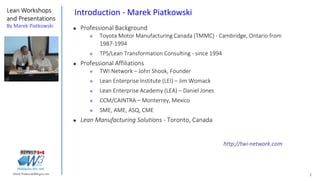
Introduction - Marek Piatkowski
 Professional Background
 Toyota Motor Manufacturing Canada (TMMC) - Cambridge, Ontario from
1987-1994
 TPS/Lean Transformation Consulting - since 1994
 Professional Affiliations
 TWI Network – John Shook, Founder
 Lean Enterprise Institute (LEI) – Jim Womack
 Lean Enterprise Academy (LEA) – Daniel Jones
 CCM/CAINTRA – Monterrey, Mexico
 SME, AME, ASQ, CME
 Lean Manufacturing Solutions - Toronto, Canada
http://twi-network.com
3Marek.Piatkowski@Rogers.com
Lean Workshops
and Presentations
By Marek Piatkowski
Thinkingwin, Win, WIN
4Marek.Piatkowski@Rogers.com
Lean Workshops
and Presentations
By Marek Piatkowski
Thinkingwin, Win, WIN
Senior Management Overview
Summary of Lean Tools and Methodologies for Executives
Why should we implement Lean?
5Marek.Piatkowski@Rogers.com
Lean Workshops
and Presentations
By Marek Piatkowski
Thinkingwin, Win, WIN
Introduction to Lean Transformation
Lean Principles and Methodologies
6Marek.Piatkowski@Rogers.com
Lean Workshops
and Presentations
By Marek Piatkowski
Thinkingwin, Win, WIN
Standardized Work and TWI Job Instructions
Suggested reading:
“The TWI Workbook”
by Patrick Graupp and
Robert J. Wrona
Participants will learn:
 About the history of TWI – Training within Industry
 About 3 Js – Job Instructions, Job Methods and Job Relations
 How TWI Job Instructions evolved into Standardized Work
 How adults learn
 How to identify Major Steps, Key Points and Reasons of a job
 How TWI JI became foundation of Standardized Work
This presentation will include small team exercises, games and video simulations
Level:
Audience:
Format:
Description:
Basic
Open to all, but designed for manufacturing engineers,
leaders, specialists, supervisors and managers
Three hour classroom style presentation
7Marek.Piatkowski@Rogers.com
Lean Workshops
and Presentations
By Marek Piatkowski
Thinkingwin, Win, WIN
Introduction to TPS / Lean
Level:
Audience:
Format:
Description:
Basic
All employees
Two to four hour classroom style presentation
 Introduction to and history of Toyota Production System (TPS) - how it
became know as Lean Transformation.
 Basic principles, methodologies and tools.
 Why should your company start a Lean Journey.
8Marek.Piatkowski@Rogers.com
Lean Workshops
and Presentations
By Marek Piatkowski
Thinkingwin, Win, WIN
Elimination of Waste - MUDA
Level:
Audience:
Format:
Description:
Basic
All employees
Two hour classroom style presentation
 Introduction to seven types of waste as defined by TPS
 How to look for Waste
 How to eliminate Waste
 Importance of understanding why Waste is a starting point of Lean
implementation
Participants will learn how to identify Waste by watching a “Making Toast
Kaizen” video.
9Marek.Piatkowski@Rogers.com
Lean Workshops
and Presentations
By Marek Piatkowski
Thinkingwin, Win, WIN
Introduction to Flow – Principles of a Pull System
Level:
Audience:
Format:
Description:
Basic
All employees
Two to four hour classroom style presentation
Participants will learn principles of:
 What is “Flow”
 Information flow and materials flow
 Reverse flow of instructions
 Introduction to a Kanban system
 Principles of a Supermarket
 Material Deliveries – “Milk Run”
This presentation will include small team exercises, games and simulations
10Marek.Piatkowski@Rogers.com
Lean Workshops
and Presentations
By Marek Piatkowski
Thinkingwin, Win, WIN
Introduction to Continuous Improvement - Kaizen
Level:
Audience:
Format:
Description:
Basic
All employees
Two to four hour classroom style presentation
Participants will learn principles of:
 3Ms – Muda (Waste), Muri (Overburden), Mura (Unevenness)
 Elimination of 7 types of waste
 5S – Workplace Organization
 Employee Involvement
This presentation will include small team exercises, games and simulations
2. Analyze the Current
Situation
1. Clarify the Goal
3. Generate Original
Ideas
4. Develop
Implementation Plan
5. Implement the Plan
6. Evaluate the New
Method
2. Analyze the Current
Situation
1. Clarify the Goal
3. Generate Original
Ideas
4. Develop
Implementation Plan
5. Implement the Plan
6. Evaluate the New
Method
2. Analyze the Current
Situation
1. Clarify the Goal
3. Generate Original
Ideas
4. Develop
Implementation Plan
5. Implement the Plan
6. Evaluate the New
Method
2. Analyze the Current
Situation
1. Clarify the Goal
3. Generate Original
Ideas
4. Develop
Implementation Plan
5. Implement the Plan
6. Evaluate the New
Method
11Marek.Piatkowski@Rogers.com
Lean Workshops
and Presentations
By Marek Piatkowski
Thinkingwin, Win, WIN
Visual Management
Level:
Audience:
Format:
Description:
Intermediate
All employees
Two to four hour classroom style presentation
Participants will learn principles of:
 What is Visual Management
 Andon boards
 Production Schedule tracking boards
 Information Centers – SQDCPP indicators
 Management daily Walk-About process
 Role of a Support Team
 Role of a Quick Respond Team
This presentation will include small team exercises, games and simulations
12Marek.Piatkowski@Rogers.com
Lean Workshops
and Presentations
By Marek Piatkowski
Thinkingwin, Win, WIN
JIT – Principles of Just-in-Time Manufacturing
Participants will learn principles of:
 Continuous flow of production
 Principles of 1x1 – one by one, single piece flow
 Takt Time - management by Takt Time
 Push system vs. Pull System
 Reduction of Customer Lead Times
This presentation will include small team exercises, games and simulations
Level:
Audience:
Format:
Description:
Intermediate
Open to all, but designed for manufacturing engineers,
leaders, specialists, supervisors and managers
Three hour classroom style presentation
13Marek.Piatkowski@Rogers.com
Lean Workshops
and Presentations
By Marek Piatkowski
Thinkingwin, Win, WIN
Introduction to Value Stream Mapping
This presentation is based on a book by John Shook and Mike Rother called
“Learning to See”. Participants will learn about:
 What is a “Value Stream”
 What is a Value Stream Map (VSM)
 Learn to identify and draw VSM icons and maps
 How to create a current state VSM
 How to develop a future sate VSM
This presentation will include small team exercises, games and simulations
Level:
Audience:
Format:
Description:
Intermediate
Open to all, but designed for manufacturing engineers,
leaders, specialists, supervisors and managers
Three hour classroom style presentation
Suggested reading:
“Learning to See” by
John Shook and Mike
Rother.
14Marek.Piatkowski@Rogers.com
Lean Workshops
and Presentations
By Marek Piatkowski
Thinkingwin, Win, WIN
Organizational Development
Fundamentals of Lean
15Marek.Piatkowski@Rogers.com
Lean Workshops
and Presentations
By Marek Piatkowski
Thinkingwin, Win, WIN
Introduction to Lean Certification Program
Level:
Audience:
Format:
Description:
Basic
Top management / Decision Makers
Two hour presentation / discussion
The audience will learn:
 Two styles of teaching
 Advantages of using internal and external consultants
 How to develop internal Lean Experts
 Four areas of Lean development:
 Lean for shop floor supervisors
 Production Planners and Material Specialists
 Production Managers
 Manufacturing Specialist – Black Belts of Lean
16Marek.Piatkowski@Rogers.com
Lean Workshops
and Presentations
By Marek Piatkowski
Thinkingwin, Win, WIN
Introduction to PDCA – Plan-Do-Check-Act
Level:
Audience:
Format:
Description:
Intermediate
Leaders, supervisors and above
Two hour classroom style presentation
This presentation is based on Dr. Deming’s teachings of the PDCA management
cycle:
 Participants will learn planning and implementing controls for organized
activities to meet company objectives in a rational and efficient manner
 The PDCA model provides a framework for the improvement of a process or
system.
 It can be used to guide the entire improvement project, or to develop specific
projects once target improvement areas have been identified
 It is known as a four-step cycle
17Marek.Piatkowski@Rogers.com
Lean Workshops
and Presentations
By Marek Piatkowski
Thinkingwin, Win, WIN
Introduction to A3 based Problem Solving
Level:
Audience:
Format:
Description:
Intermediate
Shop floor Leaders and above, engineers and specialist
Three to four hours of classroom style presentation
Participants will learn:
 How to define a problem. What is a problem?
 Difference between fixing a problem and solving a problem
 What is a Problem Solving “A3” report and how to use it
 What are the basic elements of a A3 report
 What are the approval steps of a A3 problem solving process
Each participant is expected to develop a simple draft of a A3 report based on a
problem they selected for this training.
Title: Reduce Scratches in Assembly (Leader: Mary )
1. Background
3. Target
4. Analysis
Shop: Device-K Assembly
Update: Dec. 15, 2010
Coach
Andy
Dec. 15, 10
Manager
5. Countermeasures and plan
6. Result & next challenge
- Device-K isour next main product!
- Increasein variety of mounting/casing
types
- Quality isa key successfactor in
assembly aswell asin thechipprocess
Device-K Sales Plan by Product Type
Sales
380% # of Major
Types
3 10
Device-K Sales Plan by Product TypeDevice-K Sales Plan by Product Type
Sales
380%
Sales
380% # of Major
Types
3 10
# of Major
Types
3 10
# of Major
Types
3 10
2. Current state(Based on November data)
Actual output
First Pass Rate(FPR)
target
Mp
Demand
Yield Ratetarget
Yield Rateactual FPR actual
Actual output
First Pass Rate(FPR)
target
Mp
Demand
Yield Ratetarget
Yield Rateactual FPR actual
First Pass Rate(FPR)
target
Mp
Demand
Yield Ratetarget
Yield Rateactual FPR actual
Mp
Demand
Yield Ratetarget
Yield Rateactual FPR actual
Scratches aremost often identified at inspection:
48%of assembly defects
End of November, 2008
Metrics Target Actual
Output
/Demand 100% 99.2%
Yield Rate 97% 85.2%
First Pass
Rate (FPR) 90% 65.1%
End of November, 2008
Metrics Target Actual
Output
/Demand 100% 99.2%
Yield Rate 97% 85.2%
First Pass
Rate (FPR) 90% 65.1%
Not improved in
thesethreemonths!
92%of defects werecaused
by Assembly!
Bad
chip
Assembly
defects
Bad Chip vs. Assembly Defects
Bad
chip
Assembly
defects
Bad
chip
Assembly
defects
Assembly
defects
Bad Chip vs. Assembly Defects
Most scratches are
repaired by re-polishing
= Waste!
re-polishing
NG:
Scratches
Inspection
About 20 sec. /p
(1) Z eroscratches!
(2) Reducemissed crimpsof 12%
FPR = 90%
* Based on November data
4-2. Trial-1: On-lineinspection just after line#1
crimper
Exit of crimper On-lineinspection!
4-3. Second observation:typesof scratches
Straight
28%
Rounded
70%
Others
2%
Fixing crimper head 4 alsoreduced missed crimp
defects.
Observed only in line#2 Next gosee-2
Observed in all lines Punchpress?
4-4. Hypothesis&gosee-2: First stepof assembly line#2?
From punch
press Straight scratchesareobserved here!
Entranceof line#2
Blade
spring
Small
pimple!
#
1
2
3
4
Action item
Fixcrimper head
Dec. 5th 12th 19th 26th Jan.
Fixbladespring
On-lineinspection Trial Prep. 2-shift inspection
Responsibility Status
Done
Done
On
track
Mary &Jack
withFacility Team
Jimmy
Mgr. Assembly
Reduceinventories
between processes
Stopmachines alternatively
MaintainImplement VM
Team On
track
2nd week of Dec, 2008
Metrics Target Actual
Yield Rate 97% 95.0%
FPR 90% 90.2%
2nd week of Dec, 2008
Metrics Target Actual
Yield Rate 97% 95.0%
FPR 90% 90.2%
(1) Remaining Defects
1) Scratches(2%)
2) Missed crimp(1%) 3) Others
(2) “Why”after current countermeasures
1) Broken head –why?
2) Pimple–why?
#2
#3
#1
#2
#3
#1
#2
#3
#1
4-1. Hypothesis&gosee-1: Assembly line#2?
18Marek.Piatkowski@Rogers.com
Lean Workshops
and Presentations
By Marek Piatkowski
Thinkingwin, Win, WIN
How to Manage in a Lean Environment
Level:
Audience:
Format:
Description:
Intermediate
Shop floor managers and supervisors
Two to four hour classroom style presentation
This presentation is designed to provide an overview of NEW role of a manger in
a Lean Environment. Participants will learn principles of:
 Roles and responsibilities of a manager
 Line site daily Team meetings
 Eyes for Waste and Eyes for Flow
 Process Audits – discipline building activities
 Management daily Walk-About process
 Visual management
 Performance management
 Schedule attainment
 Continuous improvement of process efficiencies
19Marek.Piatkowski@Rogers.com
Lean Workshops
and Presentations
By Marek Piatkowski
Thinkingwin, Win, WIN
Shop Floor Management - Standardized Work for Supervisors
Level:
Audience:
Format:
Description:
Intermediate
Shop floor managers and supervisors
One day classroom style Workshop
This presentation is help supervisors and managers develop standardized
methods for their activities. Participants will learn:
 How to develop roles and responsibilities for supervisors and managers
 How to develop a time-based set of standards for managing your area of
responsibility
 Principles of process ownership
 How to establish operating rules and procedures in order to meet
company goals, objectives and expectations – quality, cost and delivery
 How to monitor and audit performance of each “Lean” process
 Make sure that all rules, regulations and policies are followed
 Report results on a regular basis
20Marek.Piatkowski@Rogers.com
Lean Workshops
and Presentations
By Marek Piatkowski
Thinkingwin, Win, WIN
Hishin Kanri Kaizen Event – developing True North
Suggested reading:
“Getting the Right
Things done” by
Pascal Dennis
Level:
Audience:
Format:
Description:
Advanced
Senior Management
Two to three day classroom style Workshop
This workshop is designed to help senior management to develop strategic plans.
During this workshop participants will learn how:
 Hoshin Kanri methodology can be applied to Strategy Deployment process
throughout the Company
 Hoshin Kanri methodology provides a planning structure for bringing critical
processes up to the desired level of performance
 It provides a systematic approach to managing changes and improvements in
the organization
 Hoshin Kanri strives to provide management a methodology for creating
consensus about fundamental changes in the organization
During this workshops participants will actually develop their first draft of a
company strategy plans
21Marek.Piatkowski@Rogers.com
Lean Workshops
and Presentations
By Marek Piatkowski
Thinkingwin, Win, WIN
Lean in Manufacturing
Operational Lean Methodologies
22Marek.Piatkowski@Rogers.com
Lean Workshops
and Presentations
By Marek Piatkowski
Thinkingwin, Win, WIN
Introduction to Standardized Work
Participants will learn about:
 History of Standardized Work
 Benefits of Standardized Work
 Standardized Work charts and forms
 Why Standardized Work is called a foundation of Kaizen
This presentation will include small team exercises, games and video simulations
Level:
Audience:
Format:
Description:
Intermediate
Open to all, but designed for manufacturing engineers,
leaders, specialists, supervisors and managers
Three hour classroom style presentation
Suggested reading:
“Creating Continuous
Flow” by Mike Rother
and Rick Harris.
23Marek.Piatkowski@Rogers.com
Lean Workshops
and Presentations
By Marek Piatkowski
Thinkingwin, Win, WIN
Introduction to Quick Changeover process - SMED
Participants will learn principles of:
 What is Zero Changeover
 Gaining a practical grasp of Changeover lost time
 Recording and analyzing Changeover operation
 Eliminating set-up waste
 Eliminating exchange of dies waste
 Eliminating adjustment waste
 Process improvements vs. technology improvements
This presentation will include small team exercises, games and simulations
Level:
Audience:
Format:
Description:
Intermediate
Open to all, but designed for manufacturing engineers,
leaders, specialists, supervisors and managers
Three hour classroom style presentation
Suggested reading:
“Kaizen for Quick
Changeover” by
Kenichi Sekine and
Keisuke Arai.
24Marek.Piatkowski@Rogers.com
Lean Workshops
and Presentations
By Marek Piatkowski
Thinkingwin, Win, WIN
Flexible Cell Design
Participants will learn:
 Principles of flow: people flow, materials flow and work flow
 How to design and arrangement all manufacturing equipment, people,
machines and methods that support continuous flow production
 What is a “one-piece flow” – 1x1
 How correct cell design will significantly reduce transportation, inventory,
and waiting time while improving quality, delivery, and costs
 Traditional production line design vs. flexible “U” shape cell design
 How to design a flexible work cell to support changes in production
demands – ups and downs
This presentation will include small team exercises, games and simulations
Level:
Audience:
Format:
Description:
Intermediate
Open to all, but designed for manufacturing engineers,
leaders, specialists, supervisors and managers
Three hour classroom style presentation
Drill
Mill Mill
Lathe
Press Wash
2
4
5
2
4 3
1
3
1
25Marek.Piatkowski@Rogers.com
Lean Workshops
and Presentations
By Marek Piatkowski
Thinkingwin, Win, WIN
Materials Management
Classroom style training combined with shop floor activities
26Marek.Piatkowski@Rogers.com
Lean Workshops
and Presentations
By Marek Piatkowski
Thinkingwin, Win, WIN
Five Year Material Strategy Plan
 This presentation is designed to introduce the audience to lean principles of
Materials Management – Materials and Information Flow
 What are some of the key elements of materials management used by Toyota
and why they are so different from a traditional why of managing materials
 What new Materials Organization is needed to support these new activities
 How to purchase materials and schedule production based a Kanban system
NOT on a MRP driven forecast system
 How to reduce, control and maintain inventory levels
 How to develop a five year Materials Strategy for your organization
Level:
Audience:
Format:
Description:
Intermediate
Open to all, but designed for production planners, buyers,
inventory analysts and materials managers
Two to four hour classroom style presentation
27Marek.Piatkowski@Rogers.com
Lean Workshops
and Presentations
By Marek Piatkowski
Thinkingwin, Win, WIN
Production Planning – Kanban based Pull System
 This presentation is designed to introduce the audience to lean principles of
Production Planning based on a Customer driven Takt Time
 Participants will learn how the meaning of and how to apply a TPS principles
– Material flow dictates information flow
 This is where materials from this point upstream will be pulled through by the
use of key lean tools such as marketplaces, Kanbans, timed material
withdrawal and FIFO queues
 Participants will about different types of production Kanbans, production
scheduling boards, how to schedule batch production process vs. 1x1
production process
 What is a Pacemaker process and what is its role
Level:
Audience:
Format:
Description:
Intermediate
Open to all, but designed for production planners, buyers,
inventory analysts and materials managers
Two to four hour classroom style presentation
28Marek.Piatkowski@Rogers.com
Lean Workshops
and Presentations
By Marek Piatkowski
Thinkingwin, Win, WIN
Introduction to PFEP – Plan for Every Part
Level:
Audience:
Format:
Description:
Advanced
Open to all, but designed for production planners, buyers,
inventory analysts and materials managers
Two to four hour classroom style presentation
In this presentation participants will learn:
 What PFEP is
 How to create a PFEP data base
 How to start developing “plans for every part”
 How to use PFEP to start creating Purchased Parts or Finished Goods
Supermarkets
 How to use PFEP to set-up material delivery routes (Milk Runs)
 How to calculate a number of Kanbans required for each part
 How to develop a future state PFEP to reduce and control inventory levels
29Marek.Piatkowski@Rogers.com
Lean Workshops
and Presentations
By Marek Piatkowski
Thinkingwin, Win, WIN
How to design a Materials Supermarket
Level:
Audience:
Format:
Description:
Advanced
Open to all, but designed for production planners, buyers,
inventory analysts and materials managers
Two to four hour classroom style presentation
In this presentation participants will learn:
 About key design principles of a materials Supermarket
 How to start designing supermarkets for purchased parts, finished goods
and WIP inventories (mini-markets)
 What are visual management recommendations for supermarkets
 Key concepts of a supermarket design:
 Supermarket Layout
 Categorization – parts’ groupings
 Storage / Racking
 Addressing
 Couple/De-couple Tugging
 And more …
30Marek.Piatkowski@Rogers.com
Lean Workshops
and Presentations
By Marek Piatkowski
Thinkingwin, Win, WIN
Introduction to Kanban based Pull System
Level:
Audience:
Format:
Description:
Advanced
Open to all, but designed for production planners, buyers,
inventory analysts and materials managers
Two to four hour classroom style presentation
In this presentation participants will learn:
 About Kanban is a practical tool of Just-in-Time manufacturing for
controlling production and movement and delivery of materials and parts
 How Kanban card signals to produce or to deliver necessary parts, in
necessary quantities, at the necessary time, in the most economical
manner
 What are the different types of a Kanban for delivery and production
 What is a Pull System and how it works
 What are the advantages of a Kanban based Pull system vs. traditional
MRP system
31Marek.Piatkowski@Rogers.com
Lean Workshops
and Presentations
By Marek Piatkowski
Thinkingwin, Win, WIN
Material Delivery Methods
Level:
Audience:
Format:
Description:
Advanced
Open to all, but designed for production planners, buyers,
inventory analysts and materials managers
Two to four hour classroom style presentation
In this presentation participants will learn:
 About two types of material delivery methods:
 Time based (regular schedule) - deliveries based on a regular
schedule, aka “Milk Run”
 Random based - deliveries based on a “as needed” signal
 Rules and regulations and operating principles of material delivery
methods – “Line Ready” components
 Different type of equipment used for delivering materials
 How to define and standardize delivery routes
 How to design Point-of-Use (Parts Presentation at the Line) racks
32Marek.Piatkowski@Rogers.com
Lean Workshops
and Presentations
By Marek Piatkowski
Thinkingwin, Win, WIN
Training Workshops
Classroom style training combined with shop floor activities
33Marek.Piatkowski@Rogers.com
Lean Workshops
and Presentations
By Marek Piatkowski
Thinkingwin, Win, WIN
Gemba Walk – Practical Introduction to Lean
Level:
Audience:
Format:
Description:
Intermediate
Shop floor employees, supervisors and managers
8 hour classroom style workshop + shop floor activities
This is a full day workshop combining classroom style training with shop floor
visits. The workshop is based on a teaching principle of Hear-See-Do. After each
training session participants will move to the shop floor where they will audit
process and methods described in a training session. The topics for this
workshop are:
 Introduction to TPS / Lean
 7 Types of Waste
 Principles of 5 S
 Visual Management
 Gemba walk
 Materials Management
 Standardized Work
34Marek.Piatkowski@Rogers.com
Lean Workshops
and Presentations
By Marek Piatkowski
Thinkingwin, Win, WIN
Workplace Organization – 5S Practical Workshop
Level:
Audience:
Format:
Description:
Intermediate
Shop floor employees, supervisors and managers
8 hour classroom style workshop + shop floor activities
This is a full day workshop combining classroom style training with shop floor
activities. This workshop is designed to help the Leader (Supervisor) to
implement a 5S program in a specific area of the operation (shop floor or
warehouse). During the workshop participants will:
 Learn principles of 5S
 Learn why the Workplace Organization is a starting point of
Continuous Improvement
 Why organization and orderliness are a foundation for achieving zero
defects, cost reductions and safety improvements
 Learn a sequence of implementation of a 5S event
 Learn why without Workplace Organization discipline you will not be
able to implement Lean Transformation successfully
35Marek.Piatkowski@Rogers.com
Lean Workshops
and Presentations
By Marek Piatkowski
Thinkingwin, Win, WIN
Value Stream Mapping Workshop
 This workshop is based on a book by John Shook and Mike Rother called
“Learning to See”.
 Participants must complete introduction Lean, introduction to VSM and
introduction to Kaizen prior to attending this workshop
 Participants will be required to create a current VSM for an existing process
and develop a future state VSM include process improvement
recommendations.
 The workshop will conclude with a management style presentation
 Maximum classroom size is 24 participants
Level:
Audience:
Format:
Description:
Intermediate
Open to all, but designed for manufacturing engineers,
leaders, specialists, supervisors and managers
Two days classroom style workshop + shop floor activities
Suggested reading:
“Learning to See” by
John Shook and Mike
Rother.
36Marek.Piatkowski@Rogers.com
Lean Workshops
and Presentations
By Marek Piatkowski
Thinkingwin, Win, WIN
TWI JI - Job Instructions Training
Level:
Audience:
Format:
Description:
Intermediate
Shop floor Leaders and above, engineers and specialist
10 hours of classroom training delivered in 3 or 5 days
Suggested reading:
“The TWI Workbook”
by Patrick Graupp and
Robert J. Wrona
Participants will learn:
 About a history of TWI training and how it became a foundation of TPS
 How TWI training is essential for developing supervisory and leadership skills
 Four major elements of the TWI JI
• roles and responsibilities of a Leader
• how to create a Job Breakdown sheet
• how to teach adults
• how to develop training timetables.
 Why TWI training should be used as first step towards standardization
 Maximum classroom size is 12 participants
Each participant will be given a homework assignment and will be required to
demonstrate abilities to teach following the TWI model.
37Marek.Piatkowski@Rogers.com
Lean Workshops
and Presentations
By Marek Piatkowski
Thinkingwin, Win, WIN
Advanced – Understand A3 Thinking
Level:
Audience:
Format:
Description:
Advanced
Shop floor Leaders and above, engineers and specialist
8 hour classroom style workshop + homework assignment
Participants will learn:
 How to define a problem. What is a problem?
 Difference between fixing a problem and solving a problem
 What is a Problem Solving “A3” report and how to use it
 What are the basic elements of a A3 report
 What are A3 reports used for
 What are the approval steps of a A3 problem solving process
Each participant is expected to develop a simple draft of a A3 report based on a
problem they selected for this training.
Suggested reading:
“Understanding A3
Thinking” by Art
Smalley and Durward
K. Sobek
38Marek.Piatkowski@Rogers.com
Lean Workshops
and Presentations
By Marek Piatkowski
Thinkingwin, Win, WIN
Managing to Learn - MTL
This workshop is
based on a book
“Managing to Learn”
by John Shook.
Level:
Audience:
Format:
Description:
Advanced
Open to all, but designed for manufacturing engineers,
leaders, specialists, supervisors and managers
Two day classroom style workshop + individual activities
This workshop will teach participants how to use the A3 management process to
solve problems, gain agreement and lead. Participants will gain hands-on
experience in improving their Problem Solving skills by:
 Writing A3s
 Reading and reviewing A3s
 Responding and evaluating A3s
They also will:
 Learn key concepts of writing and presenting an A3 report
 Write and present their own A3
 Read, listen, and coach others using the A3 process
Marek Piatkowski was certified by John Shook to deliver this workshop as
designed by the “Managing to Learn” workbook.
39Marek.Piatkowski@Rogers.com
Lean Workshops
and Presentations
By Marek Piatkowski
Thinkingwin, Win, WIN
TPM – Creating Basic Stability Workshop
Level:
Audience:
Format:
Description:
Advanced
Open to all, but designed for manufacturing engineers,
leaders, specialists, supervisors and managers
One day classroom style workshop + shop floor activities
Creating basic stability will teach participants:
 Different types of equipment breakdowns
 Difference between repairs and maintenance
 What is Total Preventive Maintenance – TPM
 How to design mistake proofing – Poka Yoke
 What is Multi Skilled maintenance
 What is a roles of a multi-skilled maintenance person
 Prevention of equipment breakdowns
 Maximum classroom size is 24 participants
Suggested reading:
“Creating Level Pull”
by Art Smalley.
40Marek.Piatkowski@Rogers.com
Lean Workshops
and Presentations
By Marek Piatkowski
Thinkingwin, Win, WIN
Creating Continuous Flow Workshop
Level:
Audience:
Format:
Description:
Advanced
Open to all, but designed for manufacturing engineers,
leaders, specialists, supervisors and managers
One day classroom style workshop + shop floor activities
This workshop is based on a book by Kiyoshi Suzaki called “The New
Manufacturing Challenge” – techniques for continuous improvement. In this
workshop participants will learn about:
 Continuous flow of production
 Principles of 1x1 – one by one, single piece flow
 Machine layout designed for flow
 Work cell design – people flow and materials flow
 Separation of man’s work from machine’s work
 Parts presentation at a Line
 Creating Continuous flow
 Maximum classroom size is 24 participants
Suggested reading:
“The New
Manufacturing
Challenge” by Kiyoshi
Suzaki.
41Marek.Piatkowski@Rogers.com
Lean Workshops
and Presentations
By Marek Piatkowski
Thinkingwin, Win, WIN
Standardized Work - Workshop
Level:
Audience:
Format:
Description:
Advanced
Open to all, but designed for manufacturing engineers,
leaders, specialists, supervisors and managers
One day classroom style workshop + shop floor activities
In this workshop participants will learn about:
 What Standardized Work is – what are best know work practices
 How to collect information and complete Standardized Work charts
 How to balance a Line
 Work cell design – people flow and materials flow
 Standard Work-in-Process inventory
 How to develop Waste free Standardized Work
 Maximum classroom size is 24 participants
This workshop will include small team exercises, games and video simulations
Suggested reading:
“Creating Continuous
Flow” by Mike Rother
and Rick Harris.
42Marek.Piatkowski@Rogers.com
Lean Workshops
and Presentations
By Marek Piatkowski
Thinkingwin, Win, WIN
Toyota KATA – Coaching KATA Workshop
Level:
Audience:
Format:
Description:
Advanced
Open to all, but designed for managers, project leaders,
specialists and supervisors
One day classroom style workshop + shop floor activities
This workshop is based on “Improvement KATA Handbook”
developed by Mike Rother. Participants will learn about:
 A systematic way to develop and sustain continuous
improvement, adapt to change and an innovative way to
manage the organization.
 A way to standardized how the members of an
organization develop solutions. The IK/CK make creative
work teachable.
 Practice patterns to embed in daily work
Suggested reading:
“Toyota KATA” by
Mike Rother
This workshop will include small team exercises, games and video simulations
43Marek.Piatkowski@Rogers.com
Lean Workshops
and Presentations
By Marek Piatkowski
Thinkingwin, Win, WIN
Toyota KATA – Improvement KATA Workshop
Level:
Audience:
Format:
Description:
Advanced
Open to all, but designed for managers, project leaders,
specialists and supervisors
One day classroom style workshop
Upon completion of this workshop Participants will learn about:
 Understand principle behavior patterns at the core of the
Improvement Kata methodology
 Provide participants with the knowledge of fundamental
routines, mindset, and behavioral routine practices of
Improvement KATA
 Enable participants to experience the behavioral routines
of Toyota KATA including the Improvement KATA and the
Coaching KATA through interactive, hands-on experience
Suggested reading:
“Toyota KATA” by
Mike Rother
This workshop will include small team exercises, games and video simulations
44Marek.Piatkowski@Rogers.com
Lean Workshops
and Presentations
By Marek Piatkowski
Thinkingwin, Win, WIN
Kaizen Events
“Learning-by-Doing” - Shop floor process improvement events
45Marek.Piatkowski@Rogers.com
Lean Workshops
and Presentations
By Marek Piatkowski
Thinkingwin, Win, WIN
Changeover and Set-up Reductions – SMED Kaizen
Level:
Audience:
Format:
Description:
Advanced
Shop floor operators, engineers, leaders, specialists,
supervisors and managers
Three days classroom style training + shop floor activities
This is a Kaizen style workshop:
 Participants will be involved in a real changeover process improvement event
for a selected line or a press
 Classroom training will cover all theoretical elements of a set-up reduction
process. Including preparation stage, exchange of dies and clean up and
adjustments.
 Participants will video tape an actual changeover process and identify all
external and internal activities.
 The workshop will conclude with a management style presentation
 Maximum classroom size is 12 participants
Suggested reading:
“Kaizen for Quick
Changeover” by
Kenichi Sekine and
Keisuke Arai.
46Marek.Piatkowski@Rogers.com
Lean Workshops
and Presentations
By Marek Piatkowski
Thinkingwin, Win, WIN
Stop Time Analysis – Kaizen Workshop
Level:
Audience:
Format:
Description:
Advanced
Open to all, but designed for manufacturing engineers,
leaders, specialists, supervisors and managers
8 hour classroom style workshop + shop floor activities
This workshop is designed to learn how to set up, evaluate and analyze the
current problems with an existing (operating) production Line. At the end of this
Kaizen Workshop participant will develop a list of countermeasures (solutions) of
how to improve the efficiency of the Line. Topics and activities presented in this
workshop include:
 Ability to sense abnormalities
 Jidoka – stop and fix the problem
 Line Stops – fixed position stop systems
 Prevention of passing defects
 Machine stops – principles of Pokayoke
 Prevention of equipment breakdowns
47Marek.Piatkowski@Rogers.com
Lean Workshops
and Presentations
By Marek Piatkowski
Thinkingwin, Win, WIN
Materials Management – Kaizen Event
 This is real Kaizen workshop designed to improve materials handling and
management in a specific area of the operation (shop floor or warehouse)
 Participants will create a current state Value Stream Map and design a future
state (6 months) VSM
 In a classroom environment participants will create a PFEP data base, design
racks for parts storage, delivery routes and methods of material deliveries,
calculate min/max levels of inventories and create a Kanban system
 Participants will create production scheduling boards, material delivery
boards (Kanban boards) and critical elements of supermarket visual
management (fixed locations and variable locations)
 This Kaizen event will conclude with a Management Presentation
Level:
Audience:
Format:
Description:
Advanced
Materials managers, production planners, buyers, inventory
analysts and material handlers
Five days classroom style training + shop floor activities
48Marek.Piatkowski@Rogers.com
Lean Workshops
and Presentations
By Marek Piatkowski
Thinkingwin, Win, WIN
Standardized Work - Kaizen Event
M/C # 5
M/C # 3
WIP
R/M
M/C # 4
M/C # 2
M/C # 1
R/M
WIP
WIP
Sequence of Implementation
1.Select Production
Line or a Cell
7. Implement
Standardized Work
6. Kaizen - process
improvements
Created by:
Work Elements
(Working or Walking - Waiting is NOT a work element) # 1 # 2 # 3 # 4 # 5
1 Load cross bar 4.5 3.5 5.5 7.0 4.5 VA 4.5 A lot of walking
2 Load C bracket 6.5 4.5 5.5 5.5 VA 5.5 A lot of walking
3 Insert pins and screws 7.0 6.0 7.0 6.0 VA 6.0 Using both hands
4 Start the machine 1.0 1.0 1.0 1.0 NVW 1.0
Waiting for machine to cycle 7.0 7.0 7.0 7.0 W 7.0 Waiting - 7 seconds
5 Unload C bracket 4.5 10.0 4.5 4.5 VA 4.5 Walk and inspect
6 Unload cross bar 5.0 5.0 4.0 4.0 VA 4.0 Walk and inspect
Total 25.5 30.0 27.5 28.0 25.5
Part Description
PROCESS CAPACITY SHEET
Notes#
Best
Time**
Operator Cycle Times
Operator Time Observations
Total Cycle Times Type of
Work*
Line / Section Date
Created by:
# 1 # 2 # 3 # 4 # 5
1 Gear Cut - GC614 34 32 37 33 32 5 28 33
2 Chamfer - CH228 14 13 12 13 13 6 7 13
3 Gear Cut - GC 1444 46 43 45 42 43 6 38 44
4 Gear Cut - GC 1445 35 39 32 37 36 6 30 36
5 Test - TS1110 10 9 11 11 9 7 3 10
Total 139 136 137 136 133 30 106 136
PROCESS CAPACITY SHEET
Machine
Auto Time
NotesMachine Description#
Machine Cycle
Time*
Machine Capacity
Machine Time Observations
Machine Cycle Times Observations Manual
Time
J.F.Gaudette
Machine / Section Date Part Description
Gear Machining 07.03.09 8" Pinion Gear
Machine
4.Calculate Process
Capacity
Man
INITIAL OBSERVATION SHEET .
Process Name / Address: Manufacturing Cell D
Date:
04.03.11
Rough Sketch of a Process 1. pattern drtivern onto capanello
2. etsblno momento frinvertp lagunad seca
3. ingotment dfrromgn drafter mondureato
4. picken dtiremnto
5. installatzione drivento
7. wlk away from the unit unt smhmilen
8. ih kinde finito
9. stndo tsrtto forgetito moento
Completed by: Andrew MacPhailJunior
Quality Check Safety
Standard In-Process-
Stock
Operator Cycle Times
Number of Shifts
3
Critical Operation
Observ. # 1 Observ. # 2 Observ. # 3 Observ. # 4 Observ. # 5 C/T
39 42
301020
44 41 45.5 37
7.2
Work Elements
6. test minutorgen
Working Hours per Shift TAKT TIMECustomer Requirements
M/C # 5
M/C # 3
WIP
R/M
M/C # 4
M/C # 2
M/C # 1
R/M
WIP
WIP
3.Capture current
situation
2.Calculate Takt
Time or PCT
5.Analyze Current
Situation
5
10
15
20
25
30
D2 - 26
Takt Time = 27 sec
D2 - 10 D2 - 12 D2 - 14 D2 - 16 D2 - 18 PP - 01 D2 - 01PP - 03
5
10
15
20
25
30
D2 - 26
Takt Time = 27 sec
D2 - 10 D2 - 12 D2 - 14 D2 - 16 D2 - 18 PP - 01 D2 - 01PP - 03
2. Analyze the Current
Situation
1. Clarify the Goal
3. Generate Original
Ideas
4. Develop
Implementation Plan
5. Implement the Plan
6. Evaluate the New
Method
2. Analyze the Current
Situation
1. Clarify the Goal
3. Generate Original
Ideas
4. Develop
Implementation Plan
5. Implement the Plan
6. Evaluate the New
Method
Level:
Audience:
Format:
Description:
Advanced
Open to all, but designed for manufacturing engineers,
leaders, specialists, supervisors and managers
Five days classroom style training + shop floor activities
 This is real Kaizen workshop designed to implement Standardized Work in a
specific area of the operation (shop floor or warehouse)
 Participants will start by selecting a specific production line or a work cell
 They will capture current situation by calculating Takt Time, observing and
measuring machine and operator cycle times
 They will calculate process capacity, develop operator balance charts, analyze
collected data and recommend process improvements
 Participants, working with operator, will implement standardized work
recommendations on the shop floor by make layout changes, work sequence
changes, parts presentation changes and implementing new material flow
 This Kaizen event will conclude with a Management Presentation
49Marek.Piatkowski@Rogers.com
Lean Workshops
and Presentations
By Marek Piatkowski
Thinkingwin, Win, WIN
TWI Job Instructions – Train-the-Trainer
Level:
Audience:
Format:
Description:
Advanced
Internal Trainers
Three hour sessions/day - delivered in five days
Suggested reading:
“The TWI Workbook”
by Patrick Graupp and
Robert J. Wrona
This is a Train-the-Trainer workshop for the TWI Job Instruction. Upon
completion of this workshops participants will be certified to deliver a TWI Job
Instructions training. During this workshop participants will:
 Learn how to deliver a TWI JI training
 Learn four major elements of the TWI JI – roles and responsibilities of a
Leader, how to create a Job Breakdown sheet, how to teach adults and how
to develop training timetables.
 Have an opportunity to practice presentation and delivery skills
 Given all necessary skills and materials needed to deliver the TWI JI training
 Demonstrate ability to teach in order to be certified
Prior to attending this workshops participants must complete the TWI Job
Instruction training.
50Marek.Piatkowski@Rogers.com
Lean Workshops
and Presentations
By Marek Piatkowski
Thinkingwin, Win, WIN
Management and Consulting Services
Marek Piatkowski
51Marek.Piatkowski@Rogers.com
Lean Workshops
and Presentations
By Marek Piatkowski
Thinkingwin, Win, WIN
Marek Piatkowski also provides management and consulting services in the
following areas:
 Lean Transformation Strategy
 Efficiencies and Process Improvements using TPS/Lean Methodologies
 Supply Chain Management Strategy
 Team Leader based Organization
 New Plant Start-ups
 New employee and promotion selection process
 Quality Circles
 Suggestion program
 Training recommendations for implementing Lean
 Lean Assessment
 Lean Accounting
52Marek.Piatkowski@Rogers.com
Lean Workshops
and Presentations
By Marek Piatkowski
Thinkingwin, Win, WIN
Changing the World. One Transformation at a time
This presentation is an intellectual property of W3 Group Canada Inc.
No parts of this document can be copied or reproduced
without written permission from:
Marek Piatkowski
W3 Group Canada Inc.
iPhone: 416-235-2631
Cell: 248-207-0416
Marek.Piatkowski@rogers.com
http://twi-network.com
Thinkingwin, Win, WIN
53Marek.Piatkowski@Rogers.com
Lean Workshops
and Presentations
By Marek Piatkowski
Thinkingwin, Win, WIN
Presentations in this
Workshop
1. Log in to:
www.slideshare.net
2. Type in my name in
search area:
Marek Piatkowski
3. Select a presentation you
want to see
4. Learn and Enjoy