
Web Development
Bob Daniels Executive Director
Instructors Practicing experts who have mastered their craft  and are passionate about teaching Over 1,000 hours of real-world, objective-based, hands-on training
Over 15,000 sq.ft. of modern studios and labs All equipped with the latest digital imaging hardware and  industry-leading software Facility
Joel McNamee Program Director
Creativity  +  Technical Proficiency Fundamentals of the Program
Two Semesters (four sections) Web Development Foundation Data Driven Web Development Rich Media Web Development Managed & Socialized Web Content Special Topic Presentations Search Engine Optimization (SEO) Preventing cross-site scripting And more… Web Development Certificate
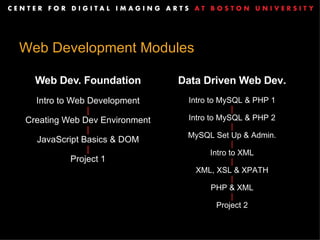
Web Dev. Foundation Intro to Web Development | Creating Web Dev Environment | JavaScript Basics & DOM | Project 1 Web Development Modules Data Driven Web Dev. Intro to MySQL & PHP 1 | Intro to MySQL & PHP 2 | MySQL Set Up & Admin. | Intro to XML | XML, XSL & XPATH | PHP & XML | Project 2
Rich Media Web Dev. Intro to Flash | Flash & ActionScript 3.0 | Project 3 | Intro to Ajax | Advanced Ajax | Project 4 Web Development Modules Managed Web Content Content Management | Creating a Content Managed Site | Web 2.0 & Socialized Web | Final Project
Modules WDV101: Introduction to Web Development WDV102 : Creating a Web Development and Deployment Environment WDV103 : Javascript Basics and the Document Object Model WDV104 : Project 1 WDV201: Introduction to MySQL and PHP I WDV202: Introduction to MySQL and PHP II WDV203: Setting Up a MYSQL Database WDV204 : Introduction to XML for Structured Data Manipulation WDV205 : Manipulating XML with XSL & XPATH WDV206 : PHP and XML WDV207 : Object Oriented Programming with PHP WDV208 : Project 2 Semester One
Modules WDV301 Content Management WDV302 Creating a Content Managed Site WDV303 Customizing CMS WDV304 Web 2.0 and Socializing Your Site WDV305 Project 3 WDV401 Introduction to Flash WDV402 Flash and ActionScript 3.0 WDV403 Project 4 WDV404 Introduction to AJAX WDV405 Putting the X in AJAX  WDV406: Final Project Semester Two
Introduction to Web Development In this first module students will be introduced to the fundamental concepts of the web and web development. Students will start by building basic web pages from the ground up using XHTML and a text editor. XHTML vs. HTML Introduce the benefits of CSS (Cascading Style sheets) for formatting web pages. Section 1: Web Development Foundation
Creating a Web Development Environment In this module students will learn how to set up a web development environment in both a local and hosted setting. Setup and configuration of web servers will be covered. As will managing files via FTP (file transfer protocol).  Use of Open Source development tools will be introduced and encouraged. Advanced XHTML will be explored. Section 1: Web Development Foundation
JavaScript Basics & the DOM Build dynamic and interactive web pages using XHTML and JavaScript. Develop a familiarity with fundamental scripting concepts such as objects, properties, and methods. Learn how to create image rollovers, pop-up windows, and explore the Document Object Model (DOM) for basic form validation. Section 1: Web Development Foundation
Project 1 The first project will utilize the XHTML, CSS and JavaScript skills of the student to build a basic “marketing oriented” web site.  Credit will be given based on presentation and the prevalence of dynamic content.  Test user will be a “sample customer” who has no knowledge of HTML programming. Section 1: Web Development Foundation
Introduction to MySQL & PHP (Part 1) Students will be introduced to the concepts behind integrating database driven content into their web pages. Grounding in SQL (structured query language) and MySQL (open source relational database) concepts for reading and writing of relational data.  PHP will be introduced as a way to connect to a database and present data within a web site. Section 2: Data Driven Web Development
Introduction to MySQL & PHP (Part 2) In this module students will build on the previous module by using complex SQL queries and processing that data via their progressing PHP scripting skills. Section 2: Data Driven Web Development
Setting Up a MySQL Database Learn to set up and use the popular phpMyAdmin tool to create and manage MySQL databases. Design a simple database populate DB with data from a spreadsheet integrate data from this database into web page Set up a PHP development and debugging environment. Use of Open Source development environments will continue to be encouraged. Section 2: Data Driven Web Development
Introduction to XML In this module students will learn the principles of XML document structure and how organizations typically use XML to format data. Introduce XSLT for the selective processing and formatting of XML data  Integrate XML via XSLT to web pages. Section 2: Data Driven Web Development
Manipulating XML with XSL & XPATH In this module students will extend their knowledge of XML by using more complex XML documents. Start to use XPATH and XSL to transform XML into formats more suitable for their web application. Integrate and transform data from multiple XML documents. Introduce structured logic constructs within XSL and XPATH. Section 2: Data Driven Web Development
PHP & XML In this module students will extend their knowledge of PHP by manipulating and processing XML documents with built-in PHP functions. Create XML parsers and learn the benefits of this approach when it comes to processing data from multiple documents. The options and relative benefits of different approaches will be discussed as they apply to large documents. Section 2: Data Driven Web Development
Project 2 This project will require the student to build a more dynamic site where the content will be database and/or XML driven thus enabling the site to be changed at any time. Students will need to produce a design that works for varying amounts of content as well as providing the mechanism for the content to be updated by a non-technical person. Section 2: Data Driven Web Development
Content Management Joomla is one of many open source CMS’s (content management systems) available today. Joomla provides an infrastructure that incorporates many Web 2.0 concepts such as blogs, pod casts, forums, and newsletters as well as providing a collaborative authoring environment for its content. Students will learn how to leverage these features to provide a fully managed web environment that can be offered to prospective customers. Section 3: Managed & Socialized Content
Creating a Content Managed Site Learn how to set Joomla on their own system and as a hosted solution. Build a site using Joomla that incorporates many of the techniques learned throughout  the program. Section 3: Managed & Socialized Content
Web 2.0 and the Social Web This module will explore the socialization of the web and web content. Students will focus on how to provide a complete solution for prospective clients that incorporates not only web development techniques but also focuses on how these technologies are utilized to build sites like MySpace and Facebook. Students will begin to architect their final project that will focus not on building web sites but what it takes to build web communities. Section 3: Managed & Socialized Content
Project 3 In this project students will be required to build a complete web community using Joomla as the base.  The student will be encouraged to create a brief project plan that encompasses all aspects of the community.  The plan will incorporate elements of user interaction and user interface design as well as its “back-end” database needs.  A detailed list of community modules and the technologies required to build each module will be created and discussed with the instructor. Section 3: Managed & Socialized Content
introduction to Flash This is an introductory course that provides designers and developers new to the Flash environment the knowledge and hands-on practice they need to create rich Flash content. Students will produce an engaging interface using text, graphics, animations, video, and sound. Basic user interactions are added using built in ActionScript behaviors and Script Assist. Section 4: Rich Media Web Development
Flash & ActionScript 3.0 ActionScript provides experienced Flash designers with the knowledge and hands-on practice they need to create dynamically generated event-driven animation and interactive games with Flash. Learn ActionScript fundamental programming techniques. Introduce core concepts including instance names, variables, functions, properties, and methods; then proceed through conditions, loops, event handling, and animating with ActionScript.  Section 4: Rich Media Web Development
Project 4 In this project the student will be required to produce a short animated Flash presentation incorporating video. The text of the presentation will be dynamically driven enabling new information to be added at any time by a non-technical person. Convert the navigation from a previous project to use Flash. Section 4: Rich Media Web Development
Introduction to Ajax Introduce Ajax (Asynchronous JavaScript and XML) and the basic techniques for creating web applications that require users to interact with large amounts of data. Ajax has emerged as a powerful platform for building web applications with extensive client-side interactivity. Unlike older approaches, which require reloading of the entire page with every POST back, Ajax uses the JavaScript DOM, the XMLHttpRequest object, XML, and CSS to download and display just the content that needs to change. Section 4: Rich Media Web Development
Putting the X in Ajax & Web Services Many of the giants of the Internet today (like Amazon.com) allow programmatic interaction with their services. In this module students will learn the basics of incorporating web services into their applications to provide value added functionality including ecommerce options. AJAX techniques will incorporate this new functionality into the student’s web site. Section 4: Rich Media Web Development
Final Project This project will require the student to look at ways in which AJAX techniques can be used to improve the user’s experience of their CMS site. These same techniques will be used to incorporate information from other web sites by incorporating web service calls to those sites. Section 4: Rich Media Web Development
Typical Job Titles Average Salaries in Boston  E-Commerce Programmer   $66,200 Web Programmer   $71,300 Web Developer   $76,500 Webmaster   $79,500 sources: cbsalary.com & beantownweb.blogspot.com Career Paths for Web Development
Job Vacancies by Skill Number of Job Openings SQL 1,100 XML   500 JavaScript   350 Ajax   180 Flash   200 MySQL   140 PHP   130 sources: boston.com & beantownweb.blogspot.com Career Paths for Web Development