The Marketer’s
Toolkit 2023
Your guide to focus, survive & thrive
Global Trends Report
© Copyright WARC 2022. All rights reserved.
The Marketer’s Toolkit 2023: Finding focus in uncertain times
We began last year hoping to put the
economic havoc of the pandemic
behind us. Instead, within weeks the war
in Ukraine turned the world on
its head.
The war has had a transformative
impact on energy prices, inflation and
the cost of living around the world.
The IMF forecasts 2.7% global growth
in 2023, down from 6% in 2021, and
presents the weakest growth profile
since 2001 (except for the global
financial crisis and the acute phase of
the COVID-19 pandemic). Meanwhile
inflation is expected to improve, but still
remain high, at 6.5%.
The Marketer’s Toolkit survey of
1,700+ marketers worldwide found
that 95% expected to be impacted
by economic recession. While it will
undoubtedly be the single greatest
concern worldwide, there are several
other issues marketers will also need to
contend with.
The war, climate change and rapidly
deteriorating US-China trade relations
threaten the regular supply of goods,
driving major changes in industries
that have built businesses on the
basis of just-in-time availability. Media
fragmentation and cultural divides
are making it harder than ever to
aggregate audiences and create
messages that resonate broadly. Even
the technology giants are finding
revenues harder to come by. And of
course, the climate emergency has
only escalated in the intervening
months between COPs.
In this situation, WARC’s proprietary
STEPIC framework is particularly useful,
helping us start our theme selection
process by collating a broad selection
of macro-level drivers, before extensive
research and analysis filter it down
to the five most important areas of
change that we address in the Global
Trends Report.
Uncertainty will rule in 2023, but
marketers who are able to drive
transformative change in consequential
areas can benefit from emerging
opportunities. The 2023 Marketer’s
Toolkit is designed to help companies
find and focus on these opportunities,
and make the most of the coming year.
The 12th edition of WARC’s
annual Marketer’s Toolkit
includes a series of reports
aimed at helping marketers
identify and focus on key
areas of industry disruption,
determine the most effective
strategies, and benefit from
arising opportunities.
Aditya Kishore
Director of Insight
WARC
2
© Copyright WARC 2022. All rights reserved.
The
Marketer’s
Toolkit
2023
Marketer’s Toolkit 2023 – The Global Trends Report
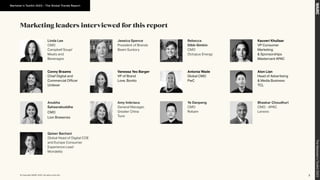
Marketing leaders interviewed for this report
Linda Lee
CMO
Campbell Soup/
Meats and
Beverages
Conny Braams
Chief Digital and
Commercial Officer
Unilever
Bhaskar Choudhuri
CMO - APAC
Lenovo
Alon Lian
Head of Advertising
& Media Business
TCL
Jessica Spence
President of Brands
Beam Suntory
Rebecca
Dibb-Simkin
CMO
Octopus Energy
Anubha
Sahasrabuddhe
CMO
Lion Breweries
Qaiser Bachani
Global Head of Digital COE
and Europe Consumer
Experience Lead
Mondelēz
Vanessa Yeo Barger
VP of Brand
Love, Bonito
Amy Imbriaco
General Manager,
Greater China
Tumi
Kauveri Khullaar
VP Consumer
Marketing
& Sponsorships
Mastercard APAC
Antonia Wade
Global CMO
PwC
Ye Danpeng
CMO
Robam
3
© Copyright WARC 2022. All rights reserved.
The
Marketer’s
Toolkit
2023
Marketer’s Toolkit 2023 – The Global Trends Report
In this
report
Contents
1
Marketing in a
cost-of-living crisis
Current macroeconomic factors
are driving very high levels of price
sensitivity. Marketers must find ways
to maintain brand equity and increase
market share in an increasingly
difficult economic scenario.
5
Price vs. planet:
A false dichotomy
Marketers will need to balance
sustainability initiatives with
increased price sensitivity from
consumers in this current economic
environment.
4
The clash of
demand, delivery
and disruption
War, climate change and inflation
are all creating unprecedented
disruption for global supply-chains.
Consistent inventory and reliable
delivery of products will emerge as
an important differentiator in 2023.
2
A reckoning
for Big Tech
Shifts in demand, new competition
and the blurring of product
categories mean that gravity is
finally starting to affect technology
leaders, forcing new strategies
from them in 2023.
3
The era of
“bubble up” culture
Technological and societal trends
have split traditional segments into
different ideological and interest-based
communities. Increasingly, effective
marketing will require marketers to target
messaging based on these elements.
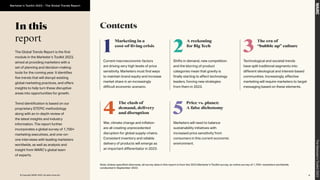
The Global Trends Report is the first
module in the Marketer’s Toolkit 2023,
aimed at providing marketers with a
set of planning and decision-making
tools for the coming year. It identifies
five trends that will disrupt existing
global marketing practices, and offers
insights to help turn these disruptive
areas into opportunities for growth.
Trend identification is based on our
proprietary STEPIC methodology
along with an in-depth review of
the latest insights and industry
information. The report further
incorporates a global survey of 1,700+
marketing executives, and one-on-
one interviews with leading marketers
worldwide, as well as analysis and
insight from WARC’s global team
of experts.
Note: Unless specified otherwise, all survey data in this report is from the 2023 Marketer’s Toolkit survey, an online survey of 1,700+ marketers worldwide,
conducted in September 2022.
4
The
Marketer’s
Toolkit
2023
Marketer’s Toolkit 2023 – The Global Trends Report
© Copyright WARC 2022. All rights reserved.
The STEPIC
methodology
This report is part of the 12th annual
Marketer’s Toolkit from WARC, aimed at
providing insight and planning support for
the main challenges facing marketers in
the coming year.
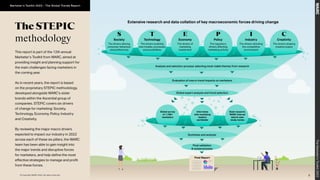
As in recent years, the report is based
on the proprietary STEPIC methodology,
developed alongside WARC’s sister
brands within the Ascential group of
companies. STEPIC covers six drivers
of change for marketing: Society,
Technology, Economy, Policy, Industry
and Creativity.
By reviewing the major macro drivers
expected to impact our industry in 2022
across each of these six pillars, the WARC
team has been able to gain insight into
the major trends and disruptive forces
for marketers, and help define the most
effective strategies to manage and profit
from these forces.
Synthesis and analysis
Final Report
Final validation
& review process
Extensive research and data collation of key macroeconomic forces driving change
Global expert analysis and trend selection
Analysis and selection process; selecting most viable themes from research
Evaluation of macro-trend impacts on marketers
S C
Creativity
The drivers shaping
creative output
T
Technology
The drivers enabling
new models, processes
and possibilities
E
Economy
The drivers of
marketing
investment
P
Policy
The regulatory
drivers affecting
marketing activity
I
Industry
The drivers dictating
the competitive
environment
Society
The drivers altering
consumer behaviour
and preferences
Desk research,
WARC internal
data & case
study review
Global survey
of 1,700+
marketers
Interviews
with marketing
leaders
worldwide
5
© Copyright WARC 2022. All rights reserved.
The
Marketer’s
Toolkit
2023
Marketer’s Toolkit 2023 – The Global Trends Report
Marketing in a
cost-of-living crisis
1
2022 has been a year of two-pronged
economic anxiety. First, inflation gripped
the globe, and now, most major economies
appear poised for a recession that isn’t
expected to offer much pricing relief. This
chapter looks at how marketers can
navigate a treacherous time.
The
Marketer’s
Toolkit
2023
© Copyright WARC 2022. All rights reserved.
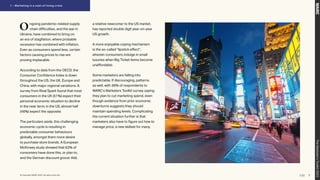
Ongoing pandemic-related supply
chain difficulties, and the war in
Ukraine, have combined to bring on
an era of stagflation, where probable
recession has combined with inflation.
Even as consumers spend less, certain
factors causing prices to rise are
proving implacable.
According to data from the OECD, the
Consumer Confidence Index is down
throughout the US, the UK, Europe and
China, with major regional variations. A
survey from Rival Spark found that most
consumers in the UK (51%) expect their
personal economic situation to decline
in the near term; in the US, almost half
(46%) expect the opposite.
The particulars aside, this challenging
economic cycle is resulting in
predictable consumer behaviours
globally, amongst them more desire
to purchase store brands. A European
McKinsey study showed that 62% of
consumers have done this, or plan to,
and the German discount grocer Aldi,
a relative newcomer to the US market,
has reported double digit year-on-year
US growth.
A more enjoyable coping mechanism
is the so-called “lipstick effect”,
wherein consumers indulge in small
luxuries when Big Ticket items become
unaffordable.
Some marketers are falling into
predictable, If discouraging, patterns
as well, with 36% of respondents to
WARC’s Marketers Toolkit survey saying
they plan to cut marketing spend, even
though evidence from prior economic
downturns suggests they should
maintain spending levels. Complicating
the current situation further is that
marketers also have to figure out how to
manage price, a new skillset for many.
7
© Copyright WARC 2022. All rights reserved.
The
Marketer’s
Toolkit
2023
1 – Marketing in a cost-of-living crisis
How important are each of the following societal topics and consumer
concerns in terms of their impact on your 2023 marketing strategy?
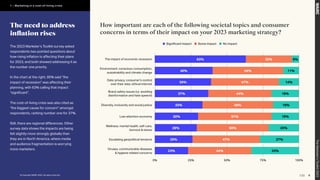
The 2023 Marketer’s Toolkit survey asked
respondents two pointed questions about
how rising inflation is affecting their plans
for 2023, and both showed addressing it as
the number one priority.
In the chart at the right, 95% said “the
impact of recession” was affecting their
planning, with 63% calling that impact
“significant”.
The cost-of-living crisis was also cited as
“the biggest cause for concern” amongst
respondents, ranking number one for 37%.
Still, there are regional differences. Other
survey data shows the impacts are being
felt slightly more strongly globally than
they are in North America, where media
and audience fragmentation is worrying
more marketers.
The need to address
inflation rises
Significant impact Some impact No impact
The impact of economic recession
Environment: conscious consumption,
sustainability and climate change
Data: privacy, consumer's control
over their data, ethical internet
Brand safety issues (i.e. avoiding
disinformation and hate speech)
Diversity, inclusivity and social justice
Low-attention economy
Wellness: mental health, self-care,
burnout & stress
Escalating geopolitical tensions
Viruses, communicable diseases
& hygiene related concerns
0% 25% 50% 75% 100%
33%
27%
20%
19%
18%
19%
14%
11%
5%
44%
47%
50%
51%
49%
44%
47%
49%
32%
23%
26%
29%
30%
33%
37%
39%
40%
63%
The
Marketer’s
Toolkit
2023
8
1 – Marketing in a cost-of-living crisis
© Copyright WARC 2022. All rights reserved.
How marketers are responding
Data from the Toolkit survey shows
marketers are deploying many
strategies to manage the economic
situation, including a plan to
“adjust spend between brand and
performance marketing” on the part
of 43%. As we’ve seen during prior
economic slowdowns, there is also a
healthy – or unhealthy – percentage
(36%) who plan on reducing marketing
spend.
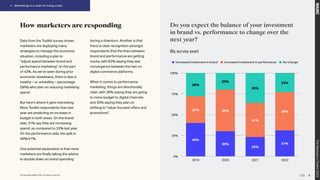
But here’s where it gets interesting.
More Toolkit respondents than last
year are predicting an increase in
budget in both areas. On the brand
side, 31% say they are increasing
spend, as compared to 23% last year.
On the performance side, the split is
46%/41%.
One potential explanation is that more
marketers are finally taking the advice
to double down on brand spending
during a downturn. Another is that
there is clear recognition amongst
respondents that the lines between
brand and performance are getting
murky, with 62% saying they see
convergence between the two on
digital commerce platforms.
When it comes to performance
marketing, things are directionally
clear, with 39% saying they are going
to move budget to digital channels
and 35% saying they plan on
shifting to “value-focused offers and
promotions”.
Do you expect the balance of your investment
in brand vs. performance to change over the
next year?
(By survey year)
Increased investment in brand Increased investment in performance No change
0%
25%
50%
75%
100%
2019 2020 2021 2022
24%
36%
20%
28%
46%
41%
50%
32%
31%
23%
30%
40%
9
© Copyright WARC 2022. All rights reserved.
The
Marketer’s
Toolkit
2023
1 – Marketing in a cost-of-living crisis
The rush to cut advertising spend
is understandable, especially in
organisations where marketing isn’t
viewed as an investment – as is the
focus on price promotions to support
sales. However, evidence supports going
in the opposite direction on both.
During downturns, marketers
who continue to invest in brand
advertising and are prudent about
price promotions:
• Often weather increases in
pricing better because they’ve
built brand equity.
• Come out stronger, often because
they focus on gaining excess share of
voice (ESOV).
• 
Enhance connections with customers
by also focusing on the tone of their
messaging.
First, let’s look at pricing; it’s not
something marketers are accustomed
to because prices have been static
for years.
Les Binet recently urged brands to
use econometrics to get a handle
on price elasticity, studying growth
prospects and price pressures in
their sector. While it’s important to
optimise around price, promotion and
ad budgets, he noted brand advertising
is the underpinning, supporting prices
and margins. The “force multiplier” of
creativity is also crucial.
Focusing on brand protects against
price elasticity. And this can be done in
many ways, via ESOV, innovation, and
getting the tone of messaging right.
According to an analysis of the
Advertising Council of Australia’s (ACA)
Effectiveness Database, ESOV has large
business effects across all budgets,
building mental availability when other
brands go dark.
But don’t let performance do the heavy
lifting when building ESOV. British
e-commerce clothing brand Asos is
finding this out the hard way; its over-
investment in performance (+80%)
and failure to invest in long-term brand
awareness has caught it in the “spiral
of doom” where continual discounting
erodes gross margins over time.
Does investment during downturns
really work? Analytic Partners data from
the last recession shows what happens
when advertising Is considered an
investment: brands that boosted their ad
investment increased incremental sales
by 17%; those that cut back saw an 18%
contraction.
The case for continuing investment
10
© Copyright WARC 2022. All rights reserved.
The
Marketer’s
Toolkit
2023
1 – Marketing in a cost-of-living crisis
The tone of messaging is also a key
consideration when marketing in a
cost-of-living crisis.
First and foremost, brands need to
convey sensitivity and transparency
– don’t resort to euphemisms when
relaying bad news. Especially when
having to raise prices, brands need to
communicate their value, aside from
price, and also realise that consumers
may have enhanced expectations in
areas such as customer experience.
Another technique is to rely on humour,
especially for brands which commonly
rely on it. In fact, following this advice
might be a competitive advantage;
humour has been declining in use
since 2009, according to research
from Kantar, despite its effectiveness
in building emotional engagement. It
is used most often in TV (37%) and
YouTube (30%), but is less popular in
print, outdoor and website ads.
System1’s analysis of 2021 Super
Bowl ads demonstrates humour’s
impact. Despite racial strife,
polarisation and ongoing worry in the
US about the pandemic, nine of the
top 10 ads favoured by consumers
employed humour. Notably, the only
top ad that wasn’t humorous – from
the employment site Indeed.com –
displayed empathy, another way that
marketers can effectively use tone.
Marketing in a cost-of-living crisis
is about expanding deep customer
connections through savvy use of
media and messaging. The evidence
shows brands which embrace this will
emerge from the crisis stronger than
those that don’t.
A few words about messaging
11
© Copyright WARC 2022. All rights reserved.
The
Marketer’s
Toolkit
2023
1 – Marketing in a cost-of-living crisis
The recession is real. That’s
something that’s led to a new
effort on our end around value,
marketing and messaging. At a time
like this, it’s important to not cut
back on our marketing … [and] lean
in, not just to market; it’s to lean into
how we can help our consumers.
We are seeing a much sharper
downturn in consumer
confidence across Western Europe
than we are in the US. You have to
be constantly pushing to understand
what people are experiencing. As we
saw through the pandemic, people
were very choiceful about where they
spent their money.
In these inflationary times, where
you are fighting for every other
… dollar that a consumer spends,
consumers will always prefer brands
that have strong equity. There might
be a small dip or small growth, but
the preference will always be to go
for the known brand and brands that
have been consistent in the past.
Linda Lee
CMO
Campbell Soup/Meats
and Beverages
Jessica Spence
President of Brands
Beam Suntory
Qaiser Bachani
Global Head of Digital COE
and Europe Consumer
Experience Lead
Mondelēz
The CMO view
The
Marketer’s
Toolkit
2023
1 – Marketing in a cost-of-living crisis
© Copyright WARC 2022. All rights reserved. 12
Explore the Case Study
Case Study
Advertiser:
Procter  Gamble
Market:
Global
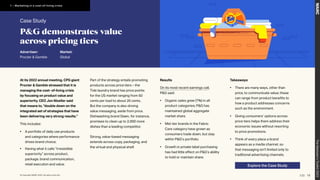
At its 2022 annual meeting, CPG giant
Procter  Gamble stressed that it is
managing the cost- of-living crisis
by focusing on product value and
superiority. CEO Jon Moeller said
that means to, “double down on the
integrated set of strategies that have
been delivering very strong results.”
This includes:
• A portfolio of daily use products
and categories where performance
drives brand choice;
• Having what it calls “irresistible
superiority” across product,
package, brand communication,
retail execution and value.
Takeaways
• 
There are many ways, other than
price, to communicate value; these
can range from product benefits to
how a product addresses concerns
such as the environment.
• Giving consumers’ options across
price tiers helps them address their
economic issues without resorting
to price promotions.
• 
Think of every place a brand
appears as a media channel, so
that messaging isn’t limited only to
traditional advertising channels.
Results
On its most recent earnings call,
PG said:
• Organic sales grew (7%) in all
product categories; PG has
maintained global aggregate
market share.
• Mid-tier brands in the Fabric
Care category have grown as
consumers trade down, but stay
within PG’s portfolio.
• Growth in private label purchasing
has had little effect on PG’s ability
to hold or maintain share.
Part of the strategy entails promoting
products across price tiers – the
Tide laundry brand has price points
for the US market ranging from 50
cents per load to about 20 cents.
But the company is also driving
value messaging, aside from price.
Dishwashing brand Dawn, for instance,
promises to clean up to 2,000 more
dishes than a leading competitor.
Strong, value-based messaging
extends across copy, packaging, and
the virtual and physical shelf.
PG demonstrates value
across pricing tiers
The
Marketer’s
Toolkit
2023
13
1 – Marketing in a cost-of-living crisis
© Copyright WARC 2022. All rights reserved.
Takeaways
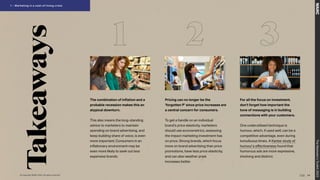
The combination of inflation and a
probable recession makes this an
atypical downturn.
This also means the long-standing
advice to marketers to maintain
spending on brand advertising, and
keep building share of voice, is even
more important; Consumers in an
inflationary environment may be
even more likely to seek out less
expensive brands.
Pricing can no longer be the
‘forgotten P’ since price increases are
a central concern for consumers.
To get a handle on an individual
brand’s price elasticity, marketers
should use econometrics, assessing
the impact marketing investment has
on price. Strong brands, which focus
more on brand advertising than price
promotions, have less price elasticity,
and can also weather price
increases better.
For all the focus on investment,
don’t forget how important the
tone of messaging is in building
connections with your customers.
One underutilised technique is
humour, which, if used well, can be a
competitive advantage, even during
tumultuous times. A Kantar study of
humour’s effectiveness found that
humorous ads are more expressive,
involving and distinct.
1 2 3
14
© Copyright WARC 2022. All rights reserved.
The
Marketer’s
Toolkit
2023
1 – Marketing in a cost-of-living crisis
A Reckoning
for Big Tech
2
Big Tech’s tectonic plates are shifting
at a quicker pace than at any time since
the launch of the iPhone in 2007. This
is heightening competition between
Alphabet, Amazon, Apple, Meta and
Microsoft, and reshaping marketers’
relationships with digital platforms.
The
Marketer’s
Toolkit
2023
© Copyright WARC 2022. All rights reserved.
Until recently, technology’s biggest
beasts had been able to enjoy
rapid growth by targeting distinct
market segments, whether e-commerce
(Amazon), hardware (Apple) or business
services (Microsoft). Even digital
advertising was neatly divided between
social (Meta’s Facebook and Instagram),
search and video (Alphabet’s Google
and YouTube).
This cosy arrangement is at an end,
however. Big Tech stocks have lost
billions of dollars in value in 2022. As
firms seek growth in a post-pandemic
landscape, the likelihood of territorial
encroachment increases.
The digital ad market has been upended
by Apple’s App Tracking Transparency
(ATT) privacy policy, which has made it
harder for apps like Snapchat to target
users and measure the success of
campaigns. As well as costing platforms
billions of dollars in lost revenues, ATT
has also reinvigorated Apple’s own
aspirations in the ad business, and
reinforced the strengths of data-rich
media owners like Amazon.
Alphabet and Meta are still expected
to earn a combined $324.3bn in ad
revenue in 2022, according to WARC
Media forecasts. However, their
‘duopoly’ dominance of the digital ad
sector is being seriously challenged
for the first time. The seemingly
unstoppable rise of TikTok, alongside
the arrival of new ad players like Netflix,
suggests brands will have more choice
in how they allocate digital marketing
budgets. And while initial reactions
to Elon Musk’s Twitter acquisition are
far from positive, his deep pockets
might eventually turn it into a stronger
competitor.
All the while, Big Tech finds itself
under a growing weight of regulatory
restrictions, with the European
Union’s upcoming Digital Markets Act
threatening ‘gatekeeper’ platforms with
huge fines over any perceived anti-
competitive behaviour.
16
The
Marketer’s
Toolkit
2023
2 – A reckoning for Big Tech
© Copyright WARC 2022. All rights reserved.
Brand confidence in Facebook
ebbs away
Facebook remains the biggest social
platform in the world, with nearly three
billion monthly active users. Yet its
star is beginning to wane – even within
parent company Meta.
In 2021, Facebook was overtaken
by Instagram as a driver of ad sales
for the first time. Plans to reinvent
Facebook as hub for e-commerce
have seen mixed results; the platform
recently announced it would close its
live shopping feature. WARC Media
forecasts Facebook’s annual global
revenue will decline from $54.9bn in
2021 to $46.1bn in 2023.
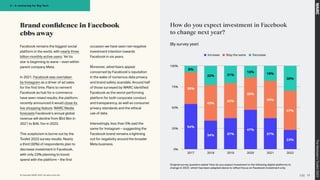
This scepticism is borne out by the
Toolkit 2023 survey results. Nearly
a third (30%) of respondents plan to
decrease investment in Facebook,
with only 23% planning to boost
spend with the platform – the first
occasion we have seen net-negative
investment intention towards
Facebook in six years.
Moreover, advertisers appear
concerned by Facebook’s reputation
in the wake of numerous data privacy
and brand safety scandals. Around half
of those surveyed by WARC identified
Facebook as the worst-performing
platform for both corporate conduct
and transparency, as well as consumer
privacy standards and the ethical
use of data.
Interestingly, less than 5% said the
same for Instagram – suggesting the
Facebook brand remains a lightning
rod for negativity around the broader
Meta business.
How do you expect investment in Facebook
to change next year?
(By survey year)
Original survey question asked ‘How do you expect investment in the following digital platforms to
change in 2023’, which has been adapted above to reflect focus on Facebook investment only.
0%
25%
50%
75%
100%
2017 2018 2019 2020 2021 2022
30%
18%
13%
21%
22%
8%
47%
45%
39%
42%
43%
38%
23%
37%
47%
37%
34%
54%
Increase Stay the same Decrease
17
The
Marketer’s
Toolkit
2023
2 – A reckoning for Big Tech
© Copyright WARC 2022. All rights reserved.
Which of the following emerging technologies do you expect to be most
important to you next year?
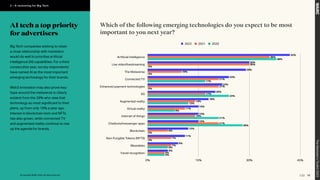
Big Tech companies wishing to retain
a close relationship with marketers
would do well to prioritise artificial
intelligence (AI) capabilities. For a third
consecutive year, survey respondents
have named AI as the most important
emerging technology for their brands.
Web3 innovation may also prove key:
hype around the metaverse is clearly
evident from the 29% who view that
technology as most significant to their
plans, up from only 10% a year ago.
Interest in blockchain tech and NFTs
has also grown, while connected TV
and augmented reality continue to rise
up the agenda for brands.
AI tech a top priority
for advertisers
2022 2021 2020
Arti cial intelligence
Live video/livestreaming
The Metaverse
Connected TV
Enhanced payment technologies
5G
Augmented reality
Virtual reality
Internet of things
Chatbots/messenger apps
Blockchain
Non-Fungible Tokens (NFTS)
Wearables
Facial recognition
0% 15% 30% 45%
5%
6%
0%
0%
28%
21%
8%
12%
24%
0%
17%
0%
0%
38%
5%
7%
7%
6%
21%
14%
11%
14%
17%
21%
21%
10%
30%
36%
6%
9%
11%
12%
15%
15%
15%
18%
20%
22%
24%
29%
30%
42%
18
The
Marketer’s
Toolkit
2023
2 – A reckoning for Big Tech
© Copyright WARC 2022. All rights reserved.
This year’s Toolkit survey finds
advertisers reappraising long-held
assumptions about the Big Tech
landscape.
1. Brands have more choice in the
tech space
Two years ago, nearly one-in-five (19%)
advertisers claimed that Google and
Facebook’s digital media ‘duopoly’ was
one of their biggest concerns when
drawing up marketing plans. Those
worries have subsided: only 11% of
respondents now cite the duopoly as a
major headache.
The majority of advertisers (62%)
agree that a range of changing market
dynamics are forcing strategic shifts
from the tech giants – from Netflix’s
move into the ad space, to Meta’s
growing focus on augmented reality and
metaverse innovation.
This enforced competition will likely
mean Big Tech firms working harder to
attract brand dollars, which can only be
good news for marketers.
2. Regulation is giving brands
more control
Data privacy remains a top-three
societal concern for advertisers, with
39% saying it will have a significant
impact on their 2023 marketing
strategy.
Regulators are similarly preoccupied.
Europe’s Digital Markets Act (DMA),
which comes into force in 2023, arrives
hot on the heels of further restrictive
guidelines from authorities in China and
India, even if the prospect of antitrust
measures in the US appears to have
diminished.
The DMA targets large-scale platform
businesses which provide a ‘gateway’
between businesses and consumers
(i.e. Amazon, Meta, Alphabet and
Microsoft). Firms must adhere to
complex rules on data transparency,
and brands have greater autonomy to
set their own prices.
3. TikTok is reshaping the
digital landscape
TikTok has shaken the Big Tech status
quo and brands are responding in kind:
76% of those surveyed plan to increase
investment with the mobile video app
in 2023.
Alphabet recently admitted younger
users prefer discovery via TikTok videos,
rather than written searches on Google.
Both YouTube (Shorts) and Instagram
(Reels) are betting heavily on TikTok-
lookalike products, though in watch time
TikTok remains the undisputed leader of
short-form video.
Nonetheless, the pivot to full-screen,
vertical video content across Big Tech
will have an impact on how brands plan
social and video campaigns in 2023.
Shifting attitudes towards Big Tech
19
The
Marketer’s
Toolkit
2023
2 – A reckoning for Big Tech
© Copyright WARC 2022. All rights reserved.
Despite economic headwinds,
Big Tech’s restless pursuit of the next
big revenue opportunity will remain
undimmed. Each major tech player
is determined to seize first-mover
advantage in a nascent field, such as:
Digital healthcare
Digital health and wearable technology
ownership grew markedly during
the pandemic, and is likely to be a
key battleground in 2023. This trend
didn’t go unnoticed by Big Tech, which
collectively spent $3.6bn on health-
related MA activity in 2021, centred
on data and devices. Investment
stepped up this year: Amazon
acquired primary care tech provider
One Medical in a $3.9bn deal, while
TikTok-owner ByteDance revealed its
own $1.5bn acquisition of hospital
company Amcare.
Metaverse
For all the hype, Meta’s vision of the
metaverse remains unfulfilled. The
company hopes its new Quest Pro VR
headset will encourage users to work
in virtual environments, while brands
can use Meta’s Avatar Store to sell
digital goods. However, rivals may be
stealing a march. Apple will release
of its own mixed-reality headset
in 2023, with augmented reality
glasses expected to arrive by 2025.
A resurgent Microsoft, meanwhile,
already buoyed by its acquisition of
gaming company Activision Blizzard,
is looking at the space through a
B2B lens, and plans to build its own
‘industrial metaverse’.
Commerce
Yes, some heat has come out of the
digital commerce sector. Instagram’s
scaling back of shopping features
reveals that social commerce has
not taken off at the expected speed.
However, despite evidence that
Western consumers reject the notion of
Chinese-style ‘super-apps’, companies
have not yet given up on their plans
to integrate content and commerce.
TikTok is reportedly planning to operate
its own US warehouses, to further
capitalise on the #TikTokmademebuyit
trend for video content influencing
purchase behaviour.
What’s next for Big Tech in 2023
20
The
Marketer’s
Toolkit
2023
2 – A reckoning for Big Tech
© Copyright WARC 2022. All rights reserved.
The CMO view
Marketers need to cut through
the hype and return to the
fundamentals of marketing. What
can we do that would appeal to
consumers, not because it’s a shiny
new toy but it makes their lives
simpler, helps them connect to
their passions…
Behind the scenes, we’re
working to ensure we play a
part in making this evolving arena
representative, inclusive and safe
for everyone who uses it. Robust
governance around issues such as data
privacy, safety, equity, diversity and
inclusion, sustainability and ethics
needs to be established, and we’re
using our scale and global profile to
help set future-fit foundations for our
business and beyond.
It’s about making sure that
whatever experience you’re
trying to create is absolutely spot
on, and also has been bought and
optimised at the right cost level so
that it brings that ROI that you’re
looking for. That’s how we tend to
approach all these conversations
with our partners.
Kauveri Khullaar
VP Consumer Marketing
 Sponsorships
Mastercard APAC
Conny Braams
Chief Digital and
Commercial Officer
Unilever
Qaiser Bachani
Global Head of Digital COE
and Europe Consumer
Experience Lead
Mondelēz
The
Marketer’s
Toolkit
2023
21
2 – A reckoning for Big Tech
© Copyright WARC 2022. All rights reserved.
Explore the Case Study
In November 2021, beauty business
Lush opted to remove itself from
Facebook, Instagram, Snapchat and
TikTok in protest at user and brand
safety concerns.
Lush likened the environment provided
by social platforms to a “dark and
dangerous alleyway”, and unbecoming
of a company whose purpose is to
help people “relax and pay attention to
their wellbeing”.
The ‘Anti-Social Media Policy’
stipulates Lush will not invest in any
platform that allows “harassment,
harm and manipulation”, nor digital
media owners that use visitor data
in “unpublished ways”. The company’s
CEO said he would be prepared to
lose out on £10m in sales as a result
of the move.
This isn’t the first time Lush has
boycotted social platforms – it did so,
briefly, in 2019 as well – but on this
occasion the abstinence has been
maintained. Instead, Lush has focused
on growing its YouTube following,
using Pinterest to share inspirational
content, and invested in re-engaging
customers through physical events.
Takeaways
• Context matters. Purpose-driven brands
may find their marketing message
compromised by the quality of media
environment in which they advertise.
• Advertisers can select the Big Tech
platforms that they believe most closely
aligns with their goals and brand values.
• Abstaining from investment with
major platforms can generate valuable
PR exposure.
Results
• Lush arrived at the pre-Christmas
trading period with a surplus cash
amount of £26.7m, reflecting
improved liquidity.
• In-person retail is a priority:
Lush invested £7.6m in new store
openings and refits across the UK
and Europe.
• Lush has attempted to maintain
reach through innovations such as
a new podcast and new wellness
app called Bathe.
Case Study
Client:
Lush
Market:
Global
Lush: Anti-Social Media Policy
22
The
Marketer’s
Toolkit
2023
2 – A reckoning for Big Tech
© Copyright WARC 2022. All rights reserved.
Takeaways
Big Tech companies are seeking
new sources of revenue, in some
cases bringing them into direct
competition for the first time.
Growth is slowing in Big Tech’s core
sectors, including digital advertising
and e-commerce. This is encouraging
those companies to invest vast sums
to win share of emerging sectors, from
digital healthcare to the metaverse.
Alphabet and Meta’s digital
advertising ‘duopoly’ is being
seriously challenged for the
first time.
Apple’s ATT policy has weakened the
ability of app-based platforms such as
Instagram and Snapchat to track users
and measure campaign performance.
This creates opportunities for firms
like Amazon and Apple, which possess
greater end-to-end visibility of the
purchase journey.
Brands have an opportunity to reset
their relationships with Big Tech.
For years, many advertisers have felt
dependent on the reach and targeting
capabilities offered by Facebook and
Google. The rise of TikTok and Amazon
as media owners, plus newcomers like
Netflix joining the advertising space,
may enable marketers to reevaluate
and recalibrate media plans to better
suit their brands’ needs.
1 2 3
23
The
Marketer’s
Toolkit
2023
2 – A reckoning for Big Tech
© Copyright WARC 2022. All rights reserved.
The era of
“bubble up” culture
3
Culture formation is increasingly a “bubble up”
phenomenon that is shaped by communities
and creators across a decentralised media
ecosystem. Against this backdrop, marketers
face profound questions around
how to consistently build relevance,
audiences and engagementat
a meaningful scale.
The
Marketer’s
Toolkit
2023
© Copyright WARC 2022. All rights reserved.
The formation and diffusion of
culture is undergoing a shift which
is eroding the idea of brands reaching
the “mainstream”.
As noted by Oliver Feldwick from
ThePartnership, popular culture was
traditionally “trickle down”, and shaped
by the few media gatekeepers with
scaled audiences. Today, however, a
combination of touchpoint proliferation,
audience fragmentation and splintering
attention means culture is increasingly
“bubble-up”.
Consequently, everything from social
movements to the latest fads now
emerge from disparate communities
– whether based around influencers,
passions or hobbies – that function
entirely independently. Top creators
on TikTok, for instance, may be famous
amongst the content-sharing app’s
users while having minimal recognition
elsewhere. Gen Z is the vanguard for
this balkanisation, spending 95 minutes
a day on TikTok, more than streaming
platforms like Netflix and Disney+
combined, upending how entertainment
content is made, discovered and
enjoyed.
One result: platforms like TikTok,
Instagram and YouTube are competing
fiercely to be the go-to destination
for creators, now a 50 million-strong
community with rising heft amongst
advertisers.
TV, by contrast, is suffering a disconnect
between high ad prices and shrinking
audiences – especially younger viewers.
Live sports prove TV can still achieve
scale, but even here digital players
like Amazon are encroaching. A return
to weekly episodic scheduling is one
way TV networks may reassert their
community-accumulation power.
As with these media owners, brands
must now answer tough questions
around connecting with creators and
communities, building scale, and mixing
granular appeals with relevance to
casual buyers and audiences.
25
The
Marketer’s
Toolkit
2023
3 – The era of “bubble up” culture
© Copyright WARC 2022. All rights reserved.
Fragmenting audiences, shifting budgets
Marketers are not convinced the age
of mainstream reach is finished – or, at
least, not yet.
Proof comes from WARC’s 2022
Marketer’s Toolkit poll: when asked if
‘The era of mass marketing is over’, a
48% plurality of interviewees rejected
this proposition.
The data, though, indicated there is
a broader awareness that the rules
of engagement are changing. While
inflation/cost-of-living were the
biggest source of concern for 2023,
mentioned by 37% of the panel, media
and audience fragmentation was close
behind on 34%.
The survey also demonstrated
how this concern is now influencing
budgets. When asked about
spending for next year, two-thirds
of respondents expect investment in
targeting interest-based communities
to rise. Sixty-three percent said the
same for gaming – a space where
community is deeply embedded – as
did 52% for their outlay on influencers
and other social media content.
Shifts in audience usage (67%)
and audience fragmentation (47%)
were cited as the main reasons for
decreasing investment in certain
digital properties – with creator-
led platforms like TikTok, Twitch
and YouTube amongst the main
beneficiaries of this shift, while legacy
social hubs like Facebook and Twitter
saw more brands plan to cut back than
raise
their outlay.
How do you expect investment in the following
digital platforms to change in 2023?
Increase Stay the same Decrease
TikTok
YouTube
Google
Twitch
Linkedln
Instagram
Amazon
WhatsApp
Spotify
Facebook
Twitter
Snapchat
Bing (Microsoft)
0% 25% 50% 75% 100%
35%
37%
28%
30%
11%
12%
9%
11%
9%
11%
4%
6%
4%
54%
44%
53%
47%
52%
50%
47%
43%
45%
40%
43%
37%
20%
11%
19%
19%
23%
37%
37%
44%
46%
46%
50%
53%
57%
76%
26
The
Marketer’s
Toolkit
2023
3 – The era of “bubble up” culture
© Copyright WARC 2022. All rights reserved.
1. Tapping into community-
first culture
To understand the power of community-
first culture, marketers can look to
MrBeast, aka Jimmy Donaldson,
an online star with over 100 million
YouTube subscribers.
While MrBeast’s brand is rooted
in stunt and giveaway videos, it is
diversifying – such as with a hamburger
line available for delivery across much
of the US, and which saw fans swamp
a recent brick-and-mortar restaurant
launch. It has been licensed in several
Asian markets, too.
This example shows fan communities:
• Are in-built audiences for new
products, even those distant from a
brand’s core competency;
• Enable monetisation based not on
mass appeals and advertising, but on
propulsion towards the mainstream
by a movement;
• Span the online and offline worlds.
2. Brands and journeys evolve
To tap into such effects, marketers
may want to:
• Perceive a brand as a plural entity
with different meanings for distinct
audiences, but shared relevance for
all of them;
• Draw bedrock insights from fans and
extend them to broader audiences,
as with McDonald’s Famous Orders;
• Reassess customer journeys, as
some buyers may purchase based
on community recommendations
(#TikTokmademebuyit) and
“discover” a brand afterwards.
3. Diversifying research methods
Each community has an internal
culture, so quantitative research
alone will not suffice:
• Qualitative research could be set
for a resurgence, as it is a powerful
way to identify communal patterns,
cues and values.
• Analysing community hierarchies
can determine which members
drive virality.
• Given consumers usually belong
to several “taste clusters”, tracing
interconnections between groups
will yield benefits.
4. Media plans need a rethink
Media strategies – from audience
identification and planning to
cross-media measurement – will
need a rethink:
• “Tribe-based” approaches can
be test-and-learn and coupled
with mass or one-to-one
communications.
• Contextual targeting can be used to
develop awareness and credibility
with communities using ads before
pursuing deeper engagement.
• As social media properties battle for
leading creators, brands must track
changing audience dynamics.
• Having found appropriate niches,
reach can be augmented with
“lookalike” communities.
Four implications of bubble-up culture
27
The
Marketer’s
Toolkit
2023
3 – The era of “bubble up” culture
© Copyright WARC 2022. All rights reserved.
The CMO view
Now, we are able to aggregate
or cluster through profiling
around values or passion points.
But whether you can identify three
or 30 relevant tribes, what has to
be unchanging is your brand’s core
values.
Afew years ago, the number of
people involved to purchase
decisions for our services would be
around four or five. Now it’s up to
14 or 15 people … That means that
they’re all coming into it with a very
different perspective of what the value
is that they’re looking for out of the
conversation.
It is no longer like a few years
ago when the global market
had a unified rhythm, a unified
language, a unified tonality, and so
on. Now, with a wave of your arm,
you will be greeted with a thousand
responses.
Anubha Sahasrabuddhe
CMO
Lion Breweries
Antonia Wade
Global CMO
PwC
Alon Lian
Head of Advertising
 Media Business
TCL
The
Marketer’s
Toolkit
2023
28
3 – The era of “bubble up” culture
© Copyright WARC 2022. All rights reserved.
29
Explore the Case Study
McDonald’s, the quick-service chain,
had long been a US cultural icon.
But the brand was losing relevance
with younger, diverse consumers,
and wanted to find a meaningful way
to re-engage them.
In doing so, McDonald’s turned to its
fans for inspiration. And the resultant
insight highlighted a core truth about
its enthusiasts which also resonated
with a much broader audience: namely,
that every customer – from high-profile
celebrities to busy working families –
has a favourite order from its menu.
This idea was translated into a
repeatable platform which asked
well-known McDonald’s fans – like
music stars Travis Scott, BTS and
Saweetie – to reveal their favourite
orders, and then gave customers the
opportunity to buy these meals in-
store. A celebrity focus enabled the
brand to engage its own audience
while tapping into the fanbases of its
big-name ambassadors, too.
Takeaways
• Fans can be a vital source of
understanding about the deepest
points of connection between consumers
and a brand.
• Partnerships can give marketers
immediate access to two communities:
a brand’s own enthusiasts and
a celebrity’s fans.
• One-off campaigns can undoubtedly
make an impression, but replicable
programs can build fanbases of
their own.
Results
• McDonald’s econometric modeling
attributed $283 million in sales
to the Famous Orders platform
between 2019 and 2021.
• In the same period, its sales were
40% higher while its return on
marketing investment was up 42%.
• Its market share amongst young
consumers outpaced the same
metric amongst all adults, with
diverse consumers being an
“engine for growth”.
Case Study
Agency:
Wieden + Kennedy
New York
Market:
McDonald’s
Market:
US
McDonald’s: Famous Orders
The
Marketer’s
Toolkit
2023
3 – The era of “bubble up” culture
© Copyright WARC 2022. All rights reserved.
Takeaways
Mass culture has become a
contested idea at a time when
communities, “tribes” and fandoms
are increasingly the source of
culture formation and dissemination.
For marketers, this means that
traditional notions of “mainstream”
appeal could be due for a rethink.
For Gen Z in particular, this is an
increasingly foreign – and, indeed,
unwelcome – lens for thinking about
their cultural lives.
Taking part in “bubble up” culture
will require that brands find authentic
ways of engaging with numerous
different communities while remaining
true to a clear, overarching proposition.
This, clearly, is no easy task. Looking
to the example of McDonald’s, with its
Famous Orders platform, can assist
marketers in understanding how to locate
connection points between their biggest
fans and a wider audience.
Creators are the lifeblood of
this new digital ecosystem, and
especially popular with members
of Gen Z. For marketers and media
owners, these influencers are a route
to cultural relevance.
The communities which follow
creators are often large, engaged and
open to their favourite online stars
pursuing brand tie-ups. Authentic
partnerships can thus yield significant
benefits for all parties.
1 2 3
30
The
Marketer’s
Toolkit
2023
3 – The era of “bubble up” culture
© Copyright WARC 2022. All rights reserved.
The clash of demand,
delivery and disruption
4
Severe political, economic and environmental
drivers are affecting brands’ access to
a range of raw materials, foodstuffs, gas
and oil, amongst other critical items.
Minimising and effectively managing
disruptions in supply chains will
offer brands a significant
advantage in 2023.
The
Marketer’s
Toolkit
2023
© Copyright WARC 2022. All rights reserved.
Interruptions to the supply of energy
and commodities from Ukraine
coupled with sanctions on Russia are
the primary cause of today’s supply
chain disruptions. But there are several
other factors that are contributing to
this perfect storm, including:
Climate change: Droughts, rising
temperatures and devastating
hurricanes are affecting agricultural
productivity. Low water levels in rivers
used for transport, and water shortages
for manufacturing plants, are also
affecting industry. And in many cases,
these also constrain rebuilding after a
natural disaster.
Sanctions and trade wars:
Geopolitical tensions and sanctions
are driving alternate sourcing strategies
as an erupting economic cold war drives
shortages of crucial raw materials.
This is costing brands like Ford, who
spent $1 billion in Q3 to adapt their
supply chain.
COVID hangover: As trading has
ramped up following the end of
lockdowns, there is a shortage of critical
staff such as port workers and truck
drivers. Some countries, notably China,
have continued to roll out lockdowns,
which also has a major impact.
Inflation: The war and supply shortages
are contributing to rampant inflation
around the world, which is resulting in
increased wage demands from labour.
Consequently, several key workers in
the delivery chain are striking in many
parts of the world.
Managing customer expectations
while minimising supply disruptions will
become a key criterion for marketing
success in the coming year.
32
The
Marketer’s
Toolkit
2023
4 – The clash of demand, delivery and disruption
© Copyright WARC 2022. All rights reserved.
Supply squeeze has big impact
on small players
Marketers recognise the looming
threat, but levels of concern vary.
Amongst respondents to the 2023
Toolkit survey, more than 60%
anticipate non-trivial supply chain
disruptions, but just 26% expect they
will be significant or severe. This rises
to one in three amongst European
respondents.
That is understandable – supply
chain challenges will vary by region
and sector. Automotive, food and
energy sectors are expected to
be worst hit, while commodities,
consumer goods and chemicals
should be least affected.
Brands with scale, resources and
negotiating muscle may grab scarce
items while smaller players lose
out, in a new variation on double
jeopardy. 28% of marketers in our
survey thought that small and medium
businesses would be worst affected
by supply chain challenges.
And 52% of marketers surveyed
felt challenger brands would be the
hardest hit by supply chain challenges,
as they struggle to become profitable.
Typically smaller than established
competitors, these brands also
face what strategist JP Castlin calls
their “Maguire moment” – mounting
pressure to deliver profits, as they
mature from the start-up stage.
Those dependent on low-cost
countries like China could be
particularly vulnerable.
Do you anticipate supply chain issues causing any
disruption to the supply and delivery of your/your
clients’ products/services over the next year?
No supply chain issues expected
Minor supply chain issues with
very rare disruptions to supplies
Occasional disruptions from
time to time with limited impact
on customers
leading to regular disruption in the
supply and delivery of our goods
Severe supply chain issues,
which threaten the survival
of our business
0% 10% 20% 30% 40%
2%
24%
35%
21%
22%
Significant supply chain issues,
33
The
Marketer’s
Toolkit
2023
4 – The clash of demand, delivery and disruption
© Copyright WARC 2022. All rights reserved.
In the past 24 months, has your organisation relocated any of their
operations from one country to one or more others
(e.g., near-shoring or re-shoring?)
Source: EY, AMM Supply chain survey, Q1 2022
Businesses of all sorts are trying to
identify ways to minimise disruption.
Key measures include:
• Move resources closer to home,
within the same country/region.
• Enable visibility into lower level suppliers.
Many brands that thought they had
diversified their sources are finding all
their vendors are dependent on the same
supplier for their raw materials.
• Create additional capacity outside China,
while still maintaining a presence there.
The goal is to have sourcing options that
are independent of China.
• Drop just-in-time delivery and maintain
larger inventories. But this strategy
comes with overstocking risks, as seen by
Walmart, Target, Nike etc.
Finding solutions
Yes, but not planning additional
relocation(s) in the next 24 months
Yes, and planning additional
relocation(s) in the next 24 months
No, but planning additional
relocation(s) in the next 24 months
No, and not planning additional
relocation(s) in the next 24 months
0% 10% 20% 30% 40%
34%
13%
31%
22%
34
The
Marketer’s
Toolkit
2023
4 – The clash of demand, delivery and disruption
© Copyright WARC 2022. All rights reserved.
Supply chain performance has
been improving, but an IPSOS survey
found 28% of US consumers still cite a
lack of products at stores, restaurants,
hotels, travel services etc. and 27%
cited longer delivery times for online
shopping.
Similarly, marketers recognise the
value of consistent inventory, with
59% agreeing that “reliable inventory
and regular delivery will become a key
brand asset in 2023.” This rises to 63%
amongst NA and EU respondents.
While major decisions on supplier
locations are not likely to reside within
the marketing realm, marketers can
help brands navigate this uncertain time.
There are powerful measures that sit
within a marketer’s remit that can have
an important impact on demand for
their products.
Marketers can help smooth
supply issues
Proactively explain inventory issues:
During COVID, a Convey US shopper
survey found that most understood
brands’ supply chain challenges and
were willing to give them latitude.
Reaching out to regular customers,
and letting them know what items are
missing (and why) is better than trying to
hide inventory gaps. Reward programs
can also be tweaked to help mitigate
customer frustration, as they will look
for brands to make up for missing items
and delivery delays.
Communicate and engage: Actively
create systems that suggest similar
items to customers unable to find
preferred products. Similarly, shift
media activity (e.g. search and social)
from low inventory items to those that
are available. Where other options
don’t work, keep in touch with the
customers, using digital and social
channels to engage with them until the
item is available and make sure they are
the first to know when it is via alarms/
notifications.
Dig into the data: Marketers have
access to data as well as expertise in
parsing it. They can map and project
demand, as well as identify early surges
for specific products, adding crucial
insight for procurement teams.
Consistent delivery critical for both marketers and consumers
35
The
Marketer’s
Toolkit
2023
4 – The clash of demand, delivery and disruption
© Copyright WARC 2022. All rights reserved.
Design for omnichannel: The shift to
omnichannel strategy will also help introduce
more flexibility, as brands will be able to
source across channels to satisfy demand.
Brands have found that integrating on-and-
offline inventory can help drive sales.
Promote overstocked items:
Marketing initiatives can also be focused
on sell-through of overstocked items,
helping mitigate the risk of keeping larger
inventories. They can also encourage
businesses to manage expenses more
efficiently, i.e. by producing more in the
summer when energy prices are lower and
stocking up for winter, when they are higher.
Joint scenario planning: Cross-functional
teams from sourcing/procurement and
marketing can strategise together, and put
plans in place for unpredictable events
and global crises. Marius Bartsch, Head of
Customer Engagement, Digitas UK argues,
“The supply chain officer and the CMO
should have each other on speed dial.”
Meanwhile McKinsey research found brands
that used scenario planning in 2021 were
twice as likely to have avoided supply chain
challenges in 2022.
Spread-out promotions: Rather than
trying to create large spikes in sales during
Black Friday, Christmas etc. stretch out that
marketing activity over a longer period,
easing buyer surges and taking pressure off
supply lines.
Don’t forget the last mile: Brands tend
to track products till they reach last mile
carrier, but it’s more important than ever that
experience is also high quality. Brands need
visibility and predictability in last mile delivery
to improve customer experience, and drive
more communication and engagement with
the brand.
Adding a product delivery and sourcing
perspective to the marketing function simply
by working more closely with supply chain
teams can help improve both inventory
management and the customer experience,
despite the significant challenges faced by
the industry in the coming year.
36
The
Marketer’s
Toolkit
2023
4 – The clash of demand, delivery and disruption
© Copyright WARC 2022. All rights reserved.
Nobody expected such
attention to the supply chain
and logistics and suddenly it has
become this sexy thing to fix. For
us, we’ve worked really closely with
our partners to make sure that we
mitigate those disruptions and also
try to make it more accessible from
a pricing perspective.
The war in Ukraine, the
continuing COVID-19
pandemic, rising inflation, an energy
crisis, supply chain disruption and
the pressing needs to address climate
change combine to produce some
of the most difficult sets of global
circumstances that business leaders
have seen in their careers.
If you look at Lenovo’s journey,
one of the key success factors
of our growth in the PC industry
and the smartphone industry has
been our ability to harness supply
chain at scale. We do have access
to multiple production facilities
and fairly fast supply chains, which
has allowed us to alleviate these
headwinds to a significant extent.
Vanessa Yeo Barger
VP of Brand
Love, Bonito
Antonia Wade
Global CMO
PwC
Bhaskar Choudhuri
CMO - APAC
Lenovo
The CMO view
The
Marketer’s
Toolkit
2023
4 – The clash of demand, delivery and disruption
© Copyright WARC 2022. All rights reserved. 37
At the start of the COVID lockdowns,
brands were scurrying to rework
their supply chains while consumers
were panic buying and stockpiling.
Grape-Nuts cereal, manufactured at
just one facility using a proprietary
recipe and production process, was
severely affected.
Unable to find Grape-Nuts on shelves,
customers took to complaining
on social media. The brand had to
respond but had no visibility on when
broad availability would be restored.
They chose to be transparent,
explaining their challenges and
promising to return as soon as
they could. They also launched a PR,
social media and email campaign,
proactively pushing their message.
In addition, the brand used social
media to engage with customers,
offered fans love letters and gifts
during a Valentine’s Day promotion,
and offered giveaways and coupons.
It also reimbursed fans who had
spent up to $110 per box on the black
market once supplies resumed.
Takeaways
• Brands should pro-actively address
supply challenges. This will work better
than silence, or an overly defensive
communication strategy. Let customers
know what the challenges are and work
to communicate timelines and likely
delivery dates.
• Brands should stay engaged with
customers via social and other platforms
during delivery delays, offering unique
or user-generated content, fan groups,
promotions and giveaways. This will help
keep customers engaged and loyal.
Results
• The campaign generated
2,496 placements and over
4 billion impressions as well as
1,200 broadcast stories, providing
broad reach for the brand.
• It resulted in a 20% increase
in brand passion, and a 5.6%
increase in sales – despite being
unavailable for months.
• The Grape-Nuts Secret Super
Fans Facebook group grew to more
than 1,200 highly engaged fanatics,
offering possibilities for sustained
engagement.
Explore the Case Study
Case Study
Client: Post Consumer
Brands (Grape-Nuts cereal)
Advertiser:
Carmichael Lynch Relate
Market:
USA
Grape-nuts: Proactive
Customer Engagement
The
Marketer’s
Toolkit
2023
38
4 – The clash of demand, delivery and disruption
© Copyright WARC 2022. All rights reserved.
Supply chain excellence will
drive market advantage.
Consistent availability and rapid
delivery sustained by a powerful,
dynamic supply chain has been a
driver of corporate value in recent
years. As supply is disrupted, the
brands able to maintain a lead here
will have an advantage. Smaller
brands with fewer resources could
lose out as a result.
Marketers can help manage
supply chain disruptions.
Proactively addressing the challenges
created by supply disruptions
and driving effective customer
communication will help blunt the
impact of inventory limitations and
delivery delays. Engaging with the
customer through social media could
result in a genuine advantage at the
end of the sales cycle.
Data analysis and planning
are critical elements for both
marketing and supply.
Marketers are skilled at developing
strategy using data, and planning for
multiple scenarios. These are exactly
the skills required for sourcing and
procurement strategies today. Joint
teams, set up to utilise each other’s
knowledge, can help brands improve
visibility and flexibility over the
next year.
1 2 3
Takeaways
39
The
Marketer’s
Toolkit
2023
4 – The clash of demand, delivery and disruption
© Copyright WARC 2022. All rights reserved.
The
Marketer’s
Toolkit
2023
Price vs. planet:
A false dichotomy
5
The threat of climate change is
frequently placed in opposition to
the short-term urgency of driving
sales in a financial crisis. The
current moment of economic stress,
however, is actually an opportunity
to bring affordable, eco-friendly
products into the mainstream.
The
Marketer’s
Toolkit
2023
© Copyright WARC 2022. All rights reserved.
At first glance, a tension exists
between marketers’ financial
needs in uncertain times and their long-
term environmental commitments.
The logic behind this argument runs as
follows: economic volatility – whether
because of rising inflation, energy
prices or interest rates, or supply-chain
roadblocks and COVID-19 aftershocks
– will cause many shoppers to ruthlessly
prioritise affordability.
Such a trend, in turn, has two
assumed consequences: one, that
eco-friendly goods are generally
high-end options, and therefore
vulnerable to trading down; and, two,
businesses facing revenue pressure
will cut green initiatives which cannot
deliver instant returns.
Research firm Kantar, for example,
discovered that 45% of consumers
think acting in a sustainable manner is
now harder due to monetary or social
constraints. For business leaders,
intelligence provider Gartner revealed
that sustainability only lagged mergers
and acquisitions amongst the spaces
where investment could fall if industry
conditions tighten.
As brand custodians and growth
architects, marketers should resist
the impulse to dilute environmental
ambitions, and instead focus on baking
eco-friendly values into their affordable
products. This would help green
options become the default, rather than
demanding people change habits, or
spend more, to protect the planet.
This approach best serves the
large number of consumers who
want purchases to be good for the
environment and their wallets. And
success in these endeavors can thus
facilitate brand differentiation and
deeper relationships.
On the flipside, inaction or ecological
regression could exert high trust and
reputational costs on companies seen
as prioritising the planet strictly when it
is convenient.
41
The
Marketer’s
Toolkit
2023
5 – Price vs. planet: A false dichotomy
© Copyright WARC 2022. All rights reserved.
Sustainability commitment is strong,
but not perfect
Over 70% of marketers anticipate
their environmental plans will remain
unchanged, or only subjected to minor
alteration, despite the varied fiscal
challenges now taking root across
the globe.
WARC’s industry survey found that
37% of represented companies expect
to continue with their sustainability
objectives, while 35% foresee “some
small compromises”.
The totals for clients and agencies on
these metrics were almost identical;
a coherence hinting at a shared
commitment to planetary protection
amidst the current monetary pressures.
However, for 28% of firms – a more
modest, but not inconsiderable, number
– the outlook is less optimistic:
• 17% are “keen to pursue sustainability
What will trigger changes to your
sustainability initiatives in 2023?
(Client-side only)
goals” but could make “significant cuts”
in the face of economic worries;
• 10% will prioritise financial indicators,
only considering ecological initiatives
that do not have a negative
fiduciary impact;
• 
1% will cancel their entire
sustainability agenda.
Amongst WARC’s client-side panel,
evolving customer preferences, rising
sustainability costs, falling sales of
premium goods and a deliberate “pivot to
price” were earmarked as the triggers for
prospective movements in environmental
strategies.
But marketers paring back such ambitions
must be aware of the reputational risks
if they are seen as only looking beyond
the bottom line when it suits them, and
of lapsing into “greenwashing” in their
communications.
0% 15% 30% 45% 60%
4%
14%
19%
21%
37%
57%
Evidence that customers are
more focused on price than
environmental issues
Increases in costs for eco-friendly
products or practices
Poor sales performance, driving
aggressive cost cutting in premium
products (eco-friendly or otherwise)
A proactive decision to
pivot to price now, as the
writing is already on the wall
Declining sales for
eco-friendly products
Other
42
The
Marketer’s
Toolkit
2023
5 – Price vs. planet: A false dichotomy
© Copyright WARC 2022. All rights reserved.
While consumers have grown
increasingly eco-conscious over time,
price is usually still a more important
purchase driver – an attitude that
solidified during COVID-19’s economic
disruption.
That does not mean shoppers are
abandoning their principles; they may,
for instance, opt for the cheapest
sustainable option, not switching to
products without these qualities.
As such, marketers must not view this
as an either/or proposition; people
want to save money and safeguard the
environment.
The value–action gap
Shoppers are often worried about
climate change but confused about
how to respond. Paying more for green
products is one solution for navigating
this “value–action gap”, but with
household budgets under pressure,
brands need to:
• Find the sweet spot across value,
convenience and sustainability;
• Make it easy by treating green
credentials as a “gift” instead of
requiring behaviour change;
• Embrace “eco-accidentalism” so this
choice is the default;
• Make consumers feel good about
these purchases.
A wide spectrum
For some companies, an affordability/
sustainability mix is baked into the
business model. Others will have to
work harder in this regard.
• The RealReal, an online luxury resale
and consignment marketplace,
intrinsically blends lower prices with
a facility for consumers to sell on
used items in a circular way.
• 
IKEA provided tips on how
customers can “upcycle” its furniture
they already own rather than buying
new goods.
• Levi’s effectively used
communications to indicate how
the back-end processes leveraged
in creating recyclable 501 jeans
worked.
Learn from other markets
Brands should look to a variety of
markets for guidance, too:
• Indian carmaker Maruti Suzuki
reframed its messaging around fuel
efficiency in a category downturn –
an appeal serving pocketbooks and
the planet.
• Cerveza Nuestra Siembra countered
rising Ecuadorian beer prices by
tapping local production to make
a wallet-pleasing, but high-quality,
brew.
• Finish dishwasher detergent
responded to a Turkish currency
crisis by drawing attention to a
scarce – and even more critical –
resource: the usable water supply.
Closing the “value–action gap”
43
The
Marketer’s
Toolkit
2023
5 – Price vs. planet: A false dichotomy
© Copyright WARC 2022. All rights reserved.
The CMO view
We don’t go and talk to
our customers about
sustainability because that just
turns people off. We’re an energy
company and people are interested
in fair energy and exceptional
customer service. An added bonus
to that is that we are proving that
green is a cheaper, better way.
Maybe we were not the first in
the market to use recycled
materials. But we were never
going to do two things: we will not
sacrifice quality, and we will not
pass that cost on to the consumer.
Yes, these materials cost more, but
it’s the right thing to do.
Short-term fluctuations only
cause short-term uncertainties,
and there can be some tactical
adjustments, but strategic
determination cannot be shaken.
Rebecca Dibb-Simkin
CMO
Octopus Energy
Amy Imbriaco
General Manager,
Greater China
Tumi
Ye Danpeng
CMO
Robam
The
Marketer’s
Toolkit
2023
44
5 – Price vs. planet: A false dichotomy
© Copyright WARC 2022. All rights reserved.
Explore the Case Study
Case Study
Agency:
Marcel Paris
Advertiser:
Carrefour
Market:
Global
As a hypermarket pioneer, Carrefour
has gained massive scale – and, with
it, the kind of negative perceptions
attached to every big corporation.
While the firm had made significant
efforts to augment its food quality,
many consumers associated it with
standardisation and commoditisation.
Moreover, the brand knew cheap, low-
quality food was limiting biodiversity,
ecologically harmful, implicated
in rising obesity and increasingly
unprofitable.
In response came “Act for Food”,
a multi-year, multi-faceted campaign
drawing on principles like removing
controversial ingredients from
Carrefour’s own-label products,
encouraging sustainable farming,
and boosting its vegetarian range.
The campaign started with challenging
European Union laws restricting
biodiversity.
Carrefour also deployed tailored
initiatives in ten countries, including
Argentina, France and Taiwan. It
pursued activities, such as enhancing
traceability via blockchain, at a global
level and addressed local-market
issues, like food price inflation in Brazil.
Takeaways
• Climate change is a global challenge;
brand solutions must similarly be
enduring, holistic and cover the needs
of people and planet alike.
• Universal principles can feed into
targeted local programs to drive
on-the-ground impact.
• Even as it tackled deep systemic
issues, Carrefour’s products were still
perceived as accessible and affordable.
Results
• Clear improvement on key criteria
– organic products choice, local
product choice, private label quality
and accessibility of healthy products
– in its seven main markets.
• Seventy-eight percent of customers
globally agreed “Carrefour with Act
for Food actively helps them to have
a healthy and responsible diet, while
remaining affordable”, while its Net
Promoter Score climbed 21 points
worldwide.
Carrefour: Act for Good
The
Marketer’s
Toolkit
2023
45
5 – Price vs. planet: A false dichotomy
© Copyright WARC 2022. All rights reserved.
Economic progress and ecological
protection are often viewed as
opposing forces, especially in periods
of financial distress. Questioning
this assumption, however, opens
up a slate of interesting possibilities
for marketers.
In the long term, blending what is right
from a pricing angle with what is right
for the planet can bring eco-friendly
products to the mainstream and
secure future mass market demand.
Reducing any friction is an invaluable
step to encouraging consumer
adoption – and can simultaneously
enhance the perceived value of a
product amongst shoppers.
Finding emotionally satisfying ways of
serving buyers could assist brands in
maintaining price elasticity in a period
of fiscal difficulty, too.
Marketers in some countries are
more experienced at dealing with
issues like currency devaluations,
fluctuating household expenditure
and looking beyond promotions as
they try to engage target audiences
in hard times.
Learning from these nations may not
always be directly transferable, but can
be useful as inspiration to kickstart
new modes of strategic thinking for
positioning sustainable goods.
1 2 3
Takeaways
46
The
Marketer’s
Toolkit
2023
5 – Price vs. planet: A false dichotomy
© Copyright WARC 2022. All rights reserved.
David Tiltman
SVP Content
WARC
Aditya Kishore
Insight Director
WARC
Lena Roland
Head of Content
WARC Strategy
Cathy Taylor
Commissioning Editor, US
WARC Strategy
Stephen Whiteside
Managing Editor,
Reporting
WARC
Anna Hamill
Senior Editor, Brands
WARC
Paul Stringer
Managing Editor,
Research  Advisory
WARC
Helena Robertson
Research Executive
WARC
Stephanie Siew
Research Executive
WARC
Sian Bateman
Manager, Content Analysis
WARC
Contact us
London
33 Kingsway
London, WC2B 6UF
United Kingdom
e: enquiries@warc.com
New York
55 W 46th St, 27th Floor
New York, NY 10036
United States
e: americas@warc.com
Singapore
WeWork
71 Robinson Rd
Singapore 068895
e: asiapacific@warc.com
Shanghai
Unit 05-08, 31/F, Garden Square
968 West Beijing Road, Jing’an District
Shanghai 200052, China
e: nihaochina@warc.com
Alex Brownsell
Head of Content
WARC Media
47
© Copyright WARC 2022. All rights reserved.
The
Marketer’s
Toolkit
2023
Marketer’s Toolkit 2023 – The Global Trends Report
The Marketer’s
Toolkit
The 2023 Marketer’s Toolkit comprises a
series of reports designed to help marketers
address major industry shifts as well as provide
them with decision-making tools to help drive
marketing effectiveness in 2023.
It will help them adapt swiftly to the main
areas of disruption anticipated in the industry.
Additional modules of the Marketer’s Toolkit
2023 will be coming soon.
China Marketer’s Toolkit
Granular insight and analysis
of the China market
Future of Digital Commerce
Insight into the development
of the digital commerce channel
for marketers
Future of Media
Developing trends in advertising
spend coupled with insight into
marketer attitudes
48
© Copyright WARC 2022. All rights reserved.
The
Marketer’s
Toolkit
2023
Marketer’s Toolkit 2023 – The Global Trends Report
At WARC, our purpose is to save
the world from ineffective marketing
by putting evidence at the heart of
every marketing decision.
We believe that effective marketing
is based on facts and not opinions.
Since 1985, we’ve brought confidence
to marketing decisions through the
most trusted research, case studies,
best practice, data and inspiration.
Today, we help 75,000+ marketers
across 100+ countries. Our clients
include the world’s leading brands,
advertising and media agencies,
media owners, research companies
and universities – including the top-
five largest agency groups and top-
five largest advertisers in the world.
Want to get access to WARC?
Get a demo
Ascential Intelligence  Events is
the proud home of world-class,
established brands including WGSN,
LIONS, WARC, and Money20/20.
Whilst we serve multiple industries,
including marketing, advertising
and fintech, each brand’s reason
for being is the same: we focus on
the future, drive innovation and
lead our customers towards new
opportunities.
We do this through our unique
content, insights, data, benchmarking
and forecasting tools through a
variety of platforms, including digital
subscriptions, consultancy and
must-attend events.
We value creativity, empowerment and
execution and we make the world a
better place by helping companies be
more relevant, seamless and creative.
With almost 1,000 employees across
five continents, we combine local
expertise with a global footprint for
clients in over 100 countries.
Ascential Intelligence  Events
is part of Ascential plc, which is
headquartered in the UK and listed
on the London Stock Exchange.
Who we are
49
© Copyright WARC 2022. All rights reserved.
The
Marketer’s
Toolkit
2023
Marketer’s Toolkit 2023 – The Global Trends Report