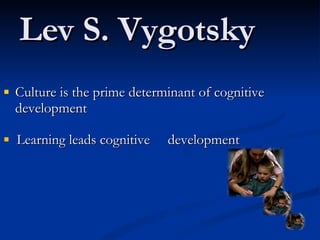
Lev S. Vygotsky Culture is the prime determinant of cognitive development Learning leads cognitive  development
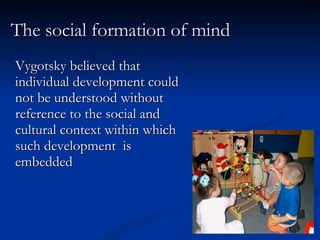
The social formation of mind Vygotsky believed that individual development could not be understood without reference to the social and cultural context within which such development  is embedded
Mind evolution is continuous Unlike Piaget or Bruner, Vygotsky focused on the mechanism of the development, excluding  distinguishable developmental stages
Vygotsky’s theoretical assumptions He rejected the idea that a single abstract principle, such as equilibration, can explain cognitive development
He offered an alternative to Piaget’s constructivism Piaget: Mind models the external world Human beings make sense of their world by  means of their mental structures Vygotsky: External world models the mind Knowledge is internalization of social activity
Mediation Mediation means that human beings purposefully interpose tools between them and their environment, in order to modify it and obtain certain benefits. Example: farmers plough the earth to acquire better crops.
He states that by using activity mediators, the human being is able to modify the environment, and this is her way of interacting with the nature Mediation is a  central concept in Vygotsky’s view of cognitive development.  It offers a complementary perspective to the behaviourist view.
Mediation   Two phenomena marked the mediated relationship of humans with their environment: The use of tools within social organized activity The use of language as a cultural form of mediation
Mediation     intelligence     higher mental processes How people convert social relations into psychological functions? They use different types of language (signs) as mediators between their minds and their  environment
Higher mental processes: symbolic mediation  When a child tries to grasp an object, and parents interpret this gesture as a pointing out to the object, they give her the object. She internalizes the gesture as a way of acquiring the object. After repeating this behaviour with other objects, the mental representation of this behaviour becomes more abstract. An interpersonal relation between child and parents becomes intrapersonal (child’s representation of  acquiring objects).
Decontextualization   development. It  appears as the detachment from the individual features of the environment . An example is when children start to play with abstract objects.  The use of abstract language is the most important  sign-mediated behaviour that occurs during cognitive
Mediation     intelligence     higher mental processes During humankind’s evolution, more complex structures of activity mediated by more complex tools produce more complex mental structures.  Psychological tools enable us to perform higher mental functions: various systems for counting mnemonic techniques algebraic symbol systems works of art writing schemes, diagrams, maps, and technical drawings all sorts of conventional signs
Zone of proximal development (ZDP) It represents one of the most obvious difference between Vygotsky’s and Piaget’s view of cognitive development
Zone of proximal development (ZPD)    This is the vygotskian concept that explains the mechanism of cognitive development  ZPD is actually the gap between actual competence level (what problem level a student is able to independently solve), and the potential development  level (what problem level could she solve with guidance from a tutor) ZPD is based on the mental functions that have not yet matured but are being in the process of maturation.
Zone of proximal development
Zone of proximal development (ZDP) It supports a representation of intellectual development based on continuity. It states that learning can force cognitive development It states the role of the teacher as a necessary mediator of child’s cognitive development.
Learning, instruction and development in Vygotsky’s view The only good type of instruction is that which leads the cognitive development.    The only good learning is that which is in advance of the development. Learning that is situated within the current developmental level is not desirable .  How could we understand the statement that some learning doesn’t bring development?
Scaffolding  Cognitive development in the zone of proximal development stresses the role of a social partner of the student (a teacher or a more skilled peer).
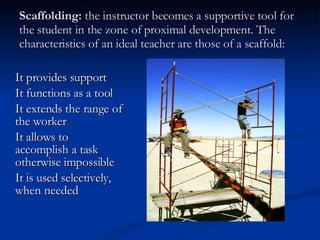
Scaffolding:  the instructor becomes a supportive tool for the student in the zone of proximal development. The characteristics of an ideal teacher are those of a scaffold: It provides support It functions as a tool It extends the range of the worker It allows to accomplish a task otherwise impossible It is used selectively, when needed
Scaffolding  In Vygotsky’s view, learning is an interactive, interpersonal activity: Instructor and student  co-construct the solution to problem Inequality between partners resides only in their respective levels of understanding. Authority is shared The psychological mechanism is to create (external) activities that will be later internalized by student
Scaffolding  example:  Palincsar’s reciprocal learning (an instructional strategy for improving reading comprehension). Intersubjectivity comes together with scaffolding.
References Cognitive development theories http://education.indiana.edu/~p540/webcourse/develop.html   Vygotsky Internet archive http://www.marxists.org/archive/vygotsky/  Theories in psychology. Vygotsky http://www.psy.pdx.edu/PsiCafe/KeyTheorists/Vygotsky.htm  Vygotsky and language acquisition http://www.sk.com.br/sk-vygot.html   Zone of proximal development. Four stages http://www.ncrel.org/sdrs/areas/issues/students/learning/lr1zpd.htm  Situating the Zone of Proximal Development  http://www.westga.edu/~distance/ojdla/summer82/marsh82.htm  Animation scafolding http://www.coe.uga.edu/epltt/vygotskyconstructionism.htm  These are not animations, but are good examples for iconic representations of scientific concepts (Bruner) http://auc.uow.edu.au/conf/Conf96/Papers/McNaught.html  Animation: Nerve Synapse (the same, Bruner)  http://camel2.conncoll.edu/academics/zoology/courses/zoo202/Nervous/synapse.html Making sentences http://www.cs.fsu.edu/~jtbauer/sentence.html