NADAR SARASWATHI COLLEGE OF ARTS&SCIENCE,THENI
DEPARTMENT OF COMPUTER SCIENCE&INFORMATION
TECHNOLOGY
V.VANMATHY
I-MSC(CS)
topic: intruder
INTRUDERS
 Any set of actions that attempt to compromise
the confidentiality, integrity, or availability of a
computer resource
 One of the most publicized attack to security is
the intruder, generally referred to a hacker or
cracker.
There classes of intruder are as follows:
 Masquerader
 Misfeasor
 Clandestine user
INTRUSION DETECTION
SYSTEM (IDS)
INTRUSION DELECTION
SYSTEM(IDS)
Intrusion detection I the process of identifying and
responding to malicious activity targeted at
resources
IDS is a system designed to test/analyze network
system traffic/events against a give set of
parameters and alert/capture data when these
IDS uses collected information and predefined
knowledge-based System reason about the
possibility of an intrusion.
IDS also provides services to cop with intrusion
such as giving alarms, activating programs to try
to deal with intrusion,etc.
FUNCTION OF IDS
ļ‚— An IDS detects attacks as soon as possible and
takes appropriate action.
ļ‚— An ID dose not usually take preventive measures
when an attack is detected
ļ‚— It is a reactive rather than a pro-active agent
ļ‚— It plays a role of informant rather than a police
officer.
PRINICIPLES OF INTRUCTION DETECTION
SYSTEM
ļ‚— An IDS must run unattended for extended periods
of time
ļ‚— The IDS must stay active and secure
ļ‚— The IDS must be also to recognize unusual
activity
ļ‚— The IDS must operate without unduly affecting
the system’s activity
ļ‚— The IDS must be configurable
PRINCIPLES OF INTRUION DETECTION
SYSTEMS
COMPONENTS OF IDS
 Basically there are three components or modules
in an intrusion detection system:
 Sensor: responsible for capturing packets and
sending to the console class.
 Console: responsible for analyzing packets
captured by enor class.
 Its is the class responsible for displaying GUI and
generating alerts
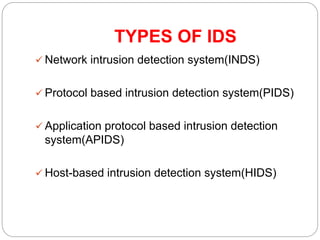
TYPES OF IDS
 Network intrusion detection system(INDS)
 Protocol based intrusion detection system(PIDS)
 Application protocol based intrusion detection
system(APIDS)
 Host-based intrusion detection system(HIDS)
VIRUSES AND RELATED
THREATS
 Perhaps the most sophisticated types of threats
to computer systems are presented by program
that exploit vulnerabilities in computing systems.
 Malicious programs
Viruses
 Virus-vital information resources under seize
 A virus is a malware program that, when
executed, replicates by inserting copies of itself
into other computer programs, data files, or the
boot sector of the hard drive
Virus phases:
Dormant-waiting on trigger event
Propagation –replicating to programs/disks
Triggering-by event to execute payload
Execution- of payload
TYPES OF VIRUSES
VIRUS
COUNTERMEASURES
Viral attacks exploit lack of integrity control on
systems to defend need to add such controls
Typically by one or more of:
 Prevention-block virus infection mechanism
 Detection-of viruses in infected system
 Reaction – restoring system to clean state
VIRUS REMOVAL TECHIQUE
FIREWALL DESIGN
PRINCIPLES
 Information system undergo a steady evolution
(from small LAN’s to internet connectivity).
 Strong security features for all workstations and
servers not established.
 Effective means of protection a local system or
network of system from network _ based security
threats while affording access to the outside world
via WAN’s or the internet.
TYPES OF FIREWALLS
ļ‚— Three common types of firewalls:
ļ‚— Packet-filtering-router.
ļ‚— Application-level-gateways.
ļ‚— Circuit-level-gateways.
ļ‚— Bastion host
TRUSTED SYSTEM
 A trusted system can protect malicious attacks
from future bugs or viruses.
 The code of a trusted system I passed through
rigorous analysis and development
 A trusted system and an untrusted system can
share a similar foundation
TRUSTED SYSTEM MODEL
vanmathy cryptography network security