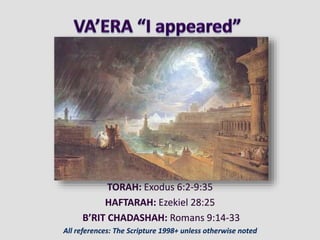
TORAH: Exodus 6:2-9:35
HAFTARAH: Ezekiel 28:25
B’RIT CHADASHAH: Romans 9:14-33
All references: The Scripture 1998+ unless otherwise noted
And Mosheh returned to ‫יהוה‬ and said, “‫,יהוה‬ why have You done evil
to this people? Why did You send me? “For ever since I came to
Pharaoh to speak in Your Name, he has done evil to this people. And
You have not delivered Your people at all.” (Exodus 5:22-23)
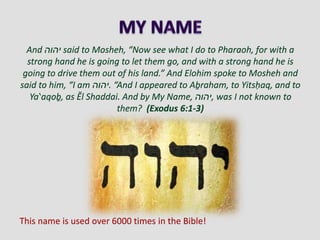
And ‫יהוה‬ said to Mosheh, “Now see what I do to Pharaoh, for with a
strong hand he is going to let them go, and with a strong hand he is
going to drive them out of his land.” And Elohim spoke to Mosheh and
said to him, “I am ‫.יהוה‬ “And I appeared to Aḇraham, to Yitsḥaq, and to
Yaʽaqoḇ, as Ěl Shaddai. And by My Name, ‫,יהוה‬ was I not known to
them? (Exodus 6:1-3)
This name is used over 6000 times in the Bible!
And Elohim spoke to Mosheh and said to him, “I am ‫.יהוה‬
(Exodus 6:2).
“Va‟era el Avraham el Yitzaq va‟el Ya‟aqob b‟ El Shaddai
va‟shemee YHVH le‟ah n‟adahtee la‟hem.”
“And I appeared to Avraham, to Yitzaq, and to Ya‟aqob, as El
Shaddai. And by My Name, YHVH, was I not known to them?”
“And I appeared to Aḇraham, to Yitsḥaq, and to
Yaʽaqoḇ, as Ěl Shaddai. And by My Name, ‫,יהוה‬ was I
not known to them? (Exodus 6:3)
• And He said to him, “I am ‫,יהוה‬ who brought you out of Ur of
the Chaldeans, to give you this land to inherit it.” (Genesis
15:7)
• And see, ‫יהוה‬ stood above it and said, “I am ‫יהוה‬ Elohim of
Aḇraham your father and the Elohim of Yitsḥaq. The land on
which you are lying, I give it to you and your seed. (Genesis
28:13)
6
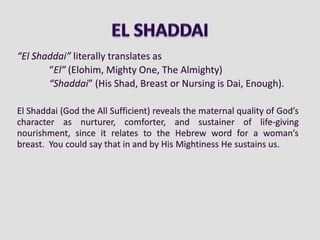
“El Shaddai” literally translates as
“El” (Elohim, Mighty One, The Almighty)
“Shaddai” (His Shad, Breast or Nursing is Dai, Enough).
El Shaddai (God the All Sufficient) reveals the maternal quality of God’s
character as nurturer, comforter, and sustainer of life-giving
nourishment, since it relates to the Hebrew word for a woman’s
breast. You could say that in and by His Mightiness He sustains us.
• .. ‫יהוה‬ appeared to Aḇram and said to him, “I am Ěl Shaddai –
walk before Me and be perfect. “And I give My covenant
between Me and you, and shall greatly increase you.”
(Genesis 17:1-2)
• To Jacob: And Elohim said to him, “I am Ěl Shaddai. Bear fruit
and increase, a nation and a company of nations shall be from
you, and sovereigns come from your body. (Genesis 35:11)
“And I also established My covenant with them, to give them the
land of Kenaʽan, the land of their sojournings, in which they have
sojourned. (Exodus 6:4)
And afterwards Mosheh and Aharon went in and said to
Pharaoh, “Thus said ‫יהוה‬ Elohim of Yisra’ĕl, ‘Let My people go, so
that they keep a festival to Me in the wilderness.’ ” And Pharaoh
said, “Who is ‫,יהוה‬ that I should obey His voice to let Yisra’ĕl go? I
do not know ‫,יהוה‬ nor am I going to let Yisra’ĕl go.”
(Exodus 5:1-2)
The Lord God of your fathers, the God of Abraham, the God of
Isaac, and the God of Jacob, hath sent me unto you: this is my
name for ever, and this is my memorial unto all generations.
(Exo 3:15)
‫יהוה‬ denotes His characteristics of “chesed” (loving-kindness)
and “rachamim” (mercies).
‫יהוה‬ will answer Moses dilemma with a speech that is awesome in its
literary structure.
Here are some of the extraordinary details of the Hebrew text:
• The first and second halves of the speech each contain exactly 50
Hebrew words
• (B) and (B1) are about the patriarchs
• (C) and (C1) are about the land
• (D) and (D1) are about Egypt and slavery
• The first half is about the past, the second half is about the future
• The first half refers to the Israelites in the third person (them)
• The second half refers to the Israelites in the second person (you)
• I am ‫–יהוה‬ Beginning, centre, and the end of the speech
A:“I am ‫.יהוה‬ (6:2)
B: appeared to Aḇraham, to Yitsḥaq, and to Yaʽaqoḇ, as Ěl Shaddai. And by
My Name, ‫,יהוה‬ was I not known to them? (6:3)
C: And I also established My covenant with them, to give them the land
of Kenaʽan, in which they have sojourned. (6:4)
D: And I have also heard the groaning of Yisra’ĕl whom the
Mitsrites are enslaving, and I have remembered My covenant. (6:5)
E: Therefore, to the children of Yisra’ĕl, ‘I am ‫,יהוה‬ (6:6)
D1: and I shall bring you out from under the burdens of the
Mitsrites, and shall deliver you from their enslaving, and shall
redeem you with an outstretched arm, and with great judgments,
and shall take you as My people, and I shall be your Elohim. And
you shall know that I am ‫יהוה‬ your Elohim who is bringing you out
from under the burdens of the Mitsrites. (6:6-7)
C1: ‘And I shall bring you into the land which I swore to give (6:8)
B1: to Aḇraham, to Yitsḥaq, and to Yaʽaqoḇ, to give it to you as an
inheritance.
A1: I am ‫’.יהוה‬ ” (6:8)
"Therefore, say to the people of Isra'el: 'I am Adonai. I will free you from
the forced labor of the Egyptians, rescue you from their oppression, and
redeem you with an outstretched arm and with great judgments. I will take
you as my people, and I will be your God. Then you will know that I am
Adonai your God, who freed you from the forced labor of the Egyptians. I
will bring you into the land which I swore to give to Avraham, Yitz'chak and
Ya`akov — I will give it to you as your inheritance. I am Adonai.' " (Exodus
6:6-8 CJB)
The first four “I wills” of Exodus 6:6–7 are central to the Passover (Pesach)
Seder. The four cups in the Passover Seder represent the four I wills that
‫יהוה‬ declares over Israel:
1. “I will bring you out” is represented in the Cup of Sanctification
2. “I will rid you out of their bondage” is represented in the Cup of
Deliverance
3. “I will redeem you” is represented in the Cup of Redemption
4. “I will take you to me” is represented in the Cup of Praise or
Completion. This last cup is marriage language. He is taking Israel to
be his bride.
1. The exchange of one thing (money or blood) for something else (the
sins of Israel) must occur. This is expressed in the phrase, “I will
redeem you.” Through the shed blood of the Passover lamb, ‫יהוה‬
redeemed Israel from the power and penalty of sin, which is death
(Ezek 18:4; Rom 6:23, 1 Peter 1:18-19)
2. Redemption involves the use of power to extricate that which is being
redeemed (in this case, Israel) from that which is holding it captive or
enslaved (i.e., the world, sin and the devil as pictured by Pharaoh and
Egypt). This is expressed in the phrase, “with an outstretched
arm.” Deut 26:8; Jer 21:5; 27:5 (Eph 1:19)
3. Redemption involves judgment upon and or destruction of the captor.
This is expressed in the phrase, “and with great judgments.”
The Renewed Covenant has “I wills” from ‫יהוה‬ as well:
“See, the days are coming,” declares ‫,יהוה‬ “when I shall make a new
covenant with the house of Yisra’ĕl and with the house of Yehuḏah, not
like the covenant I made with their fathers in the day when I took them
by the hand to bring them out of the land of Mitsrayim, My covenant
which they broke, though I was a husband to them,” declares ‫.יהוה‬
“For this is the covenant I shall make with the house of Yisra’ĕl after
those days, declares ‫:יהוה‬ I shall put My Torah in their inward parts,
and write it on their hearts. And I shall be their Elohim, and they shall
be My people. “And no longer shall they teach, each one his neighbour,
and each one his brother, saying, ‘Know ‫’,יהוה‬ for they shall all know
Me, from the least of them to the greatest of them,” declares ‫.יהוה‬
“For I shall forgive their crookedness, and remember their sin no more.”
(Jeremiah 31:31-34)
“As in the days when you came out of the land of Mitsrayim, I
shall let him see wonders.” (Micah 7:15)
And Mosheh spoke thus to the children of Yisra’ĕl, but they did not
listen to Mosheh, because of shortness of spirit, and from hard
slavery. (Exodus 6:9)
1. Because of “kotzer” (Strong’s #7115) meaning “impatient”, from the
root word katsar which means “to shorten”. The word used for
“spirit” here is “Ruach” (Strong’s #7307) meaning “spirit” or
“breath”.
2. “hard bondage”. The Hebrew word translated here as “hard” is
“kasheh” (Strong’s #7186) meaning “hard” or “stiff-necked”.
Describing the Children of Israel in Exodus 32:9, 33:3, 33:5, 34:9,
Deuteronomy 9:6, 9:13, 31:27 and Judges 2:19. The word “slavery”
“abodah” (Strong’s #5656) meaning “work”, “labour” or “service”.
Exodus 6:9 DHV “And Moshe spoke these words to the Children
of Yisra’el, but they did not “hear and obey‟ Moshe, because
they were ”impatient‟ of “spirit‟ and “stiff-necked‟ in their
“service‟.”
These are the names of the sons of Lĕwi according to their generations:
Gĕreshon, and Qehath, and Merari. And the years of the life of Lĕwi
were one hundred and thirty-seven. ..And Amram took for himself
Yoḵeḇeḏ, his father’s sister, as wife. And she bore him Aharon and
Mosheh. And the years of the life of Amram were one hundred and
thirty-seven. (Exodus 6:16-20)
Levi (Strong’s #3878) means “joined to” as in “at the heart”. His sons
Gereshon (#1648), meaning “exile”, Qehath (#6955) meaning
“assembly” and Merari (#4847) meaning “bitter herbs”.
Levi lived 137 years. The gematria of Levi’s lifespan matches that of the
word “matseva” which means “monument”.
Levi (137 years), his tribe is to be a monument for us and for all time.
That he is “joined in heart” to the “exiled assembly” and eats the
“bitter herbs” of our slavery with us. Here we see a picture of Levi’s
destiny to teach Ephraim in these last days.
The sons of Gereshon (sons of exile):
• “Libni” (#3845) meaning “white”.
• “Shim‟i” (8096) meaning “renown” or “known”, from “sh‟ma”
meaning “hear and obey”.
The sons of Qehath (the assembly) who lived 133 years;
• “Amram” (#6019) meaning “exalted people”,
• “Yitshar” (#3323 & 3324) meaning “shining oil” or “anointed”,
• “Hebron” (2275) meaning “joining” or “conjunction” and
• “Uzzi‟el” (#5816) meaning “my strength is Elohim”. ..
The numeric value of 133 matches the letters “Nun-Gimmel-Lamed”
which, depending on how they are arranged mean “to stumble” or “to
smite”, “to hide” and “to come out” or “sprout”.
The sons of Merari (bitter herbs), which are;
• “Mahli” (#4249) meaning “sick” and
• “Mushi” (#4187) meaning “yielding” as in “tested and surrendered”
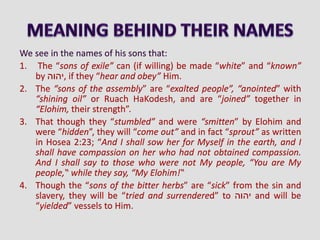
We see in the names of his sons that:
1. The “sons of exile” can (if willing) be made “white” and “known”
by ‫,יהוה‬ if they “hear and obey” Him.
2. The “sons of the assembly” are “exalted people”, “anointed” with
“shining oil” or Ruach HaKodesh, and are “joined” together in
“Elohim, their strength”.
3. That though they “stumbled” and were “smitten” by Elohim and
were “hidden”, they will “come out” and in fact “sprout” as written
in Hosea 2:23; “And I shall sow her for Myself in the earth, and I
shall have compassion on her who had not obtained compassion.
And I shall say to those who were not My people, “You are My
people,‟ while they say, “My Elohim!‟
4. Though the “sons of the bitter herbs” are “sick” from the sin and
slavery, they will be “tried and surrendered” to ‫יהוה‬ and will be
“yielded” vessels to Him.
21
And Mosheh said before ‫,יהוה‬ “See, I am of uncircumcised lips, and
why would Pharaoh listen to me?” (Exodus 6:30)
1. “arel” means “uncircumcised” or “one who stammers as with a
foreskin over his lips” or
2. “one who has a foreskin on his ears and cannot receive divine
instruction”. This is where the phrase “uncircumcised heart” also
comes from. Now, “saphah” means “speech” or “lip”, as in the
“lip”, “rim” or “border” of a vessel.
‫’יהושע‬s words in Matthew: And calling the crowd near, He said to
them, “Hear and understand: “Not that which goes into the mouth
defiles the man, but that which comes out of the mouth, this defiles the
man.” (Matthew 15:10-11)
So ‫יהוה‬ said to Mosheh, “See, I have made you an elohim to
Pharaoh, and Aharon your brother is your prophet. (Exodus 7:1)
And ‫יהוה‬ spoke to Mosheh and to Aharon, saying, “When
Pharaoh speaks to you, saying, ‘Show a miracle for yourselves,’ ..
In the story of Joseph and the dreams of Pharaoh, it was the magicians
who first attempted to interpret Pharaoh’s dreams. There are a lot of
similarities between the two events. The Hebrew has the advantage
over the Egyptian magicians
• Something is swallowed
 Sheaves and cows in Pharaoh’s dreams
 A staff in Aaron’s case
• The situation comes about as a result of Pharaoh’s fears
 The Pharaoh is anxious about his dreams: And it came to be in
the morning that his spirit was moved, and he sent and called for
all the magicians of Mitsrayim and all its wise men. And Pharaoh
related to them his dreams, but there was no one who could
interpret them for Pharaoh. (Genesis 41:8)
 The Pharaoh is worried about the Israelites: and he said to his
people, “See, the people of the children of Yisra’ĕl are more and
stronger than we, ..shall be when fighting befalls us, that they
shall join our enemies and fight against us, and shall go up out of
the land.” (Exodus 1:9-10)
As for these four young men, Elohim gave them knowledge and
skill in all learning and wisdom. And Dani’ĕl had understanding in
all visions and dreams. … And in any word of wisdom and
understanding about which the sovereign examined them, he
found them ten times better than all the magicians, the
astrologers, who were in all his reign. (Daniel 1:17-20)
“And in the days of these sovereigns the Elah of the heavens shall
set up a reign which shall never be destroyed, nor the reign pass
on to other people – it crushes and puts to an end all these
reigns, and it shall stand forever. (Daniel 2:44)
And the great dragon was thrown out, that serpent of old, called
the Devil and Satan, who leads all the world astray. He was
thrown to the earth, and his messengers were thrown out with
him. (Revelation 12:9)
And he seized the dragon, the serpent of old, who is the Devil
and Satan, and bound him for a thousand years, (Revelation
20:2)
• The sign of the rod – that they would come alive and “swallow up”
Egypt! (Egypt is called “tanniyn” (serpent and crocodile) in Isaiah
51:9, Ezra 29:3 and Ezra 32:2.)
• The sign of the leprous hand – their Elohim could heal any disease
• The sign of the Nile turning to blood – the Nile, also seen as a god,
was the life of Egypt. When it turned to blood, the Egyptians would
have seen it as the death of a god.
So Mosheh and Aharon went in to Pharaoh, and they did so, as
‫יהוה‬ commanded. And Aharon threw his rod before Pharaoh and
before his servants, and it became a serpent. But Pharaoh also
called the wise men and the practisers of witchcraft. And they,
the magicians of Mitsrayim, also did so with their magic. And
they, each one, threw down his rod, and they became serpents.
But the rod of Aharon swallowed up their rods. (Exodus 7:10-12)
“serpent” - “tanniyn”, (Strong’s #8577) used in verses 9, 10 and
12. Tanniyn is translated as “serpent” or “crocodile”.
In verse 15 “nachash” - literally means “shining one” because it
resembles burnished metal. “Nachash” is the root word in
“nekhoshet” (bronze or copper).
And Pharaoh’s heart was hardened, and he did not listen to
them, as ‫יהוה‬ had said. ..” And ‫יהוה‬ spoke to Mosheh, “Say to
Aharon, ‘Take your rod and stretch out your hand over the
waters of Mitsrayim, over their streams, over their rivers, over
their ponds, and over all their pools of water, that they become
blood. And there shall be blood in all the land of Mitsrayim, both
in wooden and in stone containers.’ ..(Exodus 7:13-25)
.. I am smiting all your border with frogs. “And the river shall
swarm with frogs, which shall go up and shall come into your
house, and into your bedroom, and on your bed, and into the
houses of your servants, .. and the frogs shall come up on you
and on your people and on all your servants.” ’ ..(Exodus 8:2-5)
Revelation 16:13-14: And I saw coming out of the mouth of the
dragon, and out of the mouth of the beast, and out of the mouth
of the false prophet, three unclean spirits, as frogs, for they are
spirits of demons, doing signs, which go out to the sovereigns of
the entire world, to gather them to the battle of that great day
of ‫יהוה‬ the Almighty.
..‘Stretch out your rod, and strike the dust of the land, so that it becomes gnats
in all the land of Mitsrayim.’ ” And they did so, and Aharon stretched out his
hand with his rod and struck the dust of the earth, and it became gnats on
man and beast. ..The magicians then said to Pharaoh, “This is the finger of
Elohim!” But the heart of Pharaoh was hardened, and he did not listen to
them, as ‫יהוה‬ had said. (Exodus 8:16-19)
The Children of Israel went through the first three plagues along with
the Egyptians. ‫יהוה‬ was showing Israel that the “Blood” was also
important to them. The pictures they saw and experienced in the
plagues of the frogs (evil spirits) and the stinging gnats were to show
them that if they did not accept His gift of salvation and deliverance,
their judgment and punishment would be as that of the nations.
NOTE:
Pharaoh’s magicians could not duplicate this plague of gnats, or lice.
They declared this to be the “Finger of Elohim”.
With that “Finger” ‫יהוה‬ wrote the two “tablets of the Testimony” in
stone and as ‫יהושע‬ said in “But if I cast out demons by the finger of
Elohim, then the reign of Elohim has come upon you. (Luke 11:20)
.. “Let My people go, so that they serve Me. .. I am sending
swarms of flies on you and your servants, ..“And I shall put a
distinction between My people and your people. Tomorrow this
sign shall be.” ’ .. the land was ruined because of the swarms of
flies. (Exodus 8:20-24)
..“Let My people go, so that they serve Me.. the hand of ‫יהוה‬ is
on your livestock in the field, on the horses, on the donkeys, on
the camels, on the cattle, and on the sheep – a very grievous
pestilence. ..And ‫יהוה‬ did this word on the next day, and all the
livestock of Mitsrayim died, but of the livestock of the children of
Yisra’ĕl, not one died. (Exodus 9:1-6)
And ‫יהוה‬ said to Mosheh and Aharon, “Fill your hands with ashes
from a furnace and let Mosheh scatter it toward the heavens
before the eyes of Pharaoh. “And it shall become fine dust in all
the land of Mitsrayim, and it shall cause boils that break out in
sores on man and beast in all the land of Mitsrayim.” ..(Exodus
9:8-12)
And ‫יהוה‬ said to Mosheh, .. for at this time I am sending all My
plagues unto your heart, and on your servants and on your
people, so that you know that there is no one like Me in all the
earth. “Now if I had stretched out My hand and struck you and
your people with pestilence, then you would have been cut off
from the earth. “And for this reason I have raised you up, in order
to show you My power, and in order to declare My Name in all
the earth. (Exodus 9:13-16)
“See, tomorrow about this time I am causing very heavy hail to
rain down, such as has not been in Mitsrayim, from the day of its
founding until now. “And now send, bring your livestock to safety,
and all that you have in the field, for the hail shall come down on
every man and every beast which is found in the field and is not
brought home, and they shall die.” ’ ..... (Exodus 9:18-33)
There was a divine order to how this would happen. We will see that
the first nine plagues are divided into three groups of three. The first
plague in each group describes a time “in the morning” (baboker)
when Moses should “stand” (yatzav) before Pharaoh with his warning:
• Plague One (blood) - “Go to Pharaoh in the morning, .. you shall
stand by the river’s bank to meet him. ... (Exodus 7:15)
• Plague Four (gnats) - And ‫יהוה‬ said to Mosheh, “Rise early in the
morning and stand before Pharaoh as he comes out to the water, ...
(Exodus 8:20)
• Plague Seven (hail) - And ‫יהוה‬ said to Mosheh, “Rise early in the
morning and stand before Pharaoh, .. (Exodus 9:13)
The goal of the first set of three plagues – Prove that He is ‫יהוה‬
‘Thus said ‫,יהוה‬ “By this you know that I am ‫.יהוה‬ ..(Exodus 7:17)
In the second plague of each of the three sets, there is no mention of
when (in the morning) or of “standing” before Pharaoh. Instead, we
see a different set of common phrases:
• Plague Two (frogs) - And ‫יהוה‬ spoke to Mosheh, “Go to Pharaoh and
say to him, ... if you refuse to let them go, see, I am smiting all your
border with frogs. (Exodus 8:1-2)
• Plague Five (cattle) And ‫יהוה‬ said to Mosheh, “Go in to Pharaoh and
speak to him, ....if you refuse to let them go, and still hold them, see,
the hand of ‫יהוה‬ is on your livestock in the field, on the horses, on the
donkeys, on the camels, on the cattle, and on the sheep – a very
grievous pestilence. (Exodus 9:1-3)
• Plague Eight (locusts) - And ‫יהוה‬ said to Mosheh, “Go in to Pharaoh,
.....if you refuse to let My people go, see, tomorrow I am bringing
locusts within your borders. (Exodus 10:1-4)
Each of the third plagues in the three sets occurs without any prior
warning:
• Plague Three (lice): And ‫יהוה‬ said to Mosheh, “Say to Aharon,
‘Stretch out your rod, and strike the dust of the land, so that it
becomes gnats in all the land of Mitsrayim.’ ” (Exodus 8:16)
• Plague Six (boils): And ‫יהוה‬ said to Mosheh and Aharon, “Fill your
hands with ashes from a furnace and let Mosheh scatter it toward
the heavens before the eyes of Pharaoh. “And it shall become fine
dust in all the land of Mitsrayim, and it shall cause boils that break
out in sores on man and beast in all the land of Mitsrayim.” (Exodus
9:8-9)
• Plague Nine (darkness); And ‫יהוה‬ said to Mosheh, “Stretch out your
hand toward the heavens, and let there be darkness over the land of
Mitsrayim, even a darkness which is felt.” (Exodus 10:21)
1. FIRST PLAGUE
WATERS to BLOOD
EXODUS 7:15-17
1. FOURTH
PLAGUE of FLIES
EXODUS 8:20-22
7. SEVENTH
PESTILENCE OF HAIL
EXODUS 9:13-15
2. SECOND PLAGUE
FROGS
EXODUS 8:1-4
2. FIFTH PLAGUE
MURRAIN
EXODUS 9:1-4
2. EIGHTH PLAGUE
LOCUSTS
EXODUS 10:1-4
3. THIRD PLAGUE
DUST INTO LICE
EXODUS 8:16-18
3. SIXTH PLAGUE
BOILS
EXODUS 9:8-10
3. NINTH PLAGUE
DARKNESS TO BE FELT
EXODUS 10:21-23
EARLY IN THE MORNING
GO TO PHARAOH
NO WARNING GIVEN
1.WHO IS THE LORD? (CHALLENGING GOD'S EXISTENCE)
2.WHY SHOULD I OBEY HIM? (CHALLENGING GOD CONCERNS HIMSELF THE WORLD)
3.WHY LET ISRAEL GO? (CHALLENGING GOD'S ABILITY TO STOP HIM)
I BRING OUT THE
CHILDREN OF ISRAEL
EXODUS 7:5
I PUT DIVISION BETWEEN
MY PEOPLE AND YOUR
PEOPLE EXODUS 8:22,23
YOU SHALL BE CUTOFF
FROM THE EARTH
EXODUS 9:15
AND ALL OF EGYPT WILL KNOW WHEN . . .
NO DEATHS DEATH OF ANIMALS DEATH OF MEN & BEASTS
WARNING GIVEN EXO 4:22/11:4
1O. TENTH PLAGUE
DEATH OF ALL FIRSTBORN
EXODUS 11:4-7
THAT ISRAEL MAY KNOW
HOW THE LORD PUTS A
DIFFERENCE BETWEEN THE
EGYPTIANS AND ISRAEL
each group brings the Egyptians one step closer in coming to know the
Hebrew’s Elohim.
1. The aim of the first group of plagues – “in order that you will know
that I am ‫”יהוה‬ has been achieved. It should be added that it was
specifically the Egyptians who first needed to be taught about the
existence of a transcendental Divine Cause, for – as opposed to
other ancient Middle Eastern religions.
2. The second group is meant to prove that not only does ‫יהוה‬ exist,
but He is involved in “the land” – in worldly, human affairs, and
that He watches over those who fear Him. How can ‫’יהוה‬s
involvement in “the midst of the land,” in worldly affairs, be
proven? This set of plagues highlights the distinction – as yet
unmentioned – between the Egyptians and the sons of Israel.
3. The third group of plagues gives special expression to the idea that
‫יהוה‬ is the only God, for His actions are without precedent in
anything that has ever happened in the world.
And Pharaoh saw that the rain, and the hail, and the thunder had
ceased, yet he sinned again and he hardened his heart, he and his
servants. And the heart of Pharaoh was hardened, and he did not let
the children of Yisra’ĕl go, as ‫יהוה‬ had said through Mosheh. (Exodus
9:34-35)
Altogether there are three different Hebrew verbs which our
translators have rendered by 'harden' or 'hardened' - ka bad, gashah,
and khazag.
• The first of these, which occurs in Exodus 7:14; 8:15, 32; 9:7 and 34,
is the weakest of the three, and means to be 'dull' or 'heavy', rather
than 'to be hard.'
• The second, which appears in Exodus 7:3 and 13:15, is the stronger
term, and means 'to be hard', or, in the Hiphil [a form of Hebrew
verbs], 'to make hard.‘
• The third has the most intensive sense, implying fixed and stubborn
resolution. It occurs in Exodus 4:21; 7:22; 8:19; 9:35; and
elsewhere.
We are in the 7000 year today. The 7000 year in scripture is
termed: today, “His rest, a Sabbath rest (Hebrews chapter 3-4 etc) the
day of the Lord and in that day”. In God’s plan for mankind the Age of
Law, the years 2000 to 4000, is when the great Hebrew Torah Sages
taught the Torah (God’s teaching and instruction) but did not
specifically teach the Messiah. In the Church Age, from the years 4000
to 6000, is when the early Church fathers taught ‫/יהושע‬Messiah and
the Holy Spirit but not the Torah (or the Law/Moses). According to the
Biblical Hebrew calendar the year is 5775/2014. There are
approximately 271 known missing years, which brings us to the year
6014. In Hebrew understanding, any years passed the 6000 are
counted as having entering into the 7000 year. Thus today, we are in
the end times, the Age of the Messiah, where Torah and Messiah join
together to become one in His people. Since Mount Sinai, there has
never been a time like this where the people of ‫,יהוה‬ who are
believers in Jesus the Messiah, desire to walk in Torah.
Ezekiel 44:23-24 “And they [teachers: rabbis and pastors] shall teach
My people the difference between the holy and the unholy, and cause
them to discern between the unclean and the clean. In controversy
they shall stand as judges, and judge it according to My judgments.
They shall keep My laws and My statutes in all My appointed meetings,
and they shall hallow My Sabbaths.”
Apostle Paul, exhorts us to choose: Do not become unevenly yoked
with unbelievers (a believer who is not faithful to, or dis-believes
Yahweh’s plan). For what partnership have righteousness (a believer
who is faithful to Yahweh) and lawlessness (a believer who chooses to
violate (by unbelief) God’s laws and teach against them)? And what
fellowship has light with darkness? And what agreement has Messiah
with Beliyaʽal (worthless or wicked)? Or what part does a believer have
with an unbeliever? And what union has the Dwelling Place of Elohim
with idols? For you are a Dwelling Place of the living Elohim, as Elohim
has said, “I shall dwell in them and walk among them, and I shall be
their Elohim, and they shall be My people.” (Paul quotes Leviticus
26:12; Jeremiah 32:38; Ezekiel 37:27.) Therefore, “Come out from
among them and be separate, says ‫,יהוה‬ and do not touch what is
unclean, and I shall receive you. (Paul quotes Isaiah 52:11; Ezekiel
20:34, 41.) “And I shall be a Father to you, and you shall be sons and
daughters to Me, says ‫יהוה‬ the Almighty.” (Paul quotes 2 Samuel 7:14.)
Having, then, these promises, beloved, let us cleanse ourselves from all
defilement of the flesh and spirit, perfecting set-apartness in the fear of
Elohim. (2 Corinthians 6:14- 7:1)
“For as the new heavens and the new earth that I make stand
before Me,” declares ‫,יהוה‬ “so your seed and your name shall
stand. “And it shall be that from New Moon to New Moon, and
from Sabbath to Sabbath, all flesh shall come to worship before
Me,” declares ‫.יהוה‬ (Isaiah 66:22-23)
TORAH: Exodus 6:2-9:35
HAFTARAH: Ezekiel 28:25
B’RIT CHADASHAH: Romans 9:14-33
51