Using the Set Operators
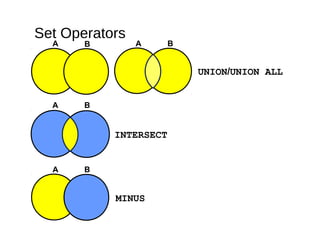
Set Operators
UNION/UNION ALL
A B A B
A B
INTERSECT
A B
MINUS
Tables Used in This Lesson
• The tables used in this lesson are:
• EMPLOYEES: Provides details regarding all
current employees
• JOB_HISTORY: Records the details of the start date and end date of
the former job, and the job identification number and department
when an employee switches jobs
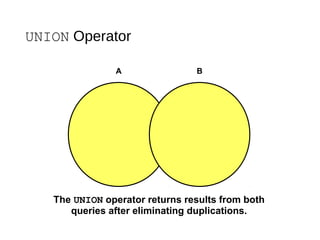
UNION Operator
A B
The UNION operator returns results from both
queries after eliminating duplications.
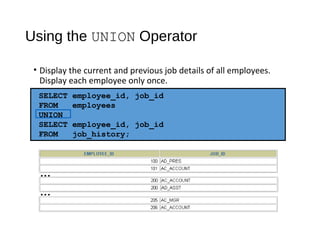
Using the UNION Operator
• Display the current and previous job details of all employees.
Display each employee only once.
SELECT employee_id, job_id
FROM employees
UNION
SELECT employee_id, job_id
FROM job_history;
…
…
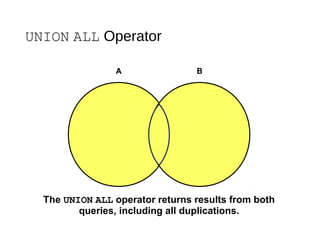
UNION ALL Operator
A B
The UNION ALL operator returns results from both
queries, including all duplications.
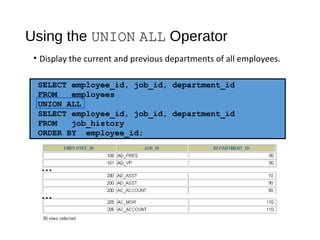
Using the UNION ALL Operator
• Display the current and previous departments of all employees.
SELECT employee_id, job_id, department_id
FROM employees
UNION ALL
SELECT employee_id, job_id, department_id
FROM job_history
ORDER BY employee_id;
…
…
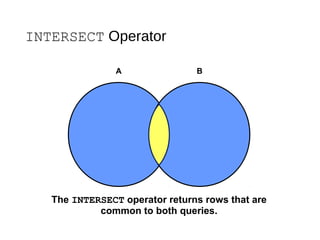
INTERSECT Operator
A B
The INTERSECT operator returns rows that are
common to both queries.
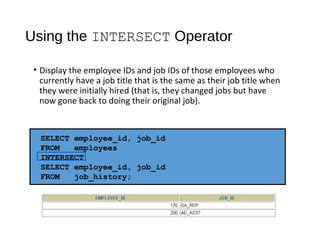
Using the INTERSECT Operator
• Display the employee IDs and job IDs of those employees who
currently have a job title that is the same as their job title when
they were initially hired (that is, they changed jobs but have
now gone back to doing their original job).
SELECT employee_id, job_id
FROM employees
INTERSECT
SELECT employee_id, job_id
FROM job_history;
MINUS Operator
A B
The MINUS operator returns rows in the first query
that are not present in the second query.
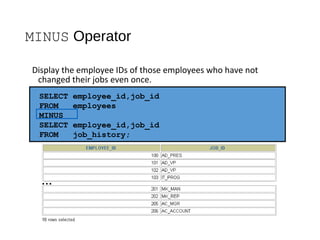
MINUS Operator
Display the employee IDs of those employees who have not
changed their jobs even once.
SELECT employee_id,job_id
FROM employees
MINUS
SELECT employee_id,job_id
FROM job_history;
…
Set Operator Guidelines
• The expressions in the SELECT lists must match in number and data
type.
• Parentheses can be used to alter the sequence of execution.
• The ORDER BY clause:
• Can appear only at the very end of the statement
• Will accept the column name, aliases from the first SELECT statement, or the
positional notation
The Oracle Server and Set Operators
• Duplicate rows are automatically eliminated except in UNION ALL.
• Column names from the first query appear in the result.
• The output is sorted in ascending order by default except in UNION
ALL.
Matching the SELECT Statements
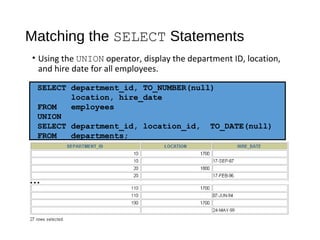
• Using the UNION operator, display the department ID, location,
and hire date for all employees.
SELECT department_id, TO_NUMBER(null)
location, hire_date
FROM employees
UNION
SELECT department_id, location_id, TO_DATE(null)
FROM departments;
…
Matching the SELECT Statement:
Example
• Using the UNION operator, display the employee ID, job ID, and
salary of all employees.
SELECT employee_id, job_id,salary
FROM employees
UNION
SELECT employee_id, job_id,0
FROM job_history;
…
Controlling the Order of Rows
• Produce an English sentence using two UNION operators.
COLUMN a_dummy NOPRINT
SELECT 'sing' AS "My dream", 3 a_dummy
FROM dual
UNION
SELECT 'I''d like to teach', 1 a_dummy
FROM dual
UNION
SELECT 'the world to', 2 a_dummy
FROM dual
ORDER BY a_dummy;