UNIT 2THE ECOSYSTEM
2.1 BIOTIC, ABIOTIC FACTORS, AND TROPHIC LEVELS
BIOTIC FACTORSBiotic factors are the living components that shape an ecosystem; any organism that affects another organism.Biotic components are:AnimalsPlantsBacteriaFungi
ABIOTIC FACTORSAbiotic factors are the non-living components of an ecosystem, affecting the life of organisms.Abiotic factors can be harmful to the ecosystem.Abiotic components are:Temperature, light, water, soil, rocks, and human influence.
WATERWater is one of nature’s most important things is life. Essential to life, an organism’s survival depends an water. Water is necessary for digestion and absorption of food; helps maintain proper muscle tone-, supplies oxygen and nutrients  to the cells; rids the body of water; and serves as a natural air conditioning system.
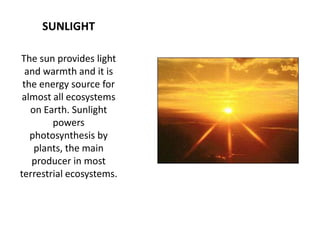
SUNLIGHTThe sun provides light and warmth and it is the energy source for almost all ecosystems on Earth. Sunlight powers photosynthesis by plants, the main producer in most terrestrial ecosystems.
TEMPERATUREMost life exists within a fairly narrow range of temperatures, from about  0 C to about 50 C. Few organisms can maintain an active metabolism below 0 C for long, and most organisms’ enzymes are denatured (they lose their shape and stop working) above 50 C. However, extraordinary adaptations  enable certain species  to live at extreme temperatures.
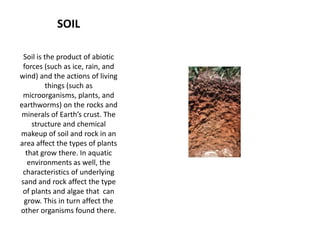
SOILSoil is the product of abiotic forces (such as ice, rain, and wind) and the actions of living things (such as microorganisms, plants, and earthworms) on the rocks and minerals of Earth’s crust. The structure and chemical makeup of soil and rock in an area affect the types of plants that grow there. In aquatic environments as well, the characteristics of underlying sand and rock affect the type of plants and algae that  can grow. This in turn affect the other organisms found there.
OXYGENOxygen is an important component of life. Most living things consume oxygen  in different forms and quantities. Most of the oxygen that is used in respiration is to obtain chemical energy from the fats and carbohydrates in our food.
WINDMany plants use the help of the wind to disperse seeds  over long distances. Organisms disperse to find new habitats rich in needed resources. Strong winds can be very destructive.
TROPHIC LEVELSThere are trophic levels within an ecosystem; these are the feeding positions that biotic components occupy on the food chain.The word trophic derives from the Greek trophe referring to food or feeding.A food chain represents a succession of organisms that eat another organism and are, in turn, eaten themselves.
TROPHIC LEVELSTrophic levels in a food chain are:Trophic level 1 – primary producersTrophic level 2 – herbivores or primary consumersTrophic level 3 – predators, carnivores which eat herbivores or secondary consumersTrophic level 4 – carnivores which eat other carnivores or tertiary consumersTrophic level 5 - apex predators which have no predators, at the top of the food chainThe path along the chain forms a one-way flow along which energy travels in the form of food.TROPHIC LEVELSProducers - (autotrophs) are typically plants or algae. Plants and algae do not usually eat other organisms, but pull nutrients from the soil or the water and manufacture their own food using photosynthesis. In this way, it is energy from the sun that usually powers the base of the food chain. An exception occurs in deep-sea hydrothermal ecosystems, where there is no sunlight. Here primary producers manufacture food through a process called chemosynthesis.
TROPHIC LEVELS2. Consumers - (heterotrophs) cannot manufacture their own food, and need to consume other organisms. They are usually animals. Animal that eat primary producers, such as plants, are called herbivores. Animals which eat other animals are called carnivores, and animals which eat both plant and other animals are called omnivores.
TROPHIC LEVELS3. Decomposers (detritivores) break down dead plant and animal material and wastes and release it again as energy and nutrients into the ecosystem for recycling. Decomposers, such as bacteria and fungi (mushrooms), feed on waste and dead matter, converting it into inorganic chemicals that can be recycled as mineral nutrients for plants to use again.
TROPHIC LEVELSIn real world ecosystems, there is more than one food chain for most organism, since most organisms eat more than one kind of food or are eaten by more than one type of predator. A diagram which sets out the intricate network of intersecting and overlapping food chains for an ecosystem is called its food web.
FIRST TROPHIC LEVELThe plants in this image, and the algae and phytoplankton in the lake, are primary producers. They take nutrients from the soil or the water, and manufacture their own food by photosynthesis, using energy from the sun.
SECOND TROPHIC LEVELRabbits eat plants at the first tropic level, so they are primary consumers.
THIRD TROPHIC LEVELFoxes eat rabbits at the second trophic level, so they are secondary consumers.
FOURTH TROPHIC LEVELGolden eagles eat foxes at the third trophic level, so they are tertiary consumers.
DECOMPOSERSThe fungi or the earthworms feed on dead matter, converting it back to nutrients that primary producers can use.
Desert
Taiga forest
Temperate forest
Trophic Levels