Transactional Workflow
By: Pranjal Bhumij
Contents:
• Introduction.
• The Conceptual Perspective.
• The Language Perspective.
The Workflow
• An orchestrated and repeated pattern of
activities.
Which enables a systematic organization of
resources and performs these following
actions with it:
1. Transform materials
2. Provide services
3. Process Information
The transaction management, already used for
several decades in the database world, have
been combined with workflow to satisfy these
requirements(clear process semantics and
robustness in process execution).
The Transaction
• To support transactional workflows, there are
two basic approaches: either transactional
aspects and workflow aspects are treated as
separate issues, or they are seen as one
integrated issue.
• In the former case, separate transaction and
workflow models exist that are combined to
obtain transactional workflows.
• In the latter case, one single transactional
workflow model is used.
• In the situation where we have separate
workflow and transaction models,
• we need to relate these two models. We have
three possible basic relations,
(PERSONAL)
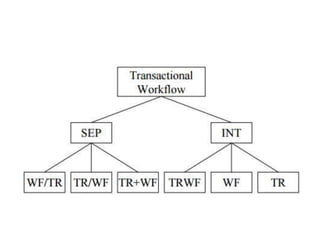
• Workflows over transactions (WF/TR): workflows are
more abstract than transactions, i.e., transaction
models are used to provide semantics to workflow
models.
• Transactions over workflows (TR/WF): transactions are
more abstract than workflows, i.e., workflow models
are used to provide process structure to transaction
models.
• Transactions and workflows as peers (TR+WF):
workflow and transaction models exist at the same
abstraction level, i.e., workflow and transaction models
can be seen as two sub-models of an implicit, loosely
coupled process model.
• Three main variants with respect to the
nature of the single model:
• Hybrid transactional workflow model (TRWF):
a single hybrid model is used that contains
both transaction and workflow concepts.
• Transactions in workflows (WF): A single
workflow model is used, in which transactional
aspects are mapped to workflow primitives.
• Workflows in transactions (TR): A single
transaction model is used, in which workflow
aspects are mapped to transaction primitives.
The language perspective
• In the conceptual point of view, we are interested in
the conceptual specification of transactional
workflows. For this specification, we use one or more
specification languages. Given the two main classes in
the taxonomy of Figure 1, we can have two situations:
• There is a separate language for specifying workflow
aspects, the workflow definition language (WFDL), and
a separate language for specifying transaction aspects,
the transaction definition language (TRDL). • There is
an integrated language for specifying both workflow
and transaction aspects, the transactional workflow
definition language (TRWFDL).
• If we have two languages, the languages can
have two relations: either one language is a
refinement of the other, or the two languages
are orthogonal with respect to another.
• If the TRDL is a refinement of the WFDL, the
WFDL level contains workflow attributes and
the intermediate states at the TRDL level are
related to transaction states. If the WFDL is a
refinement of the TRDL, the TRDL level
contains transactional attributes and the
intermediate states at the WFDL level are
related to control flow states.
• In the integrated approach, all aspects are
merged into a single language. This language
covers a state space that is the cross product
of the two state spaces discussed above
Advantages
• Ensure failure handling.
• Event Log.
• Control Flow Mining.
Conclusion
• Workflow
• Transaction
• Transaction Workflow
• The Conceptual Perspective
• The Language Perspective
• Advantages.