DOLAT RAM
15CRP25
 A database is a collection of information
that is organized so that it can be easily
accessed, managed and updated. Data
is organized into rows, columns and
tables, and it is indexed to make it
easier to find relevant information.
 A database is an organized collection of
data. It is the collection of schemas,
tables, queries, reports, views, and other
objects.
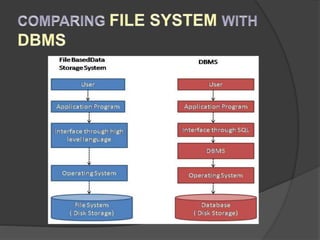
 A database management system (DBMS) is
system software for creating and managing
databases. The DBMS provides users and
programmers with a systematic way to create,
retrieve, update and manage data.
 The capture and analyzing of data is typically
performed by database management systems.
These types of database software systems are
programmed in SQL, and examples include
Microsoft SQL Server, MySQL, Oracle SAP
HANA and FoxPro.
 A database application is a computer
program whose primary purpose is
entering and retrieving information from
a computerized database. Early
examples of database applications were
accounting systems and airline
reservations systems.
 Database applications are software
programs designed to collect, manage
and disseminate information efficiently.
DATABASE APPLICATIONS
(cont…)
 Databases are used to hold administrative
information and more specialized data, such
as engineering data or economic models.
Examples of database applications include
computerized library systems, flight
reservation systems, computerized parts
inventory systems, and many content
management systems that store websites as
collections of webpages in a database.
 A characteristic of modern database
applications is that they facilitate simultaneous
updates and queries from multiple users.
 Many of today's most widely used computer systems
are database applications, for example, Facebook,
which was built on top of MySQL.
Applications are given as follows:
 Telecom
 Industry
 Education sector
 Online shopping
 Banking
 Airlines
 Manufacturing and selling
 Human resources
Data that is well organized and integrated is very useful
in decision making.
Thus, we can infer some of the following uses of DBMS:
 Effective and efficient management of data
 Query processing and management
 Easy to understand and user friendly
 Security and integrity of data
 Better Decision making
 Data sharing and storage
 Better access to accurate data
 Ensures error free information
The database applications