1
Attention is the behavioural
and cognitive process of
selectively concentrating
on some information,
while ignoring other
perceivable information
A world
of infinite
content
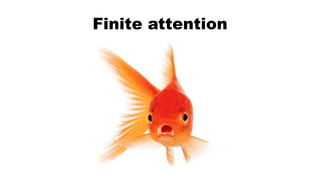
Finite attention
Types of attention
Sustained /
Selective
Types of attention
Divided
to draw attention to something,
to turn towards
advertere
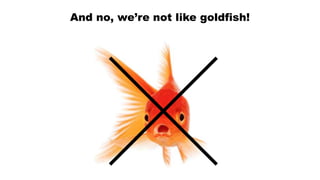
And no, we’re not like goldfish!
Newsworks and PwC study on attention
Multiple data sources:
Bespoke nationally representative study
amongst adults 18+ in Great Britain
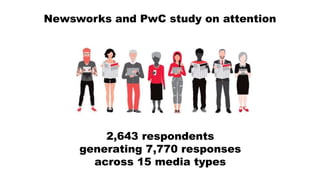
2,643 respondents
generating 7,770 responses
across 15 media types
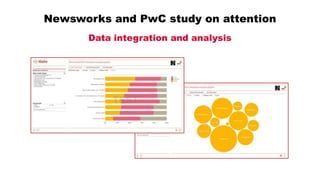
Newsworks and PwC study on attention
Data integration and analysis
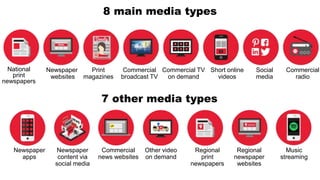
8 main media types
National
print
newspapers
Newspaper
websites
Commercial
broadcast TV
Commercial
radio
Print
magazines
Commercial TV
on demand
Social
media
Short online
videos
Newspaper
content via
social media
Other video
on demand
Regional
newspaper
websites
Commercial
news websites
Regional
print
newspapers
Music
streaming
Newspaper
apps
7 other media types
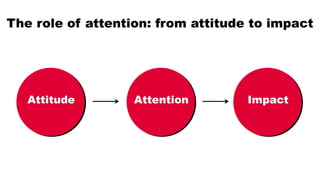
The role of attention: from attitude to impact
Attitude ImpactAttention
The role of attention: from attitude to impact
Attitude
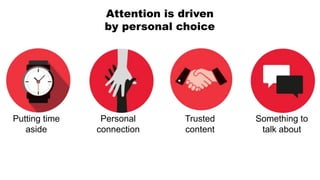
Attention is driven
by personal choice
Putting time
aside
Personal
connection
Something to
talk about
Trusted
content
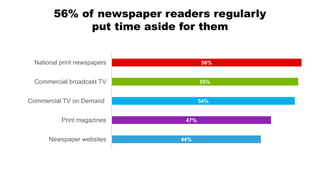
56% of newspaper readers regularly
put time aside for them
44%
47%
54%
55%
56%
Newspaper websites
Print magazines
Commercial TV on Demand
Commercial broadcast TV
National print newspapers
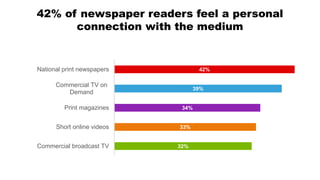
42% of newspaper readers feel a personal
connection with the medium
32%
33%
34%
39%
42%
Commercial broadcast TV
Short online videos
Print magazines
Commercial TV on
Demand
National print newspapers
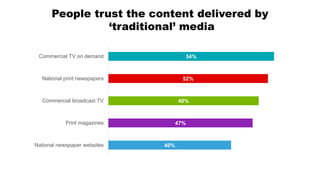
People trust the content delivered by
‘traditional’ media
40%
47%
49%
52%
54%
National newspaper websites
Print magazines
Commercial broadcast TV
National print newspapers
Commercial TV on demand
66% of newspaper readers say they fuel
their conversations
60%
62%
63%
63%
66%
Social media
Newspaper websites
Commercial broadcast TV
Short online videos
National print newspapers
The role of attention: from attitude to impact
Attitude Attention Impact
Time spent
Time spent is not enough
Time spent Advertising
response
From time spent to quality time:
the attention equation
Immersion:
Solus media usage
Focus:
Multimedia usage
with high focus
Attention = + (multimedia usage x high focus)solus media usage
The first part of the equation is solus media usage
40%
61%
57%
61%
60%
60%
Social media
Commercial radio
Commercial broadcast TV
Commercial TV on Demand
Short online videos
National print newspapers
Solus media usage
Adding in multimedia usage x high focus gives us
an overall attention score to apply to campaigns
40%
61%
57%
61%
60%
60%
14%
5%
11%
12%
15%
20%
Social media
Commercial radio
Commercial broadcast TV
Commercial TV on Demand
Short online videos
National print newspapers
Solus media usage Multiple media usage x high focus
80%
75%
73%
68%
66%
54%
The role of attention: from attitude to impact
Attitude ImpactAttention
Attention drives a powerful response
Discuss,
comment, share
Encourages
purchase
Trusted
advertising
Ideas about
brands/ products
People like to talk about, share and comment on
media content
41%
44%
46%
46%
46%
National newspaper websites
Social media
Commercial TV on demand
Short online videos
National print newspapers
Published media lead the way in giving people ideas
about brands and products
14%
19%
21%
41%
51%
Short online videos
Commercial TV on demand
Commercial broadcast TV
National print newspapers
Print magazines
Published media encourage people to consider
making a purchase
14%
19%
21%
23%
32%
Commercial radio
Commercial TV on demand
Commercial broadcast TV
National print newspapers
Print magazines
From attitude to impact: attention pays
Attitude
Putting time aside
Personal connection
Trusted content
Something to talk about
Attention
Solus media usage
Multimedia usage x high
focus
Impact
Discuss, comment, share
Trusted advertising
Ideas about brands
Encourages purchase
From attitude to impact: attention pays
37
Thank you for your attention
Contacts
Sam Tomlinson
Partner, PwC
E: sam.tomlinson@uk.pwc.com
T: +44 (0) 20 7804 0726
M: +44 (0) 7811 453 111
This publication has been prepared for general guidance on matters of interest only, and does not constitute professional advice. You should not act upon the
information contained in this publication without obtaining specific professional advice. No representation or warranty (express or implied) is given as to the
accuracy or completeness of the information contained in this publication, and, to the extent permitted by law, Newsworks and PricewaterhouseCoopers LLP
(including its members, employees and agents) do not accept or assume any liability, responsibility or duty of care for any consequences of you or anyone else
acting, or refraining to act, in reliance on the information contained in this publication or for any decision based on it.
© 2016 Newsworks and PricewaterhouseCoopers LLP. All rights reserved. In this document, “PwC” refers to the UK member firm, and may sometimes refer to the
PwC network. Each member firm is a separate legal entity. Please see www.pwc.com/structure for further details.
Denise Turner
Insight Director, Newsworks
E: denise.turner@newsworks.org.uk
T: +44 (0) 20 7839 8935
M: +44 (0) 7817 078 081