Schedra Labs, World Cup Intelligence Briefing 1 of 6
The 2026 FIFA World Cup Intelligence
Briefing
In June 2026, the global sports ecosystem is witnessing an unprecedented evolution in
scale, demographic distribution, and market footprint. As sports organizations, media
networks, and global brands track data-driven audience engagement, understanding the
sheer structural metrics of the tournament is essential for maximizing commercial
visibility.
Schedra Labs has compiled a definitive 2026 FIFA World Cup Intelligence Briefing,
applying an analytical framework to the tournament's expanded format. Below is the 7-
section data breakdown mapping out geographical footprints, competitive structures,
regional expansion, talent pools, and historic dominance vectors.
1. The Global Stage: Mapping the 2026 FIFA World Cup Footprint
The 2026 tournament marks a paradigm shift in spatial sports infrastructure, stretching
across an expansive three-country collaborative network consisting of Mexico, Canada,
and the United States. This massive tri-nation footprint expands geographic audience
reach and presents unique cross-border logistics and regional distribution requirements.
The tournament’s macro infrastructure is distributed across 16 distinct host cities:
Schedra Labs, World Cup Intelligence Briefing 2 of 6
2. By the Numbers: The Largest World Cup Ever Assembled
From an operational volume perspective, this iteration represents the single largest
tournament expansion in sports marketing history.
3. Emerging Powerhouses: Qualified Nations from Africa, Asia & North America
The 48-team expansion unlocks access for rapidly emerging football markets, driving new
consumer engagement nodes across Africa, Asia, and North America. Schedra Labs
Schedra Labs, World Cup Intelligence Briefing 3 of 6
tracks these rising regional forces as highly valuable growth vectors for international
sponsorship and sports technology adoption:
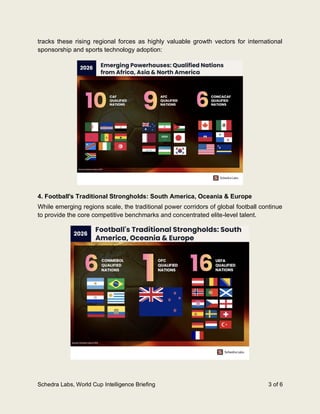
4. Football's Traditional Strongholds: South America, Oceania & Europe
While emerging regions scale, the traditional power corridors of global football continue
to provide the core competitive benchmarks and concentrated elite-level talent.
Schedra Labs, World Cup Intelligence Briefing 4 of 6
Europe's 16 slots ensure that the highest concentration of UEFA club-level professionals
remains dominant on the international grid, while CONMEBOL’s 6 slots guarantee that
South American tactical excellence shapes the elite bracket tiers.
5. The Talent Pool: Generations Set to Define the 2026 World Cup
Analyzing the athlete demographic profile yields critical insights into squad longevity,
generational transitions, and club-to-country talent pipelines.
6. Legacy of Champions: The Nations That Defined World Cup History
To understand the narrative permanence of national team brands, we must look at the
past 11 historical vectors. Brand authority in international sports isn't built overnight; it
relies on repeated systemic victory across eras.
Schedra Labs maps out the historical timeline of the past 11 champions:
Schedra Labs, World Cup Intelligence Briefing 5 of 6
7. The Race for Immortality: Football's Most Decorated Nations
The ultimate tier of brand authority belongs to a hyper-elite circle of decorated football
associations. These nations own the historical narrative, dictate global jersey sales, and
command massive algorithmic visibility inside modern media search networks.
Schedra Labs, World Cup Intelligence Briefing 6 of 6
Conclusion: Deciphering the Commercial Paradigm Shift
The 2026 FIFA World Cup is fundamentally more than an athletic showcase; it represents
a massive restructuring of global sports data, audience hubs, and brand visibility. By
expanding to 48 teams and integrating 104 matches across three nations, the tournament
fractures traditional localized sports marketing. Success in this new media landscape
requires corporate brands and sports enterprises to look beyond basic impressions and
actively monitor their semantic indexing, geographic narrative presence, and multi-
platform authority footprint. The entities that effectively decode these structural shifts will
be the ones that dominate consumer mindshare long after the final whistle blows.