Download as PDF, PPTX


![Invoking Subroutines
• Example:sub.pl
sub hope;
sub syntax($) {
print "This is 'Subroutines' slide "
.($_[0]||1) ."n";
}
syntax $ARGV[0];
#syntax();#Not enough arguments for...
hope;
hope();
&hope;
nope();
#nope;#Bareword "nope" not allowed...
sub hope { print "I hope you like Perl!n"; }
sub nope { print "I am a dangerous Bareword.n" }
my $code_ref = sub { print 'I am a closure'.$/ };
print $code_ref,$/;#CODE(0x817094c)
$code_ref->() or &$code_ref;](https://image.slidesharecdn.com/07subroutines-120926154209-phpapp01/85/Subroutines-6-320.jpg)
![Subroutine arguments
• @_
contains the parameters passed to the
subroutine
• if you call a function with two arguments, they
will be stored in $_[0] and $_[1]
• Avoid to use ($_[0] .. $_[n]) directly unless you
want to modify the arguments.
• The array @_ is a local array, but its elements
are aliases for the actual scalar parameters](https://image.slidesharecdn.com/07subroutines-120926154209-phpapp01/85/Subroutines-7-320.jpg)
![Subroutine arguments
• Example: sub_args.pl
use strict; use warnings; $ = $/;
sub modify($) {
print "The alias holding "
.($_[0]++) ." will be modifyedn";
}
modify($ARGV[0]);
print $ARGV[0];
copy_arg($ARGV[0]);
print $ARGV[0];
sub copy_arg {
my ($copy) = @_;
print "The copy holding "
.($copy++) ." will NOT modify $ARGV[0]n";
}](https://image.slidesharecdn.com/07subroutines-120926154209-phpapp01/85/Subroutines-8-320.jpg)
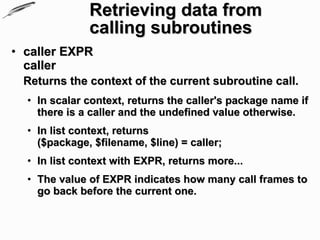
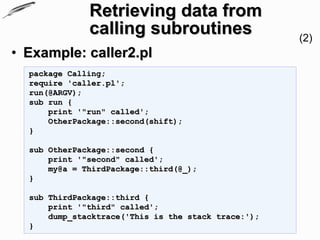
![Retrieving data from
calling subroutines
• Example:caller.pl
use Data::Dumper;
sub dump_stacktrace {
print shift || 'Dumping stacktrace:';
my $call_frame = 1;
local $,=$/;
my %i;
while(($i{package}, $i{filename}, $i{line},
$i{subroutine}, $i{hasargs}, $i{wantarray},
$i{evaltext}, $i{is_require}, $i{hints},
$i{bitmask}, $i{hinthash})
= caller($call_frame++)){
print Data::Dumper->Dump(
[%i],['call '.($call_frame-1)]
);
}
}](https://image.slidesharecdn.com/07subroutines-120926154209-phpapp01/85/Subroutines-10-320.jpg)
![Return values.
Operator wantarray
• Return values: return.pl
#prints favorite pet or a list of all pets
my @pets = qw|Goldy Amelia Jako|;
print run($ARGV[0]);
sub run {
my $pref = shift||'';#favorite or list of pets
if($pref) { favorite() }
else { local $,=$/; print pets() }
}
sub favorite {
'favorite:'.$pets[1]
}
sub pets {
return ('all pets:', @pets)
}](https://image.slidesharecdn.com/07subroutines-120926154209-phpapp01/85/Subroutines-14-320.jpg)
![Return values.
Operator wantarray
• wantarray
# prints favorite pet or a list of all pets,
# or nothing depending on context
my @pets = qw|Goldy Amelia Jako|;
run();
sub run {
if(defined $ARGV[0]) {
if($ARGV[0]==1) { my $favorite = pets() }
elsif($ARGV[0]==2) { my @pets = pets() }
}
else { pets() }
}
sub pets {
local $,=$/ and print ('all pets:', @pets) if wantarray;
return if not defined wantarray;
print 'favorite:'.$pets[1] if not wantarray;
}](https://image.slidesharecdn.com/07subroutines-120926154209-phpapp01/85/Subroutines-16-320.jpg)


![Invoking Subroutines
• Example:sub.pl
sub hope;
sub syntax($) {
print "This is 'Subroutines' slide "
.($_[0]||1) ."n";
}
syntax $ARGV[0];
#syntax();#Not enough arguments for...
hope;
hope();
&hope;
nope();
#nope;#Bareword "nope" not allowed...
sub hope { print "I hope you like Perl!n"; }
sub nope { print "I am a dangerous Bareword.n" }
my $code_ref = sub { print 'I am a closure'.$/ };
print $code_ref,$/;#CODE(0x817094c)
$code_ref->() or &$code_ref;](/p?url=https%3A%2F%2Fimage.slidesharecdn.com%2F07subroutines-120926154209-phpapp01%2F85%2FSubroutines-6-320.jpg&__src=https%3A%2F%2Fwww.slideshare.net%2Fslideshow%2Fsubroutines%2F14474026&__type=image)
![Subroutine arguments
• @_
contains the parameters passed to the
subroutine
• if you call a function with two arguments, they
will be stored in $_[0] and $_[1]
• Avoid to use ($_[0] .. $_[n]) directly unless you
want to modify the arguments.
• The array @_ is a local array, but its elements
are aliases for the actual scalar parameters](/p?url=https%3A%2F%2Fimage.slidesharecdn.com%2F07subroutines-120926154209-phpapp01%2F85%2FSubroutines-7-320.jpg&__src=https%3A%2F%2Fwww.slideshare.net%2Fslideshow%2Fsubroutines%2F14474026&__type=image)
![Subroutine arguments
• Example: sub_args.pl
use strict; use warnings; $ = $/;
sub modify($) {
print "The alias holding "
.($_[0]++) ." will be modifyedn";
}
modify($ARGV[0]);
print $ARGV[0];
copy_arg($ARGV[0]);
print $ARGV[0];
sub copy_arg {
my ($copy) = @_;
print "The copy holding "
.($copy++) ." will NOT modify $ARGV[0]n";
}](/p?url=https%3A%2F%2Fimage.slidesharecdn.com%2F07subroutines-120926154209-phpapp01%2F85%2FSubroutines-8-320.jpg&__src=https%3A%2F%2Fwww.slideshare.net%2Fslideshow%2Fsubroutines%2F14474026&__type=image)

![Retrieving data from
calling subroutines
• Example:caller.pl
use Data::Dumper;
sub dump_stacktrace {
print shift || 'Dumping stacktrace:';
my $call_frame = 1;
local $,=$/;
my %i;
while(($i{package}, $i{filename}, $i{line},
$i{subroutine}, $i{hasargs}, $i{wantarray},
$i{evaltext}, $i{is_require}, $i{hints},
$i{bitmask}, $i{hinthash})
= caller($call_frame++)){
print Data::Dumper->Dump(
[%i],['call '.($call_frame-1)]
);
}
}](/p?url=https%3A%2F%2Fimage.slidesharecdn.com%2F07subroutines-120926154209-phpapp01%2F85%2FSubroutines-10-320.jpg&__src=https%3A%2F%2Fwww.slideshare.net%2Fslideshow%2Fsubroutines%2F14474026&__type=image)


![Return values.
Operator wantarray
• Return values: return.pl
#prints favorite pet or a list of all pets
my @pets = qw|Goldy Amelia Jako|;
print run($ARGV[0]);
sub run {
my $pref = shift||'';#favorite or list of pets
if($pref) { favorite() }
else { local $,=$/; print pets() }
}
sub favorite {
'favorite:'.$pets[1]
}
sub pets {
return ('all pets:', @pets)
}](/p?url=https%3A%2F%2Fimage.slidesharecdn.com%2F07subroutines-120926154209-phpapp01%2F85%2FSubroutines-14-320.jpg&__src=https%3A%2F%2Fwww.slideshare.net%2Fslideshow%2Fsubroutines%2F14474026&__type=image)

![Return values.
Operator wantarray
• wantarray
# prints favorite pet or a list of all pets,
# or nothing depending on context
my @pets = qw|Goldy Amelia Jako|;
run();
sub run {
if(defined $ARGV[0]) {
if($ARGV[0]==1) { my $favorite = pets() }
elsif($ARGV[0]==2) { my @pets = pets() }
}
else { pets() }
}
sub pets {
local $,=$/ and print ('all pets:', @pets) if wantarray;
return if not defined wantarray;
print 'favorite:'.$pets[1] if not wantarray;
}](/p?url=https%3A%2F%2Fimage.slidesharecdn.com%2F07subroutines-120926154209-phpapp01%2F85%2FSubroutines-16-320.jpg&__src=https%3A%2F%2Fwww.slideshare.net%2Fslideshow%2Fsubroutines%2F14474026&__type=image)


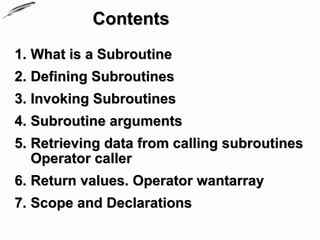
The document is a comprehensive guide to Perl subroutines, covering their definition, usage, and functionalities. Key topics include defining and invoking subroutines, handling arguments, retrieving caller information, return values, and variable scoping. It provides code examples for practical understanding of each concept discussed.


