Group No.7 Roll No
Qasim Ali 1425
Assad Ali 1407
Akber Ali 1406
Touseef Khadim 1427
SOFTWARE TESTING
 Software testing is a process of verifying and validating
that a software application or program
 1. Meets the business and technical requirements that
guided its design and development, and
 2. Works as expected.
 Main purposes
 Verification
 Validation
 Defect finding
Verification
 The verificationprocess confirms that the software meets
its technical specifications.
 A “specification” is a description of a function in terms
of a measurable output value given a specific input value
under specific preconditions.
 A simple specification may be along the line of “a SQL
query retrieving data for a single account against the
multi-month account-summary table must return these
eight fields <list> ordered by month within 3 seconds of
submission.”
Validation
 The validation process confirms that the software meets
the business requirements.
 A simple example of a business requirement is “After
choosing a branch office name, information about the
branch’s customer account managers will appear in a
new window.
 The window will present manager identification and
 summary information about each manager’s customer
base: <list of data elements>.”
 Other requirements provide details on how the data will
be summarized, formatted and displayed.
Defect finding
 A defect is a variance between the expected and actual
result. The defect’s ultimate source may be traced
 to a fault introduced in the specification, design, or
development (coding) phases.
It is the process used to identify the correctness,
completeness and quality of developed computer
software.
It is the process of executing a program/application
under positive and negative conditions by manual or
automated means. It checks for the :-
 Specification
 Functionality
 Performance
INTRODUCTION
OBJECTIVES
Uncover as many as errors (or bugs) as possible in a given
product.
Demonstrate a given software product matching its requirement
specifications.
Validate the quality of a software testing using the minimum cost
and efforts.
Generate high quality test cases, perform effective tests, and issue
correct and helpful problem reports.
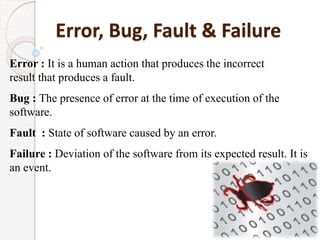
Error, Bug, Fault & Failure
Error : It is a human action that produces the incorrect
result that produces a fault.
Bug : The presence of error at the time of execution of the
software.
Fault : State of software caused by an error.
Failure : Deviation of the software from its expected result. It is
an event.
 Standard model used word wide to develop a software.
 A framework that describes the activities performed at
each stage of a software development project.
 Necessary to ensure the quality of the software.
 Logical steps taken to develop a software product.
SDLC(Software Development Life Cycle)
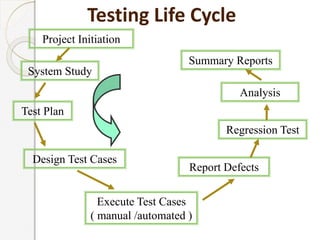
Project Initiation
System Study
Summary Reports
Analysis
Regression Test
Report Defects
Execute Test Cases
( manual /automated )
Design Test Cases
Test Plan
Testing Life Cycle
Test Plan
It is a systematic approach to test a system i.e.
software. The plan typically contains a detailed
understanding of what the eventual testing
workflow will be.
Test Case
It is a specific procedure of testing a particular
requirement.
It will include:
Identification of specific requirement tested
Test case success/failure criteria
Specific steps to execute test
Test data
• Verification: The software should confirm to its
specification (Are we building the product right?)
• Validation: The software should do what the user really
requires (Are we building the right product?)
Verification vs Validation
Testing Methodologies
Black box testing
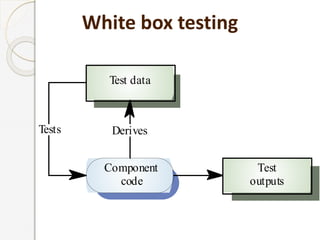
White box testing
Black box testing
 No knowledge of internal program design or code
required.
 Tests are based on requirements and functionality.
White box testing
 Knowledge of the internal program design and
code required.
 Tests are based on coverage of code
statements, branches, paths, conditions.
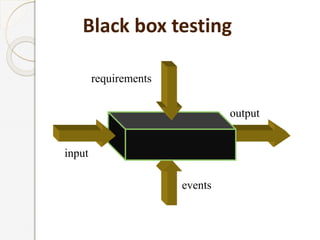
Black box testing
requirements
input
events
output
White box testing
Component
code
Test
outputs
Test data
DerivesTests
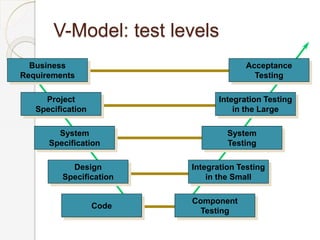
V-Model: test levels
Integration Testing
in the Small
Integration Testing
in the Large
System
Testing
Component
Testing
Acceptance
Testing
Code
Design
Specification
System
Specification
Project
Specification
Business
Requirements
Tests
Business
Requirements
Tests
Project
Specification
Tests
System
Specification
Tests
Design
Specification
Tests
Code
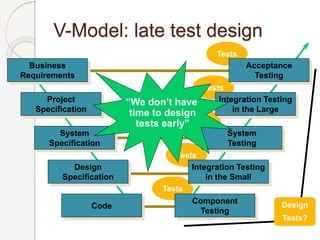
V-Model: late test design
Integration Testing
in the Small
Integration Testing
in the Large
System
Testing
Component
Testing
Acceptance
Testing
Design
Tests?
“We don’t have
time to design
tests early”
TestsTests
Business
Requirements
TestsTests
Project
Specification
TestsTests
System
Specification
TestsTests
Design
Specification
TestsTests
Code
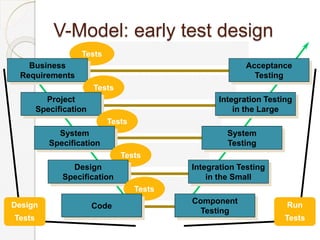
V-Model: early test design
Integration Testing
in the Small
Integration Testing
in the Large
System
Testing
Component
Testing
Acceptance
Testing
Run
Tests
Design
Tests
Early test design
 test design finds faults
 faults found early are cheaper to fix
 most significant faults found first
 faults prevented, not built in
 no additional effort, re-schedule test
design
 changing requirements caused by test
designEarly test design helps to build quality,
stops fault multiplication
Experience report: Phase 1
Phase 1: Plan
2 mo 2 mo
dev test
test
150 faults
1st mo.
50 faults
users
not
happy
Quality
fraught, lots of dev overtime
Actual
"has to go in"
but didn't work
Experience report: Phase 2
Phase 2: Plan
2 mo 6 wks
dev test
test
50 faults
1st mo.
0 faults
happy
users!
Quality
smooth, not much for dev to do
Actual
acc test: full
week (vs half day)
on time
Phase 1: Plan
2 mo 2 mo
dev test
test
150 faults
1st mo.
50 faults
users
not
happy
Quality
fraught, lots of dev overtime
Actual
"has to go in"
but didn't work
Phase 2: Plan
2 mo 6 wks
dev test
test
50 faults
1st mo.
0 faults
happy
users!
Quality
smooth, not much for dev to do
Actual
acc test: full
week (vs half day)
on time
Testing Levels
• Unit testing
• Integration testing
• System testing
UNIT TESTING
Tests each module individually.
Follows a white box testing (Logic of the program).
Done by developers.
INTEGRATION TESTING
Once all the modules have been unit tested, integration
testing is performed.
It is systematic testing.
Produce tests to identify errors associated with interfacing.
Types:
Big Bang Integration testing
Top Down Integration testing
Bottom Up Integration testing
Mixed Integration testing
SYSTEM TESTING
 The system as a whole is tested to uncover
requirement errors.
 Verifies that all system elements work properly
and that overall system function and performance
has been achieved.
Types:
Alpha Testing
Beta Testing
Acceptance Testing
Performance Testing
Alpha Testing
It is carried out by the test team within the developing
organization .
Beta Testing
It is performed by a selected group of friendly customers.
Acceptance Testing
It is performed by the customer to determine whether to
accept or reject the delivery of the system.
Performance Testing
It is carried out to check whether the system meets the
nonfunctional requirements identified in the SRS
document.
Types of Performance Testing:
Stress Testing
Volume Testing
Configuration Testing
Compatibility Testing
Regression Testing
Recovery Testing
Maintenance Testing
Documentation Testing
Usability Testing
 In order to be cost effective, the testing must be
concentrated on areas where it will be most effective.
DISCUSSION
 The testing should be planned such that when testing is
stopped for whatever reason, the most effective testing in
the time allotted has already been done.
 The absence of an organizational testing policy may
result in too much effort and money will be spent on
testing, attempting to achieve a level of quality that is
impossible or unnecessary.
THANK YOU
Govt municipal degree college
Faisalabad