1
Presented By:
Vishesh Kumar Jha(04620602018)
BCA 4TH SEMESTER 1ST SHIFT
TRINITY INSTITUTE OF PROFESSIONAL STUDIES
(Affiliated to Guru Gobind Singh Indraprastha University, Delhi)
Ranked “A” Institution of GGSIPU, Delhi
Recognised under section 2(f) of the UGC Act, 1956
NAAC Accredited “B++” Grade Institution
Ranked “A+” Institution by SFRC, Govt. of NCT of India
Software Testing
2
INTRODUCTION
 It is the process used to identify the correctness,
completeness and quality of developed computer
software.
 It is the process of executing a program/application
under positive and negative conditions by manual or
automated means. It checks for the :-
 Specification
 Functionality
 Performance
3
OBJECTIVES
Demonstrate a given software product matching its requirement
specifications.
Validate the quality of a software testing using the minimumcost
and efforts.
Generate high quality test cases, perform effective tests, and issue correct and helpful
problem reports.
Uncover as many as errors (or bugs) as possible in a given product.
4
5
Error : It is a human action that produces the
incorrect result that produces a fault.
Bug : The presence of error at the time of execution
of the software.
Fault: State of software caused by an error.
Failure : Deviation of the software from its expected result.
It is an event.
6
SDLC(Software Development Life Cycle)
 Standard model used word wide to develop a
software.
 A framework that describes the activities
performedat each stage of a software
development project.
 Necessary to ensure the quality of the software.
 Logical steps taken to develop a software product
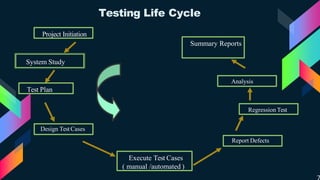
System Study
Testing Life Cycle
Test Plan
Project Initiation
Summary Reports
Execute Test Cases
( manual /automated )
Analysis
Regression Test
Report Defects
Design TestCases
8
Test Plan
It is a systematic approach to test a
system
i.e. software. The plan typically
contains a detailed understanding of
what the eventual testing workflow will
be.
9
Test Case
It is a specific procedure of testing a
particular requirement.
It will include:
 Identification of specific
requirement tested.
 Test case success/failure criteria.
 Specific steps to execute test
 Test data
10
Verification vs Validation
Verification: The software should
confirm to its specification (Are we
building the product right?)
Validation: The software should do what
the user really requires (Are we building
the right product?)
11
Black box testing
12
 No knowledge of internal
program design or code
required.
 Tests are based on
requirements and functionality.
White Box Testing
13
 Knowledge of the internal
program design and code
required.
 Tests are based on coverage of
code statements, branches,
paths, conditions
14
Unit testing
Integration testing
System testing
15
16
17
 Tests each module
individually.
 Follows a white box
testing
 (Logic of the program)
Done by developers.
18
19
Once all the modules have been unit tested, integration testing is
performed.
It is to determine the correctness the interface between the modules.
Produce tests to identify errors associated with interfacing.
Types:
 Big Bang Integration testing
 Top Down Integration testing
 Bottom Up Integration testing
 Mixed Integration testing
20
21
The system as a whole is tested to uncover requirement errors.
Verifies that all system elements work properly and that overall system function
and performance has been achieved.
Types:
1. Alpha Testing
2. Beta Testing
3. Acceptance Testing
4. Performance Testing
Alpha Testing
It is carried out by the test team within the developing organization .
Beta Testing
It is performed by a selected group of friendly customers.
Acceptance Testing
It is performed by the customer to determine whether to accept or reject
the delivery of the system.
Performance Testing
It is carried out to check whether the system meets the nonfunctional
requirements identified in the SRS document.
Types of Performance Testing
Stress Testing
Volume Testing
Configuration Testing
Compatibility Testing
Regression Testing
Recovery Testing
Maintenance Testing
Documentation Testing
Usability Testing
Software Testing