SOFTWARE COST
ESTIMATION TECHNIQUES
Prepared by
V.Santhi
Assistant Professor
Department of Computer Applications
Bon Secours College for Women
Thanjavur
 Software cost estimation based on past
performance
 Historical data used to identify cost factor
Methods
1. Top-down
2. Bottom-up
Top-Down:
 Focuses on system level costs
 Computing resources & personnel to develop the
system
 Costs of Configuration management
 Quality assurance
 System Integration
 Testing
 Publications
Bottom –Up:
 Estimates the cost to develop each module or
subsystem.
 Combine overall cost.
Techniques:
1. Expert Judgment
2. Delphi Cost Estimation
3. Work Breakdown Structure
4. COCOMO Model
EXPERT JUDGMENT
 Most widely used estimation technique
 Top-down estimation technique
Ex:
Process Control System 10 months & $ 1
million cost
New System  25% more activities  increase
our time and cost
 Same computer and external sensing/controlling
devices & same people available to develop the
new system
 Reduce our estimate by 20%
Advantages:
 Experience
 Expert confident that the project is similar to
previous one.
 Group of experts prepare a consensus
estimate.
 Minimize individual oversights.
Disadvantages:
 Interpersonal group dynamics may have on
individuals in the group.
 Political consideration
 Dominance of an overly assertive group
member.
DELPHI COST ESTIMATION
 Developed by Rand Corporation in 1948
 Without introducing the adverse side effects
of group meetings
1. A coordinator provides each estimator with
the System Definition document
2. Estimators study the definition and complete
their estimate anonymously. Ask questions
of the coordinator.
3. Coordinator prepares and distributes a
summary of the estimators response
4. Estimators complete another estimate, again
anonymously using the results from the
previous estimate.
5. The process is iterated for as many rounds
as required. No group discussion is allowed
during the entire process
VARIATION OF DELPHI COST ESTIMATION
1. Coordinator provides each estimator with a
system Definition and an estimation form
2. Coordinator calls a group meeting and discuss
the estimation issues with each other.
3. Estimators complete their estimates
anonymously
4. The coordinator prepares a summary of
estimates, but does not record any rationale.
5. The coordinator calls a group meeting to focus
on issues where the estimation vary widely
6. Estimators complete another estimate, again
anonymously. The process repeated so many
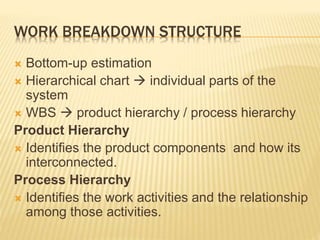
WORK BREAKDOWN STRUCTURE
 Bottom-up estimation
 Hierarchical chart  individual parts of the
system
 WBS  product hierarchy / process hierarchy
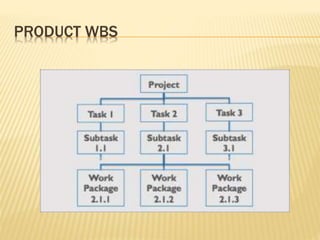
Product Hierarchy
 Identifies the product components and how its
interconnected.
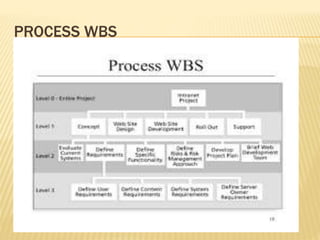
Process Hierarchy
 Identifies the work activities and the relationship
among those activities.
PRODUCT WBS
PROCESS WBS