Social media and the professional
         communicator
     Applications and
       Arguments


                             http://mediapunk.net/2010/06/nicholas-carrs-argument/
Applications and Arguments
           Applications                       Arguments
•   Media & communication          •   We all need some critical
    professionals can not afford       perspectives on social
    to be outside the social           media
    media space                    •   Too much of social media
                                       hype is marketing-driven
•   Social media is grabbing
    attention and eyeballs         •   For too long the digital
                                       utopians have led the
•   Social media represents an         charge
    important set of new           •   Now it’s time for a backlash
    communication channels         •   The ‘digital sublime’ has
•   Digital Natives are in this        become the digital
    space (our students)               ‘mundane’
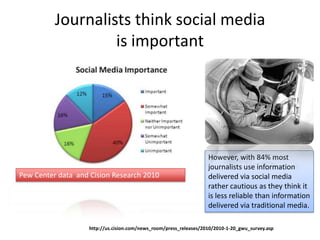
Journalists think social media
                   is important


                                                                   However, with 84% most
                                                                   journalists use information
Pew Center data and Cision Research 2010                           delivered via social media
                                                                   rather cautious as they think it
                                                                   is less reliable than information
                                                                   delivered via traditional media.

                   http://us.cision.com/news_room/press_releases/2010/2010-1-20_gwu_survey.asp
2008 data on journalists use of social media
Nearly 75% follow at least one blog regularly, compared with about 70% a year ago.

More than 75% of journalists say they use social media to research
stories, compared with about 67% last year.

Nearly 38% of journalists now say they visit a social media site at least once a week
as part of their reporting, compared with only 28% last year.

More than 53% of journalists now say they visit a social media site such as FaceBook
or YouTube at least once a month, up from about 44% last year.

Nearly 19% of journalists receive five or more RSS feeds of news
services, blogs, podcasts or videocasts every week, compared with only 16% a year
ago.

About 44% receive at least one regular RSS feed.
             http://www.marketingcharts.com/print/journalists-use-new-media-more-than-pr-pros-think-6900/
Social media in PR practice
“There are so many uses —
                                                                   •    Business to Business
conversational marketing, reaching                                 •    Brand loyalty
influencers — that PR is able to
participate in conversations and                                   •    Authenticity
answer questions, be a support
system for clients and companies, as                               •    Client connections
well as empowering customers and
power users to be a de facto
resource for your company, a
champion for your products.”
Christina Warren – mashable.com
http://mashable.com/2010/03/16/public-relations-social-media-results/


                                                                    http://www.socialmediatoday.com/SMC/190207
Social media marketing for SMEs
75% have a company page on a social                       Nearly 20% of Marketing Dollars
networking site                                           Will Go to Social Marketing in 5
                                                          Years
69% post status updates or articles of interest
on social media sites
                                                          Improving brand awareness
57% build a network through a site such as                2. Increase site traffic
LinkedIn                                                  3. Increasing lead generation
                                                          4. Improve Customer Service
54% monitor feedback about the business                   5. Generate new sales
                                                          6. Generate repeat sales
39% maintain a blog

26% tweet about areas of expertise

16% use Twitter as a service channel

                                           http://gorumors.com/crunchies/social-media-online-marketing/
Cognitive Surplus
                                   For the first time in history, the amount of television
                                   being watched by a younger generation is decreasing
                                   rather than increasing annually. Why? Because time is
                                   being poured instead into interactive media, and above
                                   all into online activities.
                                   Harnessing this cognitive surplus leads to the generation
                                   of new content and therefore new real social relations

                                   More than one trillion hours can be harnessed in this way

                                   But: does it lead to better lives and more real interaction
"we live, for the first time
in history, in a world             Shirky celebrates the cult of the amateur and the wisdom
where being part of a              of the crowd
globally interconnected
group is the normal case           Shirky does not mind that the clickstream monetized
for most citizens".                without the amateurs being rewarded financially

                     http://www.guardian.co.uk/books/2010/jun/27/cognitive-surplus-clay-shirky-book-review
‘In the quiet spaces opened up by the
prolonged, undistracted reading of a
book, people made their own
associations, drew their own inferences and
analogies, fostered their own ideas. They
thought deeply as they read deeply.’

‘Like our forebears during the later years of the
Middle Ages, we find ourselves today between
two technological worlds,’ writes Carr. ‘After
550 years, the printing press and its products
are being pushed from the center of our
intellectual life to its edges.’


                                                         Mathia Dempsey

http://www.fancygoods.com.au/matthia/2010/07/09/learning-to-balance-nicholas-carrs-the-shallows-atlantic/
The Shallows
                                • navigation & evaluation of
‘ ‘Try reading a book while
doing a crossword puzzle;         links distracts the brain
that’s the intellectual
environment of the internet.’
                                  from interpretation
                                • ‘pancake people’ (wide &
                                  thin)
                                • reliance on external
                                  memory
                                • we need data collection
                                  and reflection
You are not a gadget
    Jaron Lanier directs most of his ire toward the
    "anonymous blog comments, vapid video pranks, and
    lightweight mashups" that flit through our browsers and
    Twitter feeds. But he's also critical of bigger Internet
    landmarks, such as Wikipedia, the open-source software
    Linux, and the "hive mind" in general.
    Michael Agger,   http://www.slate.com/id/2239466/


    The only thing I criticize is the confusion of people with
    machines. This happens as a side effect of certain
    designs that depend on all of the above- designs like
    Web 2.0/Creative Commons/etc. And even in those
    cases, I have tried to make clear that I am not saying you
    Jaron Lanier http://www.jaronlanier.com/gadgetcurrency.html
    shouldn't ever use any of the tools I criticize.
So what?
Social learning                                    Curriculum
• Digital native learning                          • Can we ‘teach’ this stuff?
  habits are different                             • What are the critical
today's students think and process
                                                     content areas?
information fundamentally differently              • What are the learning
from their predecessors. These
differences go far further and deeper
                                                     outcomes we’re after?
than most educators suspect or realize.            • What is the role of the
Mark Prensky                                         academic guide?
http://www.twitchspeed.com/site/Prensky%20-
%20Digital%20Natives,%20Digital%20Immigrants%20-
%20Part1.htm
                                                   • How do we need to change
                                                     or respond?
"I Googled It"

During the study, one of the researchers asked a study participant, "What is this
website?" The student answered, "Oh, I don't know. The first thing that came
up.


http://www.readwriteweb.com/archives/so-called_digital_natives_not_media_savvy_new_study_shows.php


Social learning refers to the acquisition of social competence that happens
exclusively or primarily in a social group.

Social learning depends on group dynamics.

Social learning promotes the development of individual emotional and practical
competence as well as the perception of oneself and the acceptance of others
with their individual competencies and limitations.