THE SOCIAL LEARNING THEORY  OF  ALBERT BANDURA By Heidi Olson and Tracy Scott
Reflection Using the polling tool: Select the best answer to this question: How did you learn to cook?        A. from watching someone (Mom, Dad, Grandma?)      B. from watching Hell's Kitchen, Emeril, or Rachel Ray, or       __________ (input name here) on TV      C. I don't know how to cook      D. other
Reflection Using the text tool, type your response on the whiteboard:    Think about a product you (or someone you know) have (has) recently purchased based on a TV commercial. Write a quick thought about what influenced you to buy the product. Or if the purchase was made by someone else - what to you think influenced them to purchase the product?
Reflection Answer True or False to the following questions:   I find I learn better if I repeat an exercise more than once. When waiting at a cross-walk and no cars are coming I will wait for someone else to step off the curb first (to see if they get hit by a car or arrested) before following them. Have you ever copied someone's behavior based on the rewards that you observed this person receiving?
The social learning theory of Bandura focuses on the learning that occurs within a  social context . It considers that people learn from one another, including such concepts as observational learning, imitation, and modeling (Abbott).
This learning theory emphasizes the importance of observing and modeling the behaviors, attitudes, and emotional reactions of others.(tip.psychology)
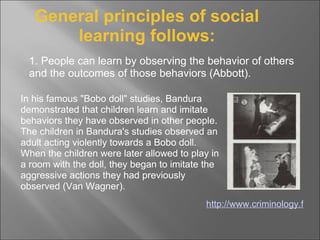
In his famous "Bobo doll" studies, Bandura demonstrated that children learn and imitate behaviors they have observed in other people. The children in Bandura's studies observed an  adult acting violently towards a Bobo doll. When the children were later allowed to play in a room with the doll, they began to imitate the aggressive actions they had previously observed (Van Wagner). 1. People can learn by observing the behavior of others and the outcomes of those behaviors (Abbott).  General principles of social learning follows: http://www.criminology.fsu.edu/crimtheory/bandura.htm
2. Learning can occur  without  a change in behavior. Behaviorists say that learning has to be represented by a permanent change in behavior, in contrast social learning theorists say that because people can learn through  observation alone , their learning may not necessarily be shown in their performance. Learning may or may not result in a behavior change (Abbott).  
3. Cognition plays a  role  in learning. Over the last 30 years social learning theory has become  increasingly cognitive  in its interpretation of human learning. Awareness and expectations of future reinforcements or punishments can have a major effect on the behaviors that people exhibit (Abbott).  http://www.wellsphere.com/viewGroupPhoto.s?showclean=true&id=18872
4. Social learning theory can be considered a bridge or a  transition  between behaviorist learning theories and cognitive learning theories (Abbott).  http://media.photobucket.com/image/bridge/britgalusa/bridgecol1.jpg?o=29
1. Attention - In order to learn, you need to be paying attention.     2. Retention - The ability to store information is an important part of the learning process.   3. Motor Reproduction - Once you have paid attention to the model and retained the information,  it is time to actually perform the behavior you observed.   4. Motivation -In order for for observational learning to be successful, you have to be motivated to imitate the behavior that has been modeled (Van Wagner). The Component Processes Underlying Observational Learning are:
Social learning theory has cognitive factors as well as behaviorist factors (actually operant factors).    1. Learning without performance: Bandura makes a distinction between learning through  observation  and the actual  imitation  of what has been learned.  2. Cognitive processing during learning: Social learning theorists contend that  attention  is a critical factor in learning (Abbott).  Cognitive Factors in Social Learning http://media.photobucket.com/image/brain/ShaenTheBrain/BlueBrain-1.jpg?o=57
3.  Expectations: As a result of being reinforced, people form expectations  about the  c onsequences  that future behaviors are likely to bring. They expect certain behaviors to bring reinforcements and others to bring punishment. The learner needs to  be aware  however, of the response reinforcements and response punishment. Reinforcement increases a response only when the learner is aware of that connection.    4. Reciprocal causation: Bandura proposed that behavior can influence both the environment and the person. In fact each of these  three variables , the person, the behavior, and the environment can have an influence on each other.    5. Modeling: There are different  types  of models. There is the  live model , a verbal instructional model and the symbolic model. (Abbott).
Bandura identified the characteristics of the following models of observational learning:   A live model involves an actual demonstration or acting out a behavior.    A verbal instructional model involves descriptions and explanations of behavior. A symbolic model, which real of fictional characters displaying behaviors in books, films, television programs or online media (Van Wagner).
  People are often reinforced for  modeling  the behavior of  others . Bandura suggested that the  environment   also reinforces  modeling.  This is in several possible ways:   1.The observer is reinforced  by the model . For example a student who changes dress to fit in with a certain group of students has a strong likelihood of being accepted and thus reinforced by that group (Abbott).     How the environment reinforces and punishes modeling:
2. The observer is reinforced by a  third person . The observer might be modeling the actions of someone else, for example, an outstanding class leader or student. The teacher notices this and compliments and praises the observer for modeling such behavior thus reinforcing that behavior.    3. The imitated  behavior itself leads  to reinforcing consequences. Many behaviors that we learn from others  produce satisfying  or reinforcing results.     4. Consequences of the model’s behavior affect the observers behavior  vicariously . This is known as vicarious reinforcement. This is where in the  model is reinforced  for a response and then the  observer shows an increase  in that same response (Abbott).
Who is Albert Bandura? http://www.xtimeline.com/timeline/Albert-Bandura used with permission from  http://www.flickr.com/photos/ghirigoribaumann A guy named Al playing a bandura A guy named Al(bert) Bandura from http://webspace.ship.edu/cgboer/bandura.html
Activity http://www.activityvillage.co.uk/Origami%20Tulip.pdf http://www.youtube.com/watch?v=F3XQMGdFG7k
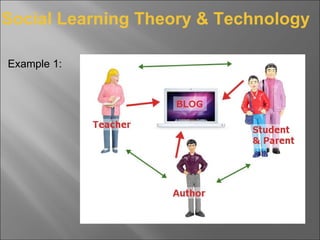
Social Learning Theory & Technology Example 1:
Social Learning Theory & Technology Example 2:                         Courtesy of CDE - UAF   http://distance.uaf.edu/cc/CE603/homework/03/H03.2.html
Social Learning Theory & Technology Example 3: Second Life Presentation
Social Learning Theory & Technology Example 3: Second Life Student Gathering http://www.flickr.com/photos/kate/344969293/
Social Learning Theory & Technology Example 3: Second Life Australia Day  Celebrations                http://www.flickr.com/photos/garyhayes/2219768941/
Social Learning Theory & Technology Social Learning Today:   "The social learning theory explains human behavior in terms of a continuous reciprocal interaction between cognitive, behavioral and environmental determinants."  –  Tu, C.-H. (1999) Sacha Chua: "A Teacher's guide to Web 2.0 at school [illustrated]" http://sachachua.com/wp/2009/09/01/a-teachers-guide-to-web-2-0-at-school-illustrated/
References Abbott, Lynda (nd).  Social Learning Theory . The University of Texas at Austin, The College of Education, Retrieved September 13, 2009 from  http://teachnet.edb.utexas.edu/~lynda_abbott/Social.html   Boeree, Dr. C. George (2006).  Albert Bandura, 1925-present . Shippenburg University. Retrieved September 13, 2009 from  http://webspace.ship.edu/cgboer/bandura.html Chih-Hsiung Tu (2000). On-line learning migration: from social learning theory to social presence theory in a CMC environment [Electronic version].  Journal of Network and Computer Applications , Vol 23, Issue 1, Jan 2000, pp 27-37 doccochs. (February 6, 2008). Theory Master Theater – Bandura Social Learning. Retrieved September 20, 2009, from  http://www.youtube.com/watch?v=byhLPxT_FJQ Hill, Janette R., Song, Liyan and West, Richard E. (2009). Social Learning Theory and Web-Based Learning Environments: A Review of Research and Discussion of Implications.  American Journal of Distance Education , 23:2, pp 88-103. Moore, Amanda (May 1999).  Albert Bandura . Muskinghum College, Department of Psychology. Retrieved September 13, 2009, from  http://www.muskingum.edu/~psych/psycweb/history/bandura.htm no author (nd). Chapter 31 Social Learning Theory of Albert Bandura. McGraw Hill Higher Education. Retrieved September 13, 2009 from  http://www.mhhe.com/socscience/comm/bandur-s.mhtml no author (2009). Social Cognitive Theory goes Global [Electronic version].  The Psychologist , June 2009, Vol 22, No. 6. Retrieved September 16 2009 from  http://issuu.com/thepsychologist/docs/0609 no author (nd). Social Learning Theory (A. Bandura). Retrieved September 17, 2009 from  http://tip.psychology.org/bandura.html Pajares, F. (2004).  Albert Bandura: Biographical sketch . Emory University, Division of Educational Studies. Retrieved September 20, 2009, from  http://des.emory.edu/mfp/bandurabio.html Patsula, Peter J. (1999). Applying Learning Theories to Online Instructional Design. Sookmyung Women’s University, Seoul. Retrieved September 13, 2009 from  http://patsula.com/usefo/webbasedlearning/tutorial1/learning_theories_full_version.html Smith, Michele, and Zane L. Berge (2009). Social Learning Theory in Second Life. [Electronic Version].  MERLOT Journal of Online Learning and Teaching , Vol. 5, No. 2, June 2009. Retrieved September 13, 2009, from  http://jolt.merlot.org/vol5no2/berge_0609.htm   Svinicki, Marila (nd). Inclass activity on Social Learning Theory. The University of Texas at Austin. Retrieved September 13, 2009 from  http://www.utexas.edu/courses/svinicki/ald320/March22.html Van  Wagner, Kendra (nd). An Overview of Bandura's Social Learning Theory. Psychology.About.com. Retrieved September 17, 2009 from  http://psychology.about.com/od/developmentalpsychology/a/sociallearning.htm