CLTL Python Course 
Object Oriented Programming in Python 
1st session 
April 24th 2013
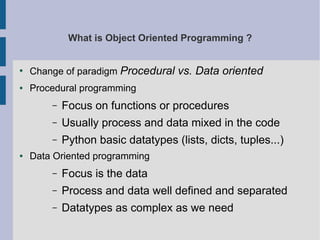
What is Object Oriented Programming ? 
● Change of paradigm Procedural vs. Data oriented 
● Procedural programming 
– Focus on functions or procedures 
– Usually process and data mixed in the code 
– Python basic datatypes (lists, dicts, tuples...) 
● Data Oriented programming 
– Focus is the data 
– Process and data well defined and separated 
– Datatypes as complex as we need
Main points of the Object Oriented Programming 
● Objects, classes, attributes, methods ... 
● Reusability 
● Data abstraction 
● Encapsulation / data hiding 
● Natural way of thinking 
● Inheritance
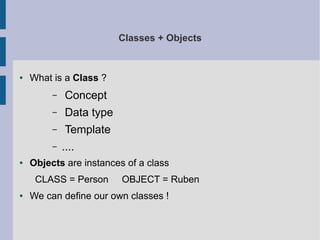
Classes + Objects 
● What is a Class ? 
– Concept 
– Data type 
– Template 
– .... 
● Objects are instances of a class 
CLASS = Person OBJECT = Ruben 
● We can define our own classes !
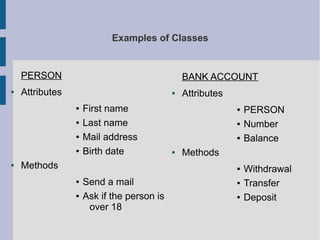
Examples of Classes 
PERSON 
● Attributes 
● First name 
● Last name 
● Mail address 
● Birth date 
● Methods 
● Send a mail 
● Ask if the person is 
over 18 
BANK ACCOUNT 
● Attributes 
● PERSON 
● Number 
● Balance 
● Methods 
● Withdrawal 
● Transfer 
● Deposit
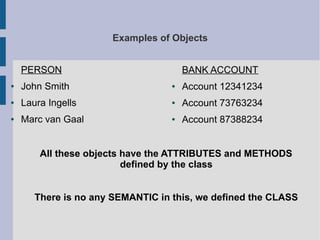
Examples of Objects 
PERSON 
● John Smith 
● Laura Ingells 
● Marc van Gaal 
BANK ACCOUNT 
● Account 12341234 
● Account 73763234 
● Account 87388234 
All these objects have the ATTRIBUTES and METHODS 
defined by the class 
There is no any SEMANTIC in this, we defined the CLASS
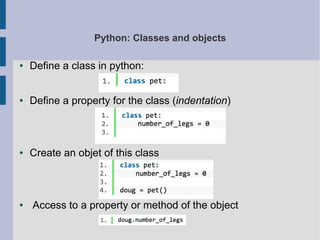
Python: Classes and objects 
● Define a class in python: 
● Define a property for the class (indentation) 
● Create an objet of this class 
● Access to a property or method of the object
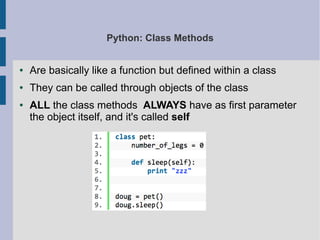
Python: Class Methods 
● Are basically like a function but defined within a class 
● They can be called through objects of the class 
● ALL the class methods ALWAYS have as first parameter 
the object itself, and it's called self
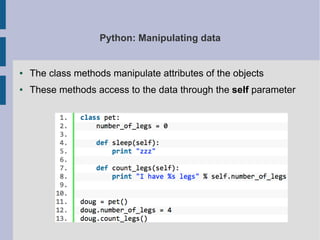
Python: Manipulating data 
● The class methods manipulate attributes of the objects 
● These methods access to the data through the self parameter
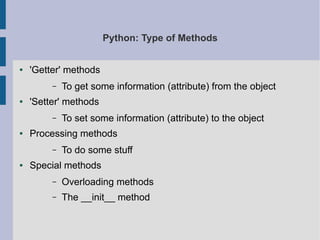
Python: Type of Methods 
● 'Getter' methods 
– To get some information (attribute) from the object 
● 'Setter' methods 
– To set some information (attribute) to the object 
● Processing methods 
– To do some stuff 
● Special methods 
– Overloading methods 
– The __init__ method
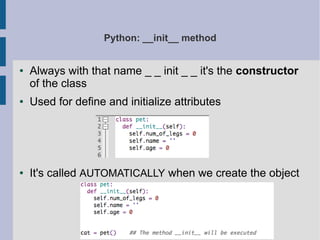
Python: __init__ method 
● Always with that name _ _ init _ _ it's the constructor 
of the class 
● Used for define and initialize attributes 
● It's called AUTOMATICALLY when we create the object
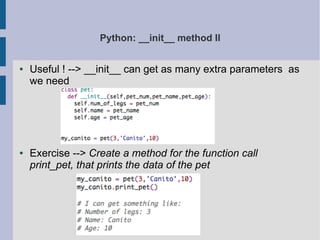
Python: __init__ method II 
● Useful ! --> __init__ can get as many extra parameters as 
we need 
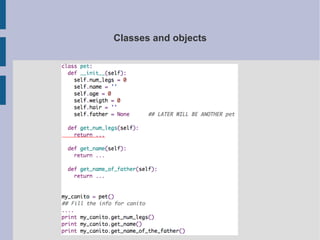
● Exercise --> Create a method for the function call 
print_pet, that prints the data of the pet
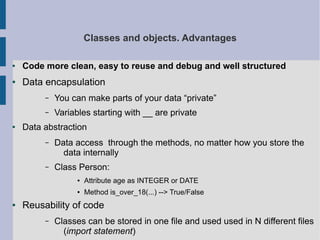
Classes and objects. Advantages 
● Code more clean, easy to reuse and debug and well structured 
● Data encapsulation 
– You can make parts of your data “private” 
– Variables starting with __ are private 
● Data abstraction 
– Data access through the methods, no matter how you store the 
data internally 
– Class Person: 
● Attribute age as INTEGER or DATE 
● Method is_over_18(...) --> True/False 
● Reusability of code 
– Classes can be stored in one file and used used in N different files 
(import statement)
Classes and objects 
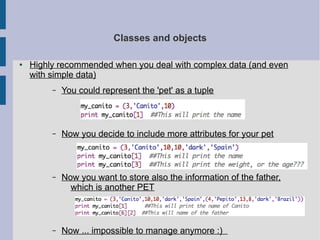
● Highly recommended when you deal with complex data (and even 
with simple data) 
– You could represent the 'pet' as a tuple 
– Now you decide to include more attributes for your pet 
– Now you want to store also the information of the father, 
which is another PET 
– Now ... impossible to manage anymore :)
Classes and objects
Inheritance 
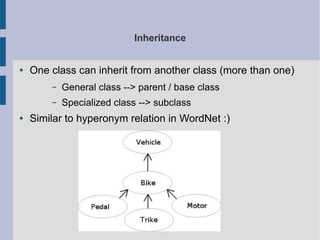
● One class can inherit from another class (more than one) 
– General class --> parent / base class 
– Specialized class --> subclass 
● Similar to hyperonym relation in WordNet :)
Inheritance II 
● Subclasses can: 
– Reuse data/methods from base classes 
– Extend the functionality of base classes 
– Modify the behaviour of base classes 
● Advantages of inheritance: 
– Reuse of code 
– Logic way of structure our classes 
– Code more clean and easy to debug 
– ....
Inheritance III 
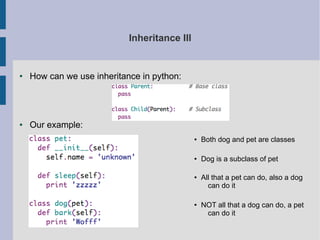
● How can we use inheritance in python: 
● Our example: 
● Both dog and pet are classes 
● Dog is a subclass of pet 
● All that a pet can do, also a dog 
can do it 
● NOT all that a dog can do, a pet 
can do it
Inheritance IV. Exercise :) 
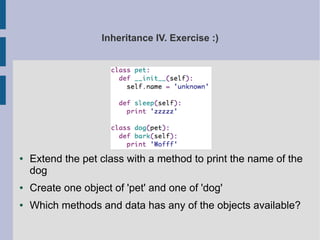
● Extend the pet class with a method to print the name of the 
dog 
● Create one object of 'pet' and one of 'dog' 
● Which methods and data has any of the objects available?