Design and Analysis of Algorithm
Greedy Methods
(Single Source shortest path,
Knapsack problem )
Lecture – 45 - 53
• A greedy algorithm always makes the choice that
looks best at the moment. (i.e. it makes a locally
optimal choice in the hope that this choice will
lead to a globally optimal solution).
• The objective of this section is to explores
optimization problems that are solvable by greedy
algorithms.
Overview
Greedy Algorithm
• In mathematics, computer science and
economics, an optimization problem is the
problem of finding the best solution from all
feasible solutions.
• Algorithms for optimization problems typically go
through a sequence of steps, with a set of
choices at each step.
• Many optimization problems can be solved using
a greedy approach.
• Greedy algorithms are simple and
straightforward.
Greedy Algorithm
• A greedy algorithm always makes the choice that
looks best at the moment.
• That is, it makes a locally optimal choice in the
hope that this choice will lead to a globally
optimal solution.
• Greedy algorithms do not always yield optimal
solutions, but for many problems they do.
• This algorithms are easy to invent, easy to
implement and most of the time provides best
and optimized solution.
Greedy Algorithm
• Application of Greedy Algorithm:
• A simple but nontrivial problem, the activity-
selection problem, for which a greedy algorithm
efficiently computes a solution.
• In combinatorics,(a branch of mathematics), a
‘matroid’ is a structure that abstracts and
generalizes the notion of linear independence in
vector spaces. Greedy algorithm always produces
an optimal solution for such problems. Scheduling
unit-time tasks with deadlines and penalties is an
example of such problem.
Greedy Algorithm
• Application of Greedy Algorithm:
• An important application of greedy techniques is
the design of data-compression codes (i.e.
Huffman code) .
• The greedy method is quite powerful and works
well for a wide range of problems. They are:
• Minimum-spanning-tree algorithms
(Example: Prims and Kruskal algorithm)
• Single Source Shortest Path.
(Example: Dijkstra's and Bellman ford algorithm)
Greedy Algorithm
• Application of Greedy Algorithm:
• A problem exhibits optimal substructure if an
optimal solution to the problem contains within it
optimal solutions to subproblems.
• This property is a key ingredient of assessing the
applicability of dynamic programming as well as
greedy algorithms.
• The subtleties between the above two techniques
are illustrated with the help of two variants of a
classical optimization problem known as knapsack
problem. These variants are:
• 0-1 knapsack problem (Dynamic Programming)
• Fractional knapsack problem (Greedy Algorithm)
Greedy Algorithm
• Problem 5: Single source shortest path
• It is a shortest path problem where the shortest
path from a given source vertex to all other
remaining vertices is computed.
• Dijkstra’s Algorithm and Bellman Ford
Algorithm are the famous algorithms used for
solving single-source shortest path problem.
Greedy Algorithm
• Problem 5: Single source shortest path
• Dijkstra’s Algorithm
• Dijkstra Algorithm is a very famous greedy
algorithm.
• It is used for solving the single source
shortest path problem.
• It computes the shortest path from one
particular source node to all other remaining
nodes of the graph.
Greedy Algorithm
• Problem 5: Single source shortest path
• Dijkstra’s Algorithm (Feasible Condition)
• Dijkstra algorithm works
• for connected graphs.
• for those graphs that do not contain any
negative weight edge.
• To provides the value or cost of the
shortest paths.
• for directed as well as undirected graphs.
Greedy Algorithm
• Problem 5: Single source shortest path
• Dijkstra’s Algorithm (Implementation)
The implementation of Dijkstra Algorithm is executed in the
following steps-
• Step-01:
• In the first step. two sets are defined-
• One set contains all those vertices which have been included
in the shortest path tree.
• In the beginning, this set is empty.
• Other set contains all those vertices which are still left to be
included in the shortest path tree.
• In the beginning, this set contains all the vertices of the
given graph.
Greedy Algorithm
• Problem 5: Single source shortest path
• Dijkstra’s Algorithm (Implementation)
The implementation of Dijkstra Algorithm is executed in the
following steps-
• Step-02:
For each vertex of the given graph, two variables are defined
as-
• Π[v] which denotes the predecessor of vertex ‘v’
• d[v] which denotes the shortest path estimate of vertex ‘v’
from the source vertex.
Greedy Algorithm
• Problem 5: Single source shortest path
• Dijkstra’s Algorithm (Implementation)
The implementation of Dijkstra Algorithm is executed in the
following steps-
• Step-02:
Initially, the value of these variables is set as-
• The value of variable ‘Π’ for each vertex is set to NIL i.e.
Π[v] = NIL
• The value of variable ‘d’ for source vertex is set to 0 i.e. d[S]
= 0
• The value of variable ‘d’ for remaining vertices is set to ∞
i.e. d[v] = ∞
Greedy Algorithm
• Problem 5: Single source shortest path
• Dijkstra’s Algorithm (Implementation)
The implementation of Dijkstra Algorithm is executed in the
following steps-
• Step-03:
The following procedure is repeated until all the vertices of the
graph are processed-
• Among unprocessed vertices, a vertex with minimum value
of variable ‘d’ is chosen.
• Its outgoing edges are relaxed.
• After relaxing the edges for that vertex, the sets created in
step-01 are updated.
Greedy Algorithm
• Problem 5: Single source shortest path
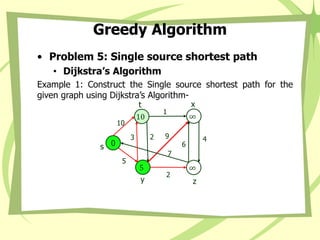
• Dijkstra’s Algorithm
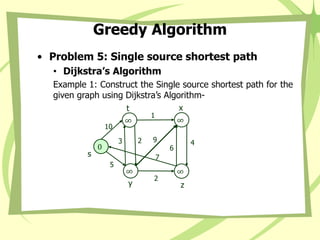
Example 1: Construct the Single source shortest path for the
given graph using Dijkstra’s Algorithm-
4
∞
s
∞
x
∞
t
∞
y
∞
z
2 9
7
1
6
2
3
5
10
Greedy Algorithm
• Problem 5: Single source shortest path
• Dijkstra’s Algorithm
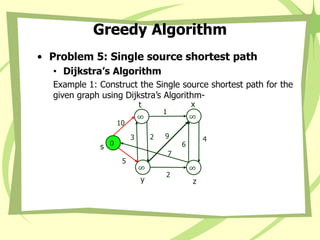
Example 1: Construct the Single source shortest path for the
given graph using Dijkstra’s Algorithm-
4
0
s
∞
x
∞
t
∞
y
∞
z
2 9
7
1
6
2
3
5
10
Greedy Algorithm
• Problem 5: Single source shortest path
• Dijkstra’s Algorithm
Example 1: Construct the Single source shortest path for the
given graph using Dijkstra’s Algorithm-
4
0
s
∞
x
∞
t
∞
y
∞
z
2 9
7
1
6
2
3
5
10
Greedy Algorithm
• Problem 5: Single source shortest path
• Dijkstra’s Algorithm
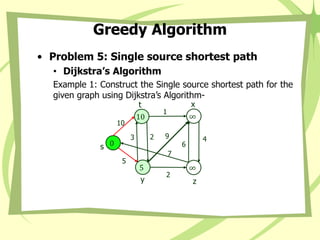
Example 1: Construct the Single source shortest path for the
given graph using Dijkstra’s Algorithm-
4
0
s
∞
x
10
t
5
y
∞
z
2 9
7
1
6
2
3
5
10
Greedy Algorithm
• Problem 5: Single source shortest path
• Dijkstra’s Algorithm
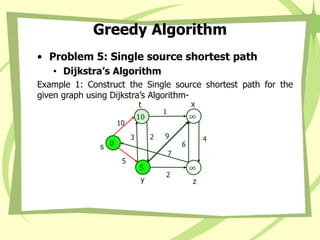
Example 1: Construct the Single source shortest path for the
given graph using Dijkstra’s Algorithm-
4
0
s
∞
x
10
t
5
y
∞
z
2 9
7
1
6
2
3
5
10
Greedy Algorithm
• Problem 5: Single source shortest path
• Dijkstra’s Algorithm
Example 1: Construct the Single source shortest path for the
given graph using Dijkstra’s Algorithm-
4
0
s
∞
x
10
t
5
y
∞
z
2 9
7
1
6
2
3
5
10
Greedy Algorithm
• Problem 5: Single source shortest path
• Dijkstra’s Algorithm
Example 1: Construct the Single source shortest path for the
given graph using Dijkstra’s Algorithm-
4
0
s
14
x
8
t
5
y
7
z
2 9
7
1
6
2
3
5
10
Greedy Algorithm
• Problem 5: Single source shortest path
• Dijkstra’s Algorithm
Example 1: Construct the Single source shortest path for the
given graph using Dijkstra’s Algorithm-
4
0
s
14
x
8
t
5
y
7
z
2 9
7
1
6
2
3
5
10
Greedy Algorithm
• Problem 5: Single source shortest path
• Dijkstra’s Algorithm
Example 1: Construct the Single source shortest path for the
given graph using Dijkstra’s Algorithm-
4
0
s
14
x
8
t
5
y
7
z
2 9
7
1
6
2
3
5
10
Greedy Algorithm
• Problem 5: Single source shortest path
• Dijkstra’s Algorithm
Example 1: Construct the Single source shortest path for the
given graph using Dijkstra’s Algorithm-
4
0
s
13
x
8
t
5
y
7
z
2 9
7
1
6
2
3
5
10
Greedy Algorithm
• Problem 5: Single source shortest path
• Dijkstra’s Algorithm
Example 1: Construct the Single source shortest path for the
given graph using Dijkstra’s Algorithm-
4
0
s
13
x
8
t
5
y
7
z
2 9
7
1
6
2
3
5
10
Greedy Algorithm
• Problem 5: Single source shortest path
• Dijkstra’s Algorithm
Example 1: Construct the Single source shortest path for the
given graph using Dijkstra’s Algorithm-
4
0
s
9
x
8
t
5
y
7
z
2 9
7
1
6
2
3
5
10
Greedy Algorithm
• Problem 5: Single source shortest path
• Dijkstra’s Algorithm
Example 1: Construct the Single source shortest path for the
given graph using Dijkstra’s Algorithm-
4
0
s
9
x
8
t
5
y
7
z
2 9
7
1
6
2
3
5
10
Greedy Algorithm
• Problem 5: Single source shortest path
• Dijkstra’s Algorithm
Example 1: Construct the Single source shortest path for the
given graph using Dijkstra’s Algorithm-
4
0
s
9
x
8
t
5
y
7
z
2 9
7
1
6
2
3
5
10
Hence the shortest path to
all the vertex from s are:
𝑠 → 𝑡 = 8
𝑠 → 𝑥 = 9
𝑠 → 𝑦 = 5
𝑠 → 𝑧 = 7
Greedy Algorithm
• Problem 5: Single source shortest path
• Dijkstra’s Algorithm (Algorithm)
DIJKSTRA(G, w, s)
1 INITIALIZE-SINGLE-SOURCE(G, s)
2 S ← Ø
3 Q ← V[G]
4 while Q ≠ Ø
5 do u ← EXTRACT-MIN(Q)
6 S ← 𝑆 ∈ {𝑢}
7 for each vertex 𝑣 ∈ 𝐴𝑑𝑗[𝑢]
8 do RELAX(u, v, w)
Greedy Algorithm
• Problem 5: Single source shortest path
• Dijkstra’s Algorithm (Algorithm)
INITIALIZE-SINGLE-SOURCE(G, s)
1 for each vertex v V[G]
2 do d[v] ← ∞
3 π[v] ← NIL
4 d[s] ← 0
RELAX(u, v, w)
1 if d[v] > d[u] + w(u, v)
2 then d[v] ← d[u] + w(u, v)
3 π[v] ← u
Greedy Algorithm
• Problem 5: Single source shortest path
• Dijkstra’s Algorithm (Complexity)
CASE-01:
• 𝐴[𝑖, 𝑗] stores the information about edge (𝑖, 𝑗).
• Time taken for selecting 𝑖 with the smallest 𝑑𝑖𝑠𝑡 is 𝑂(𝑉).
• For each neighbor of i, time taken for updating 𝑑𝑖𝑠𝑡[𝑗] is 𝑂(1)
and there will be maximum V-1 neighbors.
• Time taken for each iteration of the loop is O(V) and one
vertex is deleted from Q.
• Thus, total time complexity becomes O(𝑉2).
Greedy Algorithm
• Problem 5: Single source shortest path
• Dijkstra’s Algorithm (Complexity)
CASE-02:
• With adjacency list representation, all vertices of the graph
can be traversed using BFS in 𝑂(𝑉 + 𝐸) time.
• In min heap, operations like extract-min and decrease-key
value takes 𝑂(log 𝑉) time.
• So, overall time complexity becomes
𝑂(𝐸 + 𝑉) 𝑥 𝑂(log 𝑉) which is 𝑂((𝐸 + 𝑉) 𝑥 log 𝑉) = 𝑂(𝐸 log 𝑉)
Greedy Algorithm
• Problem 5: Single source shortest path
• Dijkstra’s Algorithm (Self Practice)
Example 2: Construct the Single source shortest path for the
given graph using Dijkstra’s Algorithm-
s
∞
c
∞
a
∞
d
∞
b
∞
e
∞
1
1
1
2
5
2
2
2
Greedy Algorithm
• Problem 5: Single source shortest path
• Bellman Ford Algorithm
• Bellman-Ford algorithm solves the single-source
shortest-path problem in the general case in which
edges of a given digraph can have negative weight
as long as G contains no negative cycles.
• Like Dijkstra's algorithm, this algorithm, uses the
notion of edge relaxation but does not use with
greedy method. Again, it uses d[u] as an upper
bound on the distance d[u, v] from u to v.
Greedy Algorithm
• Problem 5: Single source shortest path
• Bellman Ford Algorithm
• The algorithm progressively decreases an estimate
d[v] on the weight of the shortest path from the
source vertex s to each vertex v ∈ V until it achieve
the actual shortest-path.
• The algorithm returns Boolean TRUE if the given
digraph contains no negative cycles that are
reachable from source vertex s otherwise it returns
Boolean FALSE.
Greedy Algorithm
• Problem 5: Single source shortest path
Bellman Ford Algorithm (Negative Cycle
Detection)
Assume:
𝑑[𝑢] ≤ 𝑑[𝑥] + 4
𝑑[𝑣] ≤ 𝑑[𝑢] + 5
𝑑[𝑥] ≤ 𝑑[𝑣] − 10
Adding:
𝑑[𝑢] + 𝑑[𝑣] + 𝑑[𝑥] ≤ 𝑑[𝑥] + 𝑑[𝑢] + 𝑑[𝑣] − 1
Because it’s a cycle, vertices on left are same as those on right. Thus
we get 0 ≤ −1; a contradiction.
So for at least one edge (𝑢, 𝑣),
𝑑[𝑣] > 𝑑[𝑢] + 𝑤(𝑢, 𝑣)
This is exactly what Bellman-Ford checks for.
u
x
v
4
5
-10
Greedy Algorithm
• Problem 5: Single source shortest path
• Bellman Ford Algorithm (Implementation)
• Step 1: Start with the weighted graph.
• Step 2: Choose the starting vertex by making the path
value zero and assign infinity path values to all other
vertices.
• Step 3: Visit each edge and relax the path distances if
they are inaccurate.
• Step 4: Do step 3 V-1 times because in the worst case a
vertex's path length might need to be readjusted V-1
times.
• Step 5: After all vertices have their path lengths, check if
a negative cycle is present or not.
Greedy Algorithm
• Problem 5: Single source shortest path
• Bellman Ford Algorithm
Example 1: Construct the Single source shortest path for the
given graph using Bellman ford Algorithm-
∞
s
∞
x
∞
t
∞
y
∞
z
8
-3
2
5
7
9
-2
7
6
-4
Greedy Algorithm
• Problem 5: Single source shortest path
• Bellman Ford Algorithm
Example 1: Construct the Single source shortest path for the
given graph using Bellman ford Algorithm-
∞
s
∞
x
∞
t
∞
y
∞
z
8
-3
2
5
7
9
-2
7
6
-4
0
s
∞
x
∞
t
∞
y
∞
z
8
-3
2
5
7
9
-2
7
6
-4
Iteration - 1
Greedy Algorithm
• Problem 5: Single source shortest path
• Bellman Ford Algorithm
Example 1: Construct the Single source shortest path for the
given graph using Bellman ford Algorithm-
0
s
∞
x
6
t
∞
y
∞
z
8
-3
2
5
7
9
-2
7
6
-4
Iteration - 1 Edge no - 1
0
s
∞
x
∞
t
∞
y
∞
z
8
-3
2
5
7
9
-2
7
6
-4
Greedy Algorithm
• Problem 5: Single source shortest path
• Bellman Ford Algorithm
Example 1: Construct the Single source shortest path for the
given graph using Bellman ford Algorithm-
0
s
∞
x
6
t
7
y
∞
z
8
-3
2
5
7
9
-2
7
6
-4
Iteration - 1 Edge no - 2
0
s
∞
x
∞
t
∞
y
∞
z
8
-3
2
5
7
9
-2
7
6
-4
Greedy Algorithm
• Problem 5: Single source shortest path
• Bellman Ford Algorithm
Example 1: Construct the Single source shortest path for the
given graph using Bellman ford Algorithm-
0
s
∞
x
6
t
7
y
∞
z
8
-3
2
5
7
9
-2
7
6
-4
Iteration - 1 Edge no - 3
0
s
∞
x
∞
t
∞
y
∞
z
8
-3
2
5
7
9
-2
7
6
-4
Greedy Algorithm
• Problem 5: Single source shortest path
• Bellman Ford Algorithm
Example 1: Construct the Single source shortest path for the
given graph using Bellman ford Algorithm-
0
s
∞
x
6
t
7
y
∞
z
8
-3
2
5
7
9
-2
7
6
-4
Iteration - 1 Edge no - 4
0
s
∞
x
∞
t
∞
y
∞
z
8
-3
2
5
7
9
-2
7
6
-4
Greedy Algorithm
• Problem 5: Single source shortest path
• Bellman Ford Algorithm
Example 1: Construct the Single source shortest path for the
given graph using Bellman ford Algorithm-
0
s
∞
x
6
t
7
y
∞
z
8
-3
2
5
7
9
-2
7
6
-4
Iteration - 1 Edge no - 5
0
s
∞
x
∞
t
∞
y
∞
z
8
-3
2
5
7
9
-2
7
6
-4
Greedy Algorithm
• Problem 5: Single source shortest path
• Bellman Ford Algorithm
Example 1: Construct the Single source shortest path for the
given graph using Bellman ford Algorithm-
0
s
∞
x
6
t
7
y
∞
z
8
-3
2
5
7
9
-2
7
6
-4
Iteration - 1 Edge no - 6
0
s
∞
x
∞
t
∞
y
∞
z
8
-3
2
5
7
9
-2
7
6
-4
Greedy Algorithm
• Problem 5: Single source shortest path
• Bellman Ford Algorithm
Example 1: Construct the Single source shortest path for the
given graph using Bellman ford Algorithm-
0
s
∞
x
6
t
7
y
∞
z
8
-3
2
5
7
9
-2
7
6
-4
Iteration - 1 Edge no - 7
0
s
∞
x
∞
t
∞
y
∞
z
8
-3
2
5
7
9
-2
7
6
-4
Greedy Algorithm
• Problem 5: Single source shortest path
• Bellman Ford Algorithm
Example 1: Construct the Single source shortest path for the
given graph using Bellman ford Algorithm-
0
s
∞
x
6
t
7
y
∞
z
8
-3
2
5
7
9
-2
7
6
-4
Iteration - 1 Edge no - 8
0
s
∞
x
∞
t
∞
y
∞
z
8
-3
2
5
7
9
-2
7
6
-4
Greedy Algorithm
• Problem 5: Single source shortest path
• Bellman Ford Algorithm
Example 1: Construct the Single source shortest path for the
given graph using Bellman ford Algorithm-
0
s
∞
x
6
t
7
y
∞
z
8
-3
2
5
7
9
-2
7
6
-4
Iteration - 1 Edge no - 9
0
s
∞
x
∞
t
∞
y
∞
z
8
-3
2
5
7
9
-2
7
6
-4
Greedy Algorithm
• Problem 5: Single source shortest path
• Bellman Ford Algorithm
Example 1: Construct the Single source shortest path for the
given graph using Bellman ford Algorithm-
0
s
∞
x
6
t
7
y
∞
z
8
-3
2
5
7
9
-2
7
6
-4
Iteration - 1 Edge no – 10
0
s
∞
x
∞
t
∞
y
∞
z
8
-3
2
5
7
9
-2
7
6
-4
Greedy Algorithm
• Problem 5: Single source shortest path
• Bellman Ford Algorithm
Example 1: Construct the Single source shortest path for the
given graph using Bellman ford Algorithm-
0
s
∞
x
6
t
∞
y
∞
z
8
-3
2
5
7
9
-2
7
6
-4
Iteration - 2 Edge no - 1
0
s
∞
x
6
t
7
y
∞
z
8
-3
2
5
7
9
-2
7
6
-4
Greedy Algorithm
• Problem 5: Single source shortest path
• Bellman Ford Algorithm
Example 1: Construct the Single source shortest path for the
given graph using Bellman ford Algorithm-
0
s
∞
x
6
t
7
y
∞
z
8
-3
2
5
7
9
-2
7
6
-4
Iteration - 2 Edge no - 2
0
s
∞
x
6
t
7
y
∞
z
8
-3
2
5
7
9
-2
7
6
-4
Greedy Algorithm
• Problem 5: Single source shortest path
• Bellman Ford Algorithm
Example 1: Construct the Single source shortest path for the
given graph using Bellman ford Algorithm-
0
s
∞
x
6
t
7
y
16
z
8
-3
2
5
7
9
-2
7
6
-4
Iteration - 2 Edge no - 3
0
s
∞
x
6
t
7
y
∞
z
8
-3
2
5
7
9
-2
7
6
-4
Greedy Algorithm
• Problem 5: Single source shortest path
• Bellman Ford Algorithm
Example 1: Construct the Single source shortest path for the
given graph using Bellman ford Algorithm-
0
s
∞
x
6
t
7
y
16
z
8
-3
2
5
7
9
-2
7
6
-4
Iteration - 2 Edge no - 4
0
s
∞
x
6
t
7
y
∞
z
8
-3
2
5
7
9
-2
7
6
-4
Greedy Algorithm
• Problem 5: Single source shortest path
• Bellman Ford Algorithm
Example 1: Construct the Single source shortest path for the
given graph using Bellman ford Algorithm-
0
s
∞
x
6
t
7
y
16
z
8
-3
2
5
7
9
-2
7
6
-4
Iteration - 2 Edge no - 5
0
s
∞
x
6
t
7
y
∞
z
8
-3
2
5
7
9
-2
7
6
-4
Greedy Algorithm
• Problem 5: Single source shortest path
• Bellman Ford Algorithm
Example 1: Construct the Single source shortest path for the
given graph using Bellman ford Algorithm-
0
s
11
x
6
t
7
y
16
z
8
-3
2
5
7
9
-2
7
6
-4
Iteration - 2 Edge no - 6
0
s
∞
x
6
t
7
y
∞
z
8
-3
2
5
7
9
-2
7
6
-4
Greedy Algorithm
• Problem 5: Single source shortest path
• Bellman Ford Algorithm
Example 1: Construct the Single source shortest path for the
given graph using Bellman ford Algorithm-
0
s
11
x
6
t
7
y
2
z
8
-3
2
5
7
9
-2
7
6
-4
Iteration - 2 Edge no - 7
0
s
∞
x
6
t
7
y
∞
z
8
-3
2
5
7
9
-2
7
6
-4
Greedy Algorithm
• Problem 5: Single source shortest path
• Bellman Ford Algorithm
Example 1: Construct the Single source shortest path for the
given graph using Bellman ford Algorithm-
0
s
11
x
6
t
7
y
2
z
8
-3
2
5
7
9
-2
7
6
-4
Iteration - 2 Edge no - 8
0
s
∞
x
6
t
7
y
∞
z
8
-3
2
5
7
9
-2
7
6
-4
Greedy Algorithm
• Problem 5: Single source shortest path
• Bellman Ford Algorithm
Example 1: Construct the Single source shortest path for the
given graph using Bellman ford Algorithm-
0
s
4
x
6
t
7
y
2
z
8
-3
2
5
7
9
-2
7
6
-4
Iteration - 2 Edge no - 9
0
s
∞
x
6
t
7
y
∞
z
8
-3
2
5
7
9
-2
7
6
-4
Greedy Algorithm
• Problem 5: Single source shortest path
• Bellman Ford Algorithm
Example 1: Construct the Single source shortest path for the
given graph using Bellman ford Algorithm-
0
s
4
x
6
t
7
y
2
z
8
-3
2
5
7
9
-2
7
6
-4
Iteration - 2 Edge no – 10
0
s
∞
x
6
t
7
y
∞
z
8
-3
2
5
7
9
-2
7
6
-4
Greedy Algorithm
• Problem 5: Single source shortest path
• Bellman Ford Algorithm
Example 1: Construct the Single source shortest path for the
given graph using Bellman ford Algorithm-
0
s
4
x
6
t
7
y
2
z
8
-3
2
5
7
9
-2
7
6
-4
Iteration - 3 Edge no - 1
0
s
4
x
6
t
7
y
2
z
8
-3
2
5
7
9
-2
7
6
-4
Greedy Algorithm
• Problem 5: Single source shortest path
• Bellman Ford Algorithm
Example 1: Construct the Single source shortest path for the
given graph using Bellman ford Algorithm-
Iteration - 3 Edge no - 2
0
s
4
x
6
t
7
y
2
z
8
-3
2
5
7
9
-2
7
6
-4
0
s
4
x
6
t
7
y
2
z
8
-3
2
5
7
9
-2
7
6
-4
Greedy Algorithm
• Problem 5: Single source shortest path
• Bellman Ford Algorithm
Example 1: Construct the Single source shortest path for the
given graph using Bellman ford Algorithm-
Iteration - 3 Edge no - 3
0
s
4
x
6
t
7
y
2
z
8
-3
2
5
7
9
-2
7
6
-4
0
s
4
x
6
t
7
y
2
z
8
-3
2
5
7
9
-2
7
6
-4
Greedy Algorithm
• Problem 5: Single source shortest path
• Bellman Ford Algorithm
Example 1: Construct the Single source shortest path for the
given graph using Bellman ford Algorithm-
Iteration - 3 Edge no - 4
0
s
4
x
6
t
7
y
2
z
8
-3
2
5
7
9
-2
7
6
-4
0
s
4
x
6
t
7
y
2
z
8
-3
2
5
7
9
-2
7
6
-4
Greedy Algorithm
• Problem 5: Single source shortest path
• Bellman Ford Algorithm
Example 1: Construct the Single source shortest path for the
given graph using Bellman ford Algorithm-
Iteration - 3 Edge no - 5
0
s
4
x
6
t
7
y
2
z
8
-3
2
5
7
9
-2
7
6
-4
0
s
4
x
2
t
7
y
2
z
8
-3
2
5
7
9
-2
7
6
-4
Greedy Algorithm
• Problem 5: Single source shortest path
• Bellman Ford Algorithm
Example 1: Construct the Single source shortest path for the
given graph using Bellman ford Algorithm-
Iteration - 3 Edge no - 6
0
s
4
x
6
t
7
y
2
z
8
-3
2
5
7
9
-2
7
6
-4
0
s
4
x
2
t
7
y
2
z
8
-3
2
5
7
9
-2
7
6
-4
Greedy Algorithm
• Problem 5: Single source shortest path
• Bellman Ford Algorithm
Example 1: Construct the Single source shortest path for the
given graph using Bellman ford Algorithm-
Iteration - 3 Edge no - 7
0
s
4
x
6
t
7
y
2
z
8
-3
2
5
7
9
-2
7
6
-4
0
s
4
x
2
t
7
y
2
z
8
-3
2
5
7
9
-2
7
6
-4
Greedy Algorithm
• Problem 5: Single source shortest path
• Bellman Ford Algorithm
Example 1: Construct the Single source shortest path for the
given graph using Bellman ford Algorithm-
Iteration - 3 Edge no - 8
0
s
4
x
6
t
7
y
2
z
8
-3
2
5
7
9
-2
7
6
-4
0
s
4
x
2
t
7
y
2
z
8
-3
2
5
7
9
-2
7
6
-4
Greedy Algorithm
• Problem 5: Single source shortest path
• Bellman Ford Algorithm
Example 1: Construct the Single source shortest path for the
given graph using Bellman ford Algorithm-
Iteration - 3 Edge no - 9
0
s
4
x
6
t
7
y
2
z
8
-3
2
5
7
9
-2
7
6
-4
0
s
4
x
2
t
7
y
2
z
8
-3
2
5
7
9
-2
7
6
-4
Greedy Algorithm
• Problem 5: Single source shortest path
• Bellman Ford Algorithm
Example 1: Construct the Single source shortest path for the
given graph using Bellman ford Algorithm-
Iteration - 3 Edge no – 10
0
s
4
x
6
t
7
y
2
z
8
-3
2
5
7
9
-2
7
6
-4
0
s
4
x
2
t
7
y
2
z
8
-3
2
5
7
9
-2
7
6
-4
Greedy Algorithm
• Problem 5: Single source shortest path
• Bellman Ford Algorithm
Example 1: Construct the Single source shortest path for the
given graph using Bellman ford Algorithm-
Iteration - 4 Edge no - 1
0
s
4
x
2
t
7
y
2
z
8
-3
2
5
7
9
-2
7
6
-4 0
s
4
x
2
t
7
y
2
z
8
-3
2
5
7
9
-2
7
6
-4
Greedy Algorithm
• Problem 5: Single source shortest path
• Bellman Ford Algorithm
Example 1: Construct the Single source shortest path for the
given graph using Bellman ford Algorithm-
Iteration - 4 Edge no - 2
0
s
4
x
2
t
7
y
2
z
8
-3
2
5
7
9
-2
7
6
-4
0
s
4
x
2
t
7
y
2
z
8
-3
2
5
7
9
-2
7
6
-4
Greedy Algorithm
• Problem 5: Single source shortest path
• Bellman Ford Algorithm
Example 1: Construct the Single source shortest path for the
given graph using Bellman ford Algorithm-
Iteration - 4 Edge no - 3
0
s
4
x
2
t
7
y
2
z
8
-3
2
5
7
9
-2
7
6
-4
0
s
4
x
2
t
7
y
2
z
8
-3
2
5
7
9
-2
7
6
-4
Greedy Algorithm
• Problem 5: Single source shortest path
• Bellman Ford Algorithm
Example 1: Construct the Single source shortest path for the
given graph using Bellman ford Algorithm-
Iteration - 4 Edge no - 4
0
s
4
x
2
t
7
y
2
z
8
-3
2
5
7
9
-2
7
6
-4
0
s
4
x
2
t
7
y
2
z
8
-3
2
5
7
9
-2
7
6
-4
Greedy Algorithm
• Problem 5: Single source shortest path
• Bellman Ford Algorithm
Example 1: Construct the Single source shortest path for the
given graph using Bellman ford Algorithm-
Iteration - 4 Edge no - 5
0
s
4
x
2
t
7
y
2
z
8
-3
2
5
7
9
-2
7
6
-4
0
s
4
x
2
t
7
y
2
z
8
-3
2
5
7
9
-2
7
6
-4
Greedy Algorithm
• Problem 5: Single source shortest path
• Bellman Ford Algorithm
Example 1: Construct the Single source shortest path for the
given graph using Bellman ford Algorithm-
Iteration - 4 Edge no - 6
0
s
4
x
2
t
7
y
2
z
8
-3
2
5
7
9
-2
7
6
-4
0
s
4
x
2
t
7
y
2
z
8
-3
2
5
7
9
-2
7
6
-4
Greedy Algorithm
• Problem 5: Single source shortest path
• Bellman Ford Algorithm
Example 1: Construct the Single source shortest path for the
given graph using Bellman ford Algorithm-
Iteration - 4 Edge no - 7
0
s
4
x
2
t
7
y
−2
z
8
-3
2
5
7
9
-2
7
6
-4
0
s
4
x
2
t
7
y
2
z
8
-3
2
5
7
9
-2
7
6
-4
Greedy Algorithm
• Problem 5: Single source shortest path
• Bellman Ford Algorithm
Example 1: Construct the Single source shortest path for the
given graph using Bellman ford Algorithm-
Iteration - 4 Edge no - 8
0
s
4
x
2
t
7
y
2
z
8
-3
2
5
7
9
-2
7
6
-4 0
s
4
x
2
t
7
y
−2
z
8
-3
2
5
7
9
-2
7
6
-4
Greedy Algorithm
• Problem 5: Single source shortest path
• Bellman Ford Algorithm
Example 1: Construct the Single source shortest path for the
given graph using Bellman ford Algorithm-
Iteration - 4 Edge no - 9
0
s
4
x
2
t
7
y
−2
z
8
-3
2
5
7
9
-2
7
6
-4
0
s
4
x
2
t
7
y
2
z
8
-3
2
5
7
9
-2
7
6
-4
Greedy Algorithm
• Problem 5: Single source shortest path
• Bellman Ford Algorithm
Example 1: Construct the Single source shortest path for the
given graph using Bellman ford Algorithm-
Iteration - 4 Edge no – 10
0
s
4
x
2
t
7
y
2
z
8
-3
2
5
7
9
-2
7
6
-4 0
s
4
x
2
t
7
y
−2
z
8
-3
2
5
7
9
-2
7
6
-4
Greedy Algorithm
• Problem 5: Single source shortest path
• Bellman Ford Algorithm
Example 1: Construct the Single source shortest path for the given graph
using Bellman ford Algorithm-
0
s
4
x
2
t
7
y
−2
z
8
-3
2
5
7
9
-2
7
6
-4
0
s
∞
x
∞
t
∞
y
∞
z
8
-3
2
5
7
9
-2
7
6
-4
0
s
∞
x
6
t
7
y
∞
z
8
-3
2
5
7
9
-2
7
6
-4
0
s
4
x
6
t
7
y
2
z
8
-3
2
5
7
9
-2
7
6
-4
0
s
4
x
2
t
7
y
2
z
8
-3
2
5
7
9
-2
7
6
-4
After Iteration 1
After Iteration 3
After Iteration 2
After Iteration 4
Greedy Algorithm
• Problem 5: Single source shortest path
• Bellman Ford Algorithm (Algorithm)
BELLMAN-FORD(G, w, s)
1 INITIALIZE-SINGLE-SOURCE(G, s)
2 for i ← 1 to |V[G]| - 1
3 do for each edge (u, v) ∈ E[G]
4 do RELAX(u, v, w)
5 for each edge (u, v) ∈ E[G]
6 do if d[v] > d[u] + w(u, v)
7 then return FALSE
8 return TRUE
Greedy Algorithm
• Problem 5: Single source shortest path
• Bellman Ford Algorithm (Algorithm)
INITIALIZE-SINGLE-SOURCE(G, s)
1 for each vertex v V[G]
2 do d[v] ← ∞
3 π[v] ← NIL
4 d[s] ← 0
RELAX(u, v, w)
1 if d[v] > d[u] + w(u, v)
2 then d[v] ← d[u] + w(u, v)
3 π[v] ← u
Greedy Algorithm
• Problem 5: Single source shortest path
• Bellman Ford Algorithm (Analysis)
BELLMAN-FORD(G, w, s)
1 INITIALIZE-SINGLE-SOURCE(G, s) → Θ(𝑉)
2 for i ← 1 to |V[G]| - 1
3 do for each edge (u, v) ∈ E[G] Ο(𝐸)
4 do RELAX(u, v, w)
5 for each edge (u, v) ∈ E[G]
6 do if d[v] > d[u] + w(u, v) Ο(𝐸)
7 then return FALSE
8 return TRUE
Ο(𝐸)
Greedy Algorithm
• Problem 5: Single source shortest path
• Bellman Ford Algorithm(Self Practice)
Example 2: Construct the Single source shortest path for the
given graph using Bellman Ford Algorithm-
s
∞
c
∞
a
∞
d
∞
b
∞
e
∞
1
1
1
2
5
2
2
2
Greedy Algorithm
• Problem 5: Knapsack Problem
Problem definition:
• The Knapsack problem is an “combinatorial
optimization problem”, a topic in mathematics
and computer science about finding the optimal
object among a set of object .
• Given a set of items, each with a weight and a
profit, determine the number of each item to
include in a collection so that the total weight is
less than or equal to a given limit and the total
profit is as large as possible.
Greedy Algorithm
• Problem 5: Knapsack Problem
Versions of Knapsack:
• Fractional Knapsack Problem:
Items are divisible; you can take any fraction of
an item and it is solved by using Greedy
Algorithm.
• 0/1 Knapsack Problem:
Items are indivisible; you either take them or
not and it is solved by using Dynamic
Programming(DP).
Greedy Algorithm
• Problem 5: Knapsack Problem
• Fractional Knapsack Problem:
Given n objects and a knapsack with a capacity
“M” (weight)
• Each object 𝑖 has weight 𝑤𝑖 and profit 𝑝𝑖.
• For each object 𝑖, suppose a fraction 𝑥𝑖
, 0 ≤ 𝑥𝑖 ≤ 1, can be placed in the
knapsack, then the profit earned is 𝑝𝑖. 𝑥𝑖 .
Greedy Algorithm
• Problem 5: Knapsack Problem
Fractional Knapsack Problem:
The objective is to maximize profit subject to capacity constraints.
𝑖. 𝑒. 𝑚𝑎𝑥𝑖𝑚𝑖𝑧𝑒
𝑖=1
𝑛
𝑝𝑖𝑥𝑖 ------------------------------(1)
Subject to
𝑖=1
𝑛
𝑤𝑖𝑥𝑖 ≤ 𝑀 ------------------------(2)
Where, 0 ≤ 𝑥𝑖 ≤ 1,
𝑝𝑖 > 0,
𝑤𝑖 > 0.
A feasible solution is any subset {𝑥1, 𝑥2, 𝑥3, … … , 𝑥𝑛} satisfying (1) & (2).
An optimal solution is a feasible solution that maximize 𝑖=1
𝑛
𝑝𝑖𝑥𝑖.
Greedy Algorithm
• Problem 5: Knapsack Problem
Fractional Knapsack Problem(Implementation)
Fractional knapsack problem is solved using greedy method in the
following steps-
Step-01:
• For each item, compute its (profit / weight) ratio.(i.e 𝑝𝑖/𝑥𝑖)
Step-02:
• Arrange all the items in decreasing order of their (profit /
weight) ratio.
Step-03:
• Start putting the items into the knapsack beginning from the
item with the highest ratio.
• Put as many items as you can into the knapsack.
Greedy Algorithm
• Problem 5: Knapsack Problem
Fractional Knapsack Problem(Implementation)
Example 1: For the given set of items and knapsack capacity = 60 kg,
find the optimal solution for the fractional knapsack problem making use
of greedy approach.
Step-01: Compute the (profit / weight) ratio for each item-
Greedy Algorithm
• Problem 5: Knapsack Problem
Fractional Knapsack Problem(Algorithm)
FRACTIONAL_KNAPSACK (p, 𝑤, 𝑀)
1 for i = 1 to n
2 do x[i] = 0
3 weight = 0
4 for i = 1 to n
5 if weight + w[i] ≤ M
6 then x[i] = 1
7 weight = weight + w[i]
8 else
9 x[i] = (M - weight) / w[i]
10 weight = M
11 break
12 return x
Greedy Algorithm
• Problem 5: Knapsack Problem
Fractional Knapsack Problem(Implementation)
Example 1: For the given set of items and knapsack capacity = 60 kg,
find the optimal solution for the fractional knapsack problem making use
of greedy approach.
Item Weight Profit
1 5 30
2 10 40
3 15 45
4 22 77
5 25 90
Greedy Algorithm
• Problem 5: Knapsack Problem
Fractional Knapsack Problem(Implementation)
Example 1: For the given set of items and knapsack capacity = 60 kg,
find the optimal solution for the fractional knapsack problem making use
of greedy approach.
Step-01: Compute the (profit / weight) ratio for each item-
Item Weight Profit Ratio
1 5 30 6
2 10 40 4
3 15 45 3
4 22 77 3.5
5 25 90 3.6
Greedy Algorithm
• Problem 5: Knapsack Problem
Fractional Knapsack Problem(Implementation)
Example 1: For the given set of items and knapsack capacity = 60 kg,
find the optimal solution for the fractional knapsack problem making use
of greedy approach.
Step-02: Sort all the items in decreasing order of their value / weight
ratio-
Item Weight Profit Ratio
1 5 30 6
2 10 40 4
5 25 90 3.6
4 22 77 3.5
3 15 45 3
Greedy Algorithm
• Problem 5: Knapsack Problem
Fractional Knapsack Problem(Implementation)
Example 1: For the given set of items and knapsack capacity = 60 kg,
find the optimal solution for the fractional knapsack problem making use
of greedy approach.
Step-03: Start filling the knapsack by putting the items into it one by
one.
Item Weight Profit Ratio
1 5 30 6
2 10 40 4
5 25 90 3.6
4 22 77 3.5
3 15 45 3
Knapsack
weight
Items in
Knapsack Cost
60 ∅ 0
Greedy Algorithm
• Problem 5: Knapsack Problem
Fractional Knapsack Problem(Implementation)
Example 1: For the given set of items and knapsack capacity = 60 kg,
find the optimal solution for the fractional knapsack problem making use
of greedy approach.
Step-03: Start filling the knapsack by putting the items into it one by
one.
Item Weight Profit Ratio
1 5 30 6
2 10 40 4
5 25 90 3.6
4 22 77 3.5
3 15 45 3
Knapsack
weight
Items in
Knapsack Cost
60 ∅ 0
Greedy Algorithm
• Problem 5: Knapsack Problem
Fractional Knapsack Problem(Implementation)
Example 1: For the given set of items and knapsack capacity = 60 kg,
find the optimal solution for the fractional knapsack problem making use
of greedy approach.
Step-03: Start filling the knapsack by putting the items into it one by
one.
Item Weight Profit Ratio
1 5 30 6
2 10 40 4
5 25 90 3.6
4 22 77 3.5
3 15 45 3
Knapsack
weight
Items in
Knapsack Cost
60 ∅ 0
55 1 30
Greedy Algorithm
• Problem 5: Knapsack Problem
Fractional Knapsack Problem(Implementation)
Example 1: For the given set of items and knapsack capacity = 60 kg,
find the optimal solution for the fractional knapsack problem making use
of greedy approach.
Step-03: Start filling the knapsack by putting the items into it one by
one.
Item Weight Profit Ratio
1 5 30 6
2 10 40 4
5 25 90 3.6
4 22 77 3.5
3 15 45 3
Knapsack
weight
Items in
Knapsack Cost
60 ∅ 0
55 1 30
Greedy Algorithm
• Problem 5: Knapsack Problem
Fractional Knapsack Problem(Implementation)
Example 1: For the given set of items and knapsack capacity = 60 kg,
find the optimal solution for the fractional knapsack problem making use
of greedy approach.
Step-03: Start filling the knapsack by putting the items into it one by
one.
Item Weight Profit Ratio
1 5 30 6
2 10 40 4
5 25 90 3.6
4 22 77 3.5
3 15 45 3
Knapsack
weight
Items in
Knapsack Cost
60 ∅ 0
55 1 30
45 1, 2 70
Greedy Algorithm
• Problem 5: Knapsack Problem
Fractional Knapsack Problem(Implementation)
Example 1: For the given set of items and knapsack capacity = 60 kg,
find the optimal solution for the fractional knapsack problem making use
of greedy approach.
Step-03: Start filling the knapsack by putting the items into it one by
one.
Item Weight Profit Ratio
1 5 30 6
2 10 40 4
5 25 90 3.6
4 22 77 3.5
3 15 45 3
Knapsack
weight
Items in
Knapsack Cost
60 ∅ 0
55 1 30
45 1, 2 70