Simple CPU Instruction
Set Design
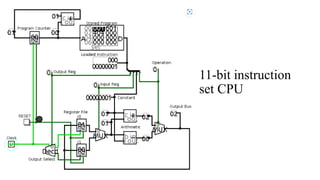
• It actually takes very little hardware to implement a simple CPU.
• An instruction fetch unit, which grabs the next instruction. The bits of the
instruction are what activate different parts of the CPU circuit to make
things happen.
• A register file, from which operands are read, and results are written.
• An arithmetic unit, which performs operations on the operands.
• There are a few key tricks used throughout these designs:
• In a circuit, feeding the output of the circuit back around to its own input,
recycling the same values over and over.
• Most CPUs operate on values of more than one bit. Using a single bus to
represent multiple bits with a single line dramatically simplifies the circuit
schematic compared to the physically more realistic approach of drawing
separate wires for each bit. Logisim calls this "Data Bits"; most other tools
call it a "bus".
• A multiplexor selects one input line from a set of inputs, based on
"select line". For example, an 8-in mux has a 3 bit select input, which
is a binary code indicating which of the 8 inputs to select as the
output. Multiplexors are used:
• In the register file, to select which register should provide input data for
arithmetic. The register select lines are controlled by the input register portion
of the instruction being executed.
• In the arithmetic unit, to pick the output of one arithmetic circuit from
those listed. The arithmetic select lines are controlled by the opcode portion
of the instruction.
11-bit instruction
set CPU
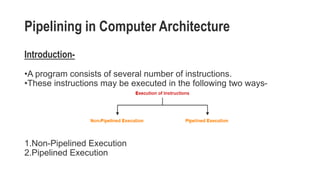
Pipelining in Computer Architecture
Introduction-
•A program consists of several number of instructions.
•These instructions may be executed in the following two ways-
1.Non-Pipelined Execution
2.Pipelined Execution
Pipelining in Computer Architecture
• 1. Non-Pipelined Execution
• In non-pipelined architecture,
• All the instructions of a program are executed sequentially one after
the other.
• A new instruction executes only after the previous instruction has
executed completely.
• This style of executing the instructions is highly inefficient.
Pipelining in Computer Architecture
Example-
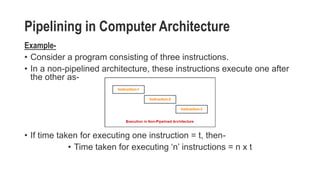
• Consider a program consisting of three instructions.
• In a non-pipelined architecture, these instructions execute one after
the other as-
• If time taken for executing one instruction = t, then-
• Time taken for executing ‘n’ instructions = n x t
Pipelining in Computer Architecture
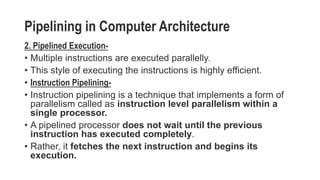
2. Pipelined Execution-
• Multiple instructions are executed parallelly.
• This style of executing the instructions is highly efficient.
• Instruction Pipelining-
• Instruction pipelining is a technique that implements a form of
parallelism called as instruction level parallelism within a
single processor.
• A pipelined processor does not wait until the previous
instruction has executed completely.
• Rather, it fetches the next instruction and begins its
execution.
Pipelining in Computer Architecture
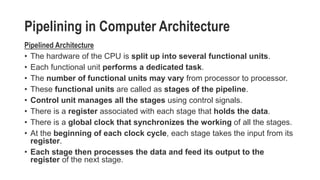
Pipelined Architecture
• The hardware of the CPU is split up into several functional units.
• Each functional unit performs a dedicated task.
• The number of functional units may vary from processor to processor.
• These functional units are called as stages of the pipeline.
• Control unit manages all the stages using control signals.
• There is a register associated with each stage that holds the data.
• There is a global clock that synchronizes the working of all the stages.
• At the beginning of each clock cycle, each stage takes the input from its
register.
• Each stage then processes the data and feed its output to the
register of the next stage.
Pipelining in Computer Architecture
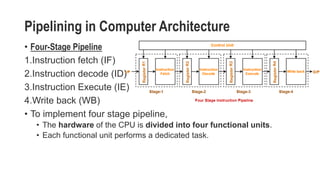
• Four-Stage Pipeline
1.Instruction fetch (IF)
2.Instruction decode (ID)
3.Instruction Execute (IE)
4.Write back (WB)
• To implement four stage pipeline,
• The hardware of the CPU is divided into four functional units.
• Each functional unit performs a dedicated task.
Pipelining in Computer Architecture
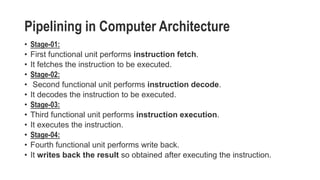
• Stage-01:
• First functional unit performs instruction fetch.
• It fetches the instruction to be executed.
• Stage-02:
• Second functional unit performs instruction decode.
• It decodes the instruction to be executed.
• Stage-03:
• Third functional unit performs instruction execution.
• It executes the instruction.
• Stage-04:
• Fourth functional unit performs write back.
• It writes back the result so obtained after executing the instruction.
Pipelining in Computer Architecture
• Execution
• Instructions of the program execute parallelly.
• When one instruction goes from nth stage to (n+1)th stage,
another instruction goes from (n-1)th stage to nth stage.
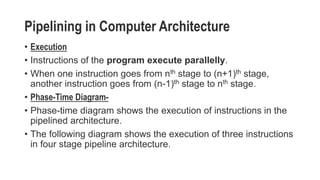
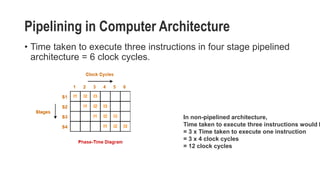
• Phase-Time Diagram-
• Phase-time diagram shows the execution of instructions in the
pipelined architecture.
• The following diagram shows the execution of three instructions
in four stage pipeline architecture.
Pipelining in Computer Architecture
• Time taken to execute three instructions in four stage pipelined
architecture = 6 clock cycles.
In non-pipelined architecture,
Time taken to execute three instructions would b
= 3 x Time taken to execute one instruction
= 3 x 4 clock cycles
= 12 clock cycles
Pipelining in Computer Architecture
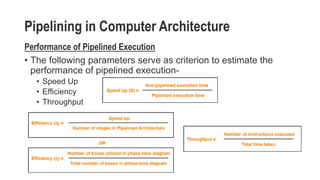
Performance of Pipelined Execution
• The following parameters serve as criterion to estimate the
performance of pipelined execution-
• Speed Up
• Efficiency
• Throughput
Simple CPU Instruction Set Design.pptx