Chhorn Chamnap
Yoolk Mango
4 Aug 2010
   Basic Ruby
   Methods
   Classes
   Method-Access Rules
   What’s in an Object?
   Classes in Depth
   What Happens When You Call a Method?
   Module
   Constants
   Self
   Scope
   Singleton Method
   Local variables
     start with a lowercase letter or an underscore
      Eg: x, string, __abc__, start_value, and firstName
     Ruby convention is to use underscores with multiple
      words (first_name)
     can't start with an uppercase letter
   Instance variables
     storing information for individual objects
     always start with a single at-sign(@)
     can start with an uppercase letter
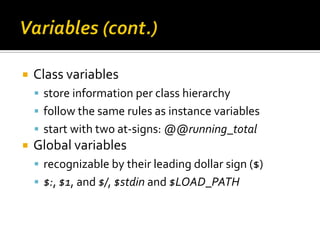
   Class variables
     store information per class hierarchy
     follow the same rules as instance variables
     start with two at-signs: @@running_total
   Global variables
     recognizable by their leading dollar sign ($)
     $:, $1, and $/, $stdin and $LOAD_PATH
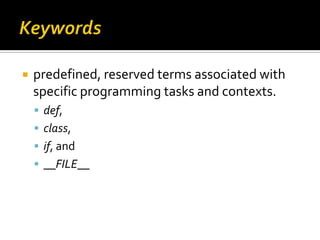
   predefined, reserved terms associated with
    specific programming tasks and contexts.
     def,
     class,
     if, and
     __FILE__
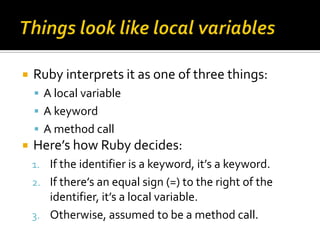
   Ruby interprets it as one of three things:
     A local variable
     A keyword
     A method call
   Here’s how Ruby decides:
    1. If the identifier is a keyword, it’s a keyword.
    2. If there’s an equal sign (=) to the right of the
       identifier, it’s a local variable.
    3. Otherwise, assumed to be a method call.
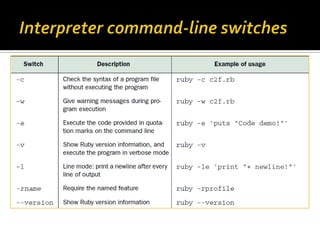
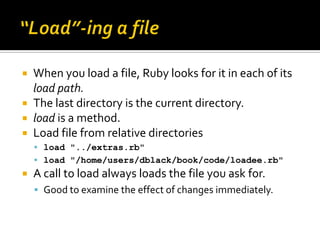
 When you load a file, Ruby looks for it in each of its
  load path.
 The last directory is the current directory.
 load is a method.
 Load file from relative directories
     load "../extras.rb"
     load "/home/users/dblack/book/code/loadee.rb"
   A call to load always loads the file you ask for.
     Good to examine the effect of changes immediately.
   Doesn’t reload files if already loaded.
     require "loadee"
     require "/home/users/code/loadee"
   Follow the same rules and conventions as
    local variables
     except, can end with ?, !, or =
   Methods are expressions that provide a value.
   In some contexts, you can’t tell, just by
    looking at an expression.
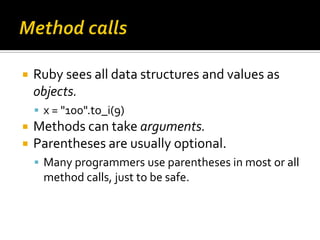
   Ruby sees all data structures and values as
    objects.
     x = "100".to_i(9)
   Methods can take arguments.
   Parentheses are usually optional.
     Many programmers use parentheses in most or all
      method calls, just to be safe.
   Have to supply the correct number of
    arguments.
   A method that allows any number of
    arguments.

    def multi_args(*x)
      puts "I can take zero or more arguments!"
    end

    multi_args(1,2,4)
    multi_args(1,2)
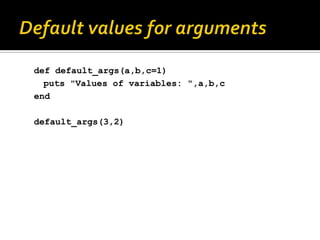
def default_args(a,b,c=1)
  puts "Values of variables: ",a,b,c
end

default_args(3,2)
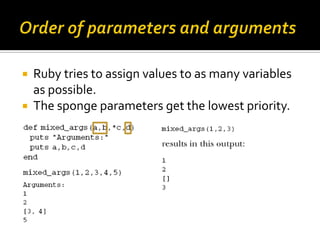
   Ruby tries to assign values to as many variables
    as possible.
   The sponge parameters get the lowest priority.
   Required ones get priority, whether they
    occur at the left or at the right of the list.
   All the optional ones have to occur in the
    middle.

def broken_args(x,*y,z=1)
                                   syntax error
end
   Classes define clusters of behavior or
    functionality.
   Classes can respond to messages, just like
    objects.
   Objects can change, acquiring methods and
    behaviors that were not defined in their class.
   In Ruby, classes are objects.
   The new method is a constructor.
   Classes are named with constants.
   Ruby executed the code within the class just
    as it would execute any other code.
   It’s possible to reopen a class and make
    additions or changes.
   These methods defined inside a class.
   Used by all instances of the class.
   They don’t belong only to one object.
   Enables individual objects to remember state.
   Always start with @.
   Visible only to the object to which they
    belong.
   Initialized in one method definition is the
    same as in other method definitions.
   Define a special method called initialize.
   Ruby allows you to define methods that end
    with an equal sign (=).
def price=(amount)       ticket.price=(63.00)
  @price = amount        ticket.price = 63.00
end
   The attributes are implemented as reader
    and/or writer methods.
   Ruby supports only single inheritance.
   Classes can import modules as mixins.
   The class Object is almost at the top of the
    inheritance chart.
• Private methods can’t be called with an explicit receiver.


class Baker                        class Baker
  def bake_cake                      def bake_cake
    pour_flour                         pour_flour
    add_egg                            add_egg
  end                                end
  def pour_flour                   private
  end                                def pour_flour
  def add_egg                        end
  end                                def add_egg
  private: pour_flour,               end
   :add_egg                        end
end
   It’s OK to use an explicit receiver for private
    setter methods.
   The top-level method is stored as a private
    instance method of the Object class.
   Every object is “born” with certain innate
    abilities.
     object_id
     respond_to?
     send
     methods
     instance_variables
   Not uncommon to define a method called
    send.
     Then, use __send__ instead.
 public_send, a safe version of send method.
 send can call an object’s private methods
  public_send can’t.
   Every class is an instance of a class called
    Class.
   You can also create a class the same way you
    create most other objects.
    my_class = Class.new
    instance_of_my_class = my_class.new
   The class Class is an instance of itself.
   Object is a class, Object is an object.
   And Class is a class. And Object is a class, and
    Class is an object.
   Which came first?
     Ruby has to do some of this chicken-or-egg stuff
     in order to get the class and object system up and
     running.
   Classes are objects.
   Instances of classes are objects, too.
   A class object has its own methods, its own
    state, its own identity.
   When you call a method, Ruby does two
    things:
     It finds the method (method lookup).
     It executes the method. (find self).
   “one step to the right, then up.”
   How objects call their methods?
     From their class
     From the superclass and earlier ancestors of their
      class
     From their own store of singleton methods
   Instances of Class can call methods that are
    defined as instance methods in their class.
     Class defines an instance method called new.
     Ticket.new
   The class Class has two new methods as:
     a class method; Class.new
     an instance method; Ticket.new
   Instances of Class have access to the instance
    methods defined in Module.
    class Ticket
      attr_reader :venue, :date
      attr_accessor :price
   Modules are bundles of methods and
    constants.
   Modules don’t have instances.
   Consists of the functionality to be added to a
    class or an object.
   Modules encourage modular design.
   Modules are the more basic structure, and
    classes are just a specialization.
   Modules get mixed in to classes, using the
    include method, referred to as mix-ins.
   The instances of the class have the ability to
    call the instance methods defined in the
    module.
   A class can mix in more than one module.
   To resolve a message into a method:
     Its class
     Modules mixed into its class
     The class’s superclass
     Modules mixed into the superclass
     Likewise, up to Object (and its mix-in Kernel) and
      BasicObject
   Define a method twice inside the same class,
    the second definition takes precedence.
    class D
      def hello
        puts “hello”
      end
    end

    class D
      def hello
        puts “hello world”
      end
    end
   If the object’s method-lookup path includes
    more than two same methods, the first one is
    the “winner”.
   A class mixes in two or more modules.
     The modules are searched in reverse order of
     inclusion
class C
  include M
  include N
  include M
end


   Re-including a module doesn’t do anything.
   N is still considered the most recently
    included module.
   Use the super keyword to jump up to the
    next-highest definition, in the method-
    lookup path.
   The way super handles arguments:
     Called with no argument list – super
     Called with an empty argument list – super()
     Called with specific arguments – super(a,b,c)
   The Kernel module provides an instance method called
    method_missing.
   Nested module/class chains are used to
    create namespaces for classes, modules, and
    methods.
    module Tools
      class Hammer
      end
    End

    h = Tools::Hammer.new
   Begin with an uppercase letter.
    eg: A, String, FirstName, and STDIN
   (FirstName) or (FIRST_NAME) is usual.
   Can be referred to from inside the instance or
    class methods.
   You get a warning if you reassign to the
    constant.


   To modify a constant, use a variable instead.

     not redefining a constant,
     good for reloading program files
   Constants have a kind
    of global visibility or
    reachability.
   Bears a close
    resemblance to
    searching a filesystem.
   Like /, the :: means “start from the top level.”
   At every moment, only one object is playing
    the role of self.
   Self is the default object or current object.
   To know which object is self, you need to
    know what context you’re in.
   But what is self when you haven’t yet entered
    any definition block?
     The answer is that Ruby provides you with a start-
     up self at the top level.
    ruby -e 'puts self'

   main is a special term that the default self
    object.
   The keyword (class, module, or def) marks a
    switch to a new self.
   In a class or module definition, self is the class
    or module object.
   In a method definition, self is the object that
    called it.
   When a singleton method is executed, self is
    the object that owns the method.
   If the receiver of the message is self, you can
    omit the receiver and the dot.
   If both a method and a variable of a given
    name exist (talk), the variable takes
    precedence.
     To force Ruby to see as a method name, you’d
     have to use self.talk or talk().
   To call a setter method, have to supply
    object-dot-notation.
    self.first_name = “dara”
    first_name = “dara”
   Every instance variable belongs to self.
   Scope refers to the reach or visibility of
    variables and constants.
   Three types of variables: global, local, and
    class variables.
   Global scope is scope that covers the entire
    program.
   Global scope is enjoyed by global variables.
   Local scope is a basic layer of every Ruby
    program.
   Every time you cross into a class, module, or
    def keyword, you start a new local scope.
     The top level has its own local scope.
     Every class or module definition block has its own
      local scope.
     Every method definition has its own local scope.
   Provides a storage mechanism shared
    between a class and its instances.
   Visible only to a class and its instances.
   They’re class-hierarchy variables.
   Let’s say we’ve created our Ticket class.
     Ticket isn’t only a class.
     Ticket is also an object in its own right.


   defined directly on the class object Ticket.
   referred to as a class method of the class.
   Where do singleton methods live?
     The singleton class
   Every object has two classes:
     The class of which it’s an instance
     Its singleton class
   Singleton classes are anonymous.
   The << object notation means the anonymous,
    singleton class of object.
   The Well-Grounded Rubyist, David A. Black
   Metaprogramming Ruby, Paolo Perrotta