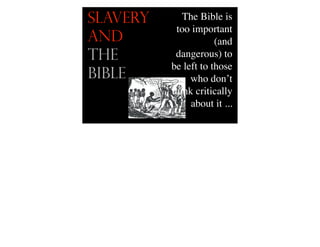
Slavery
and
the
Bible
The Bible is
too important
(and
dangerous) to
be left to those
who don’t
think critically
about it ...
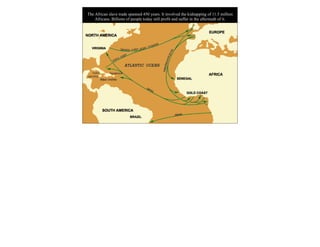
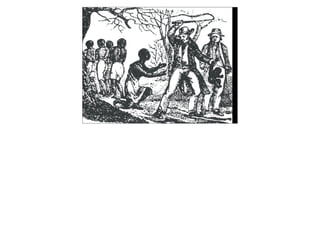
The African slave trade spanned 450 years. It involved the kidnapping of 11.5 million
Africans. Billions of people today still profit and suffer in the aftermath of it.
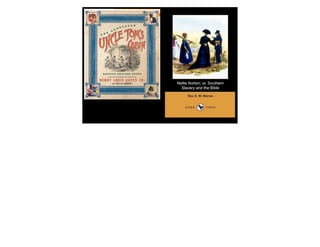
There were also many novels, counterpart to Uncle Tom’s
Cabin, such as:
Nellie Norton: or, Southern Slavery and the
Bible: A Scriptural Refutation of the
Principal Arguments Upon Which the
Abolitionists Rely: A Vindication of Southern
Slavery From the Old and New Testaments,
(1864)
by Ebenezer Willis Warren, an obscure 44-year old Protestant clergyman
from Macon, GA.  Last major defense of slavery in the U.S.
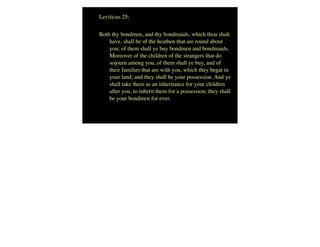
Leviticus 25:
Both thy bondmen, and thy bondmaids, which thou shalt
have, shall be of the heathen that are round about
you; of them shall ye buy bondmen and bondmaids.
Moreover of the children of the strangers that do
sojourn among you, of them shall ye buy, and of
their families that are with you, which they begat in
your land; and they shall be your possession. And ye
shall take them as an inheritance for your children
after you, to inherit them for a possession; they shall
be your bondmen for ever.
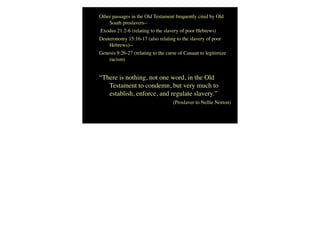
Other passages in the Old Testament frequently cited by Old
South proslavers--
Exodus 21:2-6 (relating to the slavery of poor Hebrews)
Deuteronomy 15:16-17 (also relating to the slavery of poor
Hebrews)--
Genesis 9:26-27 (relating to the curse of Canaan to legitimize
racism)
“There is nothing, not one word, in the Old
Testament to condemn, but very much to
establish, enforce, and regulate slavery.”
(Proslaver to Nellie Norton)
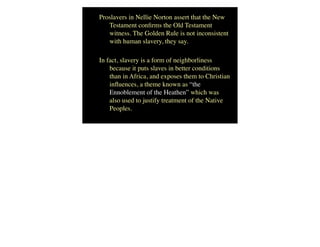
Proslavers in Nellie Norton assert that the New
Testament confirms the Old Testament
witness. The Golden Rule is not inconsistent
with human slavery, they say.
In fact, slavery is a form of neighborliness
because it puts slaves in better conditions
than in Africa, and exposes them to Christian
influences, a theme known as “the
Ennoblement of the Heathen” which was
also used to justify treatment of the Native
Peoples.
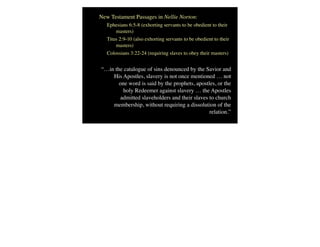
New Testament Passages in Nellie Norton:
Ephesians 6:5-8 (exhorting servants to be obedient to their
masters)
Titus 2:9-10 (also exhorting servants to be obedient to their
masters)
Colossians 3:22-24 (requiring slaves to obey their masters)
“…in the catalogue of sins denounced by the Savior and
His Apostles, slavery is not once mentioned … not
one word is said by the prophets, apostles, or the
holy Redeemer against slavery … the Apostles
admitted slaveholders and their slaves to church
membership, without requiring a dissolution of the
relation.”
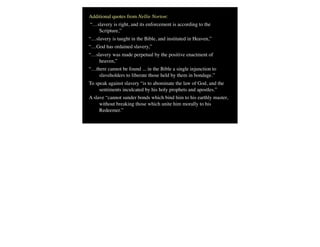
Additional quotes from Nellie Norton:
“…slavery is right, and its enforcement is according to the
Scripture,”
“…slavery is taught in the Bible, and instituted in Heaven,”
“…God has ordained slavery,”
“…slavery was made perpetual by the positive enactment of
heaven,”
“…there cannot be found ... in the Bible a single injunction to
slaveholders to liberate those held by them in bondage.” 
To speak against slavery “is to abominate the law of God, and the
sentiments inculcated by his holy prophets and apostles.” 
A slave “cannot sunder bonds which bind him to his earthly master,
without breaking those which unite him morally to his
Redeemer.”
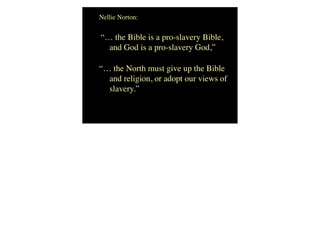
Nellie Norton:
“… the Bible is a pro-slavery Bible,
and God is a pro-slavery God,”
“… the North must give up the Bible
and religion, or adopt our views of
slavery.”
John Saffin, another proslaver of the period, wrote:
Since Abraham owned slaves …
… our Imitation of him in this Moral Action is as
warrantable as that of [adopting] his Faith.
God set different Orders and Degrees of Men
in the World ... some to be High and
Honourable, some to be Low and
Despicable… Servants of sundry sorts and
degrees, bound to obey; yea, some to be born
Slave, and so to remain during their lives.
The Biblical Argument for slavery:
The Oracular Decisions of God have positively
declared that the Slave-Trade is intrinsically
good and licit, [and that the holding of
slaves] is perfectly consonant to the
principles of the Law of Nature, the Mosaic
Dispensation, and the Christian Law …
[Thus slavery has] the positive sanction of
God in its support."
Raymond Harris, Scriptural Researches on the
Licitness of the Slave-Trade.
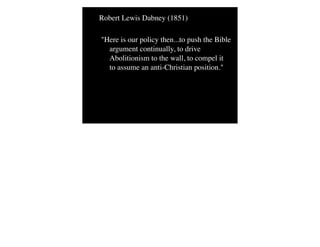
Robert Lewis Dabney (1851)
"Here is our policy then...to push the Bible
argument continually, to drive
Abolitionism to the wall, to compel it
to assume an anti-Christian position."
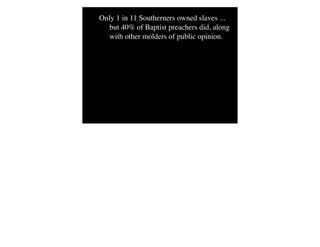
Only 1 in 11 Southerners owned slaves ...
but 40% of Baptist preachers did, along
with other molders of public opinion.
How did the proslavers use the Bible?
How did the abolitionists use the Bible?
Which method do we want to follow?
pre 1860
John Henry Hopkins:
If it were a matter to be determined by
personal sympathies, tastes, or feelings, I should
be as ready as any man to condemn the
institution of slavery, for all prejudices of
eduction, habit, and social position stand
entirely opposed to it. But as a Christian... I am
compelled to submit my weak and erring
intellect to the authority of the Almighty. For
then only can I be safe in my conclusions.
John Henry Hopkins (1792–1868) as cited in William Webb, Moving Beyond the Bible to Theology (Grand Rapids, Zondervan,
2009) 216. Emphasis added.
John Collins:
The Bible has contributed to violence in the world precisely
because it has been taken to confer a degree of certitude that
transcends human discussion and argumentation. Perhaps the
most constructive thing a biblical critic can do toward
lessening the contribution of the Bible to violence in the
world is to show that such certitude is an illusion.
John J. Collins, Does the Bible Justify Violence (Minneapolis: Fortress, 2004) 32–33
“Men never do evil so completely and cheerfully as when
they do it from religious conviction.” - Blaise Pascal (Pensees
894)
Yolanda Pierce told the bitter truth in a 2015 article:
We often fail to deconstruct how proslavery theology still
influences American Christianity. But simply put:
Theological arguments upheld the institution of slavery
long after every other argument failed. American Christian
theology was born in a cauldron of proslavery ideology,
and one of the spectacular failures of the Christian church
today is its inability to name, interrogate, confront, repent,
and dismantle the cauldron which has shaped much of its
theology. We are daily living with the remnants of a
theological white supremacy, coupled with social and
political power, which continues to uphold racist
ideologies.... [C]an this nation afford to keep ignoring the
truth that black people in America live under a threat of
racial violence, never quite feeling that we are fully equal
citizens in the nation that our enslaved ancestors built?
Meanwhile … in France:
A song lyric was written in 1847 by Placide
Clappeau, a French wine merchant, mayor of
the French town Roquemaure.
Adolphe Adam wrote the music.
Later the song was translated into English by
John S. Dwight –
It is said to have been the first music ever
broadcast over radio.
O holy night, the stars are brightly shining;
It is the night of the dear Savior’s birth!
Long lay the world in sin and error pining,
Till He appeared and the soul felt its worth.
A thrill of hope, the weary soul rejoices,
For yonder breaks a new and glorious morn.
Fall on your knees, O hear the angel voices!
O night divine, O night when Christ was born!
O night, O holy night, O night divine!
Truly He taught us to love one another;
His law is love and His Gospel is peace.
Chains shall He break for the slave is our brother
And in His Name all oppression shall cease.
Sweet hymns of joy in grateful chorus raise we,
Let all within us praise His holy Name!
Christ is the Lord! O praise His name forever!
His pow’r and glory evermore proclaim!
Literal Literary
5. Post-critical literal 6. Post-critical literary
3. Critical Literal 4. Critical Literary
1. Innocent Literal 2. Innocent Literary
InnocentCritical
encountering
God
in creation
encountering
God
in the other
(genesis 26 ff)
The Bible is too
important (and
dangerous) to be
left to those who
don’t think
critically about it ...
Dear Dr. Laura:
Thank you for doing so much to educate people regarding
God's Law. I have learned a great deal from your show, and try
to share that knowledge with as many people as I can.When
someone tries to defend the homosexual lifestyle, for example,
I simply remind them that Leviticus 18:22 clearly states it to be
an abomination... End of debate.
I do need some advice from you, however, regarding some
other elements of God's Laws and how to follow them.
1. Leviticus 25:44 states that I may possess slaves, both male and
female, provided they are purchased from neighboring nations.A
friend of mine claims that this applies to Mexicans, but not
Canadians. Can you clarify? Why can't I own Canadians?
2. I would like to sell my daughter into slavery, as sanctioned in
Exodus 21:7. In this day and age, what do you think would be a
fair price for her?
3. I know that I am allowed no contact with a woman while she
is in her period of menstrual uncleanliness - Lev.15: 19-24.The
problem is how do I tell? I have tried asking, but most women
take offense.
4.When I burn a bull on the altar as a sacrifice, I know it
creates a pleasing odor for the Lord - Lev.1:9.The problem is,
my neighbors.They claim the odor is not pleasing to them.
Should I smite them?
5. I have a neighbor who insists on working on the
Sabbath.Exodus 35:2 clearly states he should be put to death.
Am I morally obligated to kill him myself, or should I ask the
police to do it?
6.A friend of mine feels that even though eating shellfish is an
abomination - Lev. 11:10, it is a lesser abomination than
homosexuality. I don't agree. Can you settle this? Are there
'degrees' of abomination?
7. Lev. 21:20 states that I may not approach the altar of God if I
have a defect in my sight. I have to admit that I wear reading
glasses. Does my vision have to be 20/20, or is there some
wiggle-
room here?
8. Most of my male friends get their hair trimmed, including the
hair around their temples, even though this is expressly
forbidden by Lev. 19:27. How should they die?
9. I know from Lev. 11:6-8 that touching the skin of a dead pig
makes me unclean, but may I still play football if I wear gloves?
10. My uncle has a farm. He violates Lev.19:19 by planting two different
crops in the same field, as does his wife by wearing garments made of two
different kinds of thread (cotton/polyester blend). He also tends to curse
and blaspheme a lot. Is it really necessary that we go to all the trouble of
getting the whole town together to stone them? Lev.24:10-16. Couldn't we
just burn them to death at a private family affair, like we do with people who
sleep with their in-laws? (Lev. 20:14)
I know you have studied these things extensively and thus enjoy
considerable expertise in such matters, so I am confident you can help.
Thank you again for reminding us that God's word is eternal and
unchanging.
Your adoring fan.
James M. Kauffman, Ed.D. Professor Emeritus Dept. of Curriculum,
Instruction, and Special Education
University ofVirginia
Jacob and Esau ...
25:21
Isaac prayed to the Lord for his wife, because she was
barren; and the Lord granted his prayer, and his wife
Rebekah conceived. 22
The children struggled together
within her; and she said, ‘If it is to be this way, why do I
live?’*
So she went to inquire of the Lord. 23
And the Lord said to
her,
‘Two nations are in your womb,
and two peoples born of you shall be divided;
one shall be stronger than the other,
the elder shall serve the younger.’
[If the story stopped here ...]
24
When her time to give birth was at hand, there were
twins in her womb. 25
The first came out red, all his body
like a hairy mantle; so they named him Esau.
26
Afterwards his brother came out, with his hand gripping
Esau’s heel; so he was named Jacob.*
Isaac was sixty
years old when she bore them.
27 When the boys grew up, Esau was a skilful hunter, a man
of the field, while Jacob was a quiet man, living in tents.
28
Isaac loved Esau, because he was fond of game; but
Rebekah loved Jacob.
Note:
God upsetting the normal order
God for the younger
God for the woman
God for the “tent boy”
God for the liar, cheat, coward!
Note:
God upsetting the normal order (patriarchy,
primogeniture)
God for the younger
God for the woman
God for the “tent boy”
God for the liar, cheat, coward!
But does God show favoritism?
The stolen birthright - The stolen blessing ...
27:18 So he went in to his father, and said, ‘My father’; and he
said, ‘Here I am; who are you, my son?’ 19
Jacob said to his
father, ‘I am Esau your firstborn. I have done as you told me;
now sit up and eat of my game, so that you may bless me.’
20
But Isaac said to his son, ‘How is it that you have found it so
quickly, my son?’ He answered, ‘Because the Lord your God
granted me success.’ 21
Then Isaac said to Jacob, ‘Come near,
that I may feel you, my son, to know whether you are really
my son Esau or not.’ 22
So Jacob went up to his father Isaac,
who felt him and said, ‘The voice is Jacob’s voice, but the
hands are the hands of Esau.’ 23
He did not recognize him,
because his hands were hairy like his brother Esau’s hands; so
he blessed him. 24
He said, ‘Are you really my son Esau?’ He
answered, ‘I am.’ 25
Then he said, ‘Bring it to me, that I may
eat of my son’s game and bless you.’ So he brought it to him,
and he ate; and he brought him wine, and he drank. 26
Then his
father Isaac said to him, ‘Come near and kiss me, my son.’
27
So he came near and kissed him; and he smelled the smell of
his garments, and blessed him, and said,
‘Ah, the smell of my son
is like the smell of a field that the Lord has
blessed.
28
May God give you of the dew of heaven,
and of the fatness of the earth,
and plenty of grain and wine.
29
Let peoples serve you,
and nations bow down to you.
Be lord over your brothers,
and may your mother’s sons bow down to
you.
Cursed be everyone who curses you,
and blessed be everyone who blesses you!’
NOTE:
The blessing ...
Is God like a genii, under the control of a
powerful man?
Recalling Genesis 12:
I will bless you ... I will make you a great
nation ...
All nations will be blessed through you.
Not exclusive blessing, but instrumental
blessing.
27:41 Now Esau hated Jacob because of the
blessing with which his father had blessed him,
and Esau said to himself, ‘The days of mourning
for my father are approaching; then I will kill my
brother Jacob.’ 42
But the words of her elder son
Esau were told to Rebekah; so she sent and called
her younger son Jacob and said to him, ‘Your
brother Esau is consoling himself by planning to
kill you. 43
Now therefore, my son, obey my voice;
flee at once to my brother Laban in Haran, 44
and
stay with him for a while, until your brother’s fury
turns away— 45
until your brother’s anger against
you turns away, and he forgets what you have
done to him; then I will send, and bring you back
from there. Why should I lose both of you in one
day?’
Jacob’s journey ... departure and return
Rachel and Leah (cheater gets cheated,
proper order restored)
Jacob and Laban (No mother around to pull
strings....)
Jacob ready to return home (a man now,
facing final challenge)
32:6 The messengers returned to Jacob, saying, ‘We came
to your brother Esau, and he is coming to meet you, and
four hundred men are with him.’ 7
Then Jacob was greatly
afraid and distressed; and he divided the people that were
with him, and the flocks and herds and camels, into two
companies, 8
thinking, ‘If Esau comes to one company and
destroys it, then the company that is left will escape.’
9 And Jacob said, ‘O God of my father Abraham and God of my
father Isaac, O Lord who said to me, “Return to your country
and to your kindred, and I will do you good”, 10
I am not
worthy of the least of all the steadfast love and all the
faithfulness that you have shown to your servant, for with only
my staff I crossed this Jordan; and now I have become two
companies. 11
Deliver me, please, from the hand of my brother,
from the hand of Esau, for I am afraid of him; he may come
and kill us all, the mothers with the children. 12
Yet you have
said, “I will surely do you good, and make your offspring as
the sand of the sea, which cannot be counted because of their
number.” ’
13 So he spent that night there, and from what he had with
him he took a present for his brother Esau, 14
two hundred
female goats and twenty male goats, two hundred ewes and
twenty rams, 15
thirty milch camels and their colts, forty
cows and ten bulls, twenty female donkeys and ten male
donkeys. 16
These he delivered into the hand of his servants,
each drove by itself, and said to his servants, ‘Pass on
ahead of me, and put a space between drove and drove.’
17
He instructed the foremost, ‘When Esau my brother meets
you, and asks you, “To whom do you belong? Where are
you going? And whose are these ahead of you?” 18
then you
shall say, “They belong to your servant Jacob; they are a
present sent to my lord Esau; and moreover he is behind
us.” ’ 19
He likewise instructed the second and the third and
all who followed the droves, ‘You shall say the same thing to
Esau when you meet him, 20
and you shall say, “Moreover
your servant Jacob is behind us.” ’ For he thought, ‘I may
appease him with the present that goes ahead of me, and
afterwards I shall see his face; perhaps he will accept me.’
21
So the present passed on ahead of him; and he himself
spent that night in the camp.
What’s most important to Jacob now?
32:22 The same night he got up and took his two wives, his two
maids, and his eleven children, and crossed the ford of the
Jabbok. 23
He took them and sent them across the stream, and
likewise everything that he had. 24
Jacob was left alone; and a
man wrestled with him until daybreak. 25
When the man saw that
he did not prevail against Jacob, he struck him on the hip
socket; and Jacob’s hip was put out of joint as he wrestled with
him. 26
Then he said, ‘Let me go, for the day is breaking.’ But
Jacob said, ‘I will not let you go, unless you bless me.’ 27
So he
said to him, ‘What is your name?’ And he said, ‘Jacob.’ 28
Then
the man*
said, ‘You shall no longer be called Jacob, but Israel,*
for you have striven with God and with humans,*
and have
prevailed.’ 29
Then Jacob asked him, ‘Please tell me your name.’
But he said, ‘Why is it that you ask my name?’ And there he
blessed him. 30
So Jacob called the place Peniel,*
saying, ‘For I
have seen God face to face, and yet my life is preserved.’ 31
The
sun rose upon him as he passed Penuel, limping because of his
hip. 32
Therefore to this day the Israelites do not eat the thigh
muscle that is on the hip socket, because he struck Jacob on the
hip socket at the thigh muscle.
33
Now Jacob looked up and saw Esau coming, and four hundred
men with him. So he divided the children among Leah and
Rachel and the two maids. 2
He put the maids with their
children in front, then Leah with her children, and Rachel and
Joseph last of all. 3
He himself went on ahead of them, bowing
himself to the ground seven times, until he came near his
brother.
4 But Esau ran to meet him, and embraced him, and fell on his
neck and kissed him, and they wept. 5
When Esau looked up
and saw the women and children, he said, ‘Who are these with
you?’ Jacob said, ‘The children whom God has graciously given
your servant.’ 6
Then the maids drew near, they and their
children, and bowed down; 7
Leah likewise and her children
drew near and bowed down; and finally Joseph and Rachel
drew near, and they bowed down. 8
Esau said, ‘What do you
mean by all this company that I met?’ Jacob answered, ‘To find
favour with my lord.’ 9
But Esau said, ‘I have enough, my
brother; keep what you have for yourself.’ 10
Jacob said,
‘No, please; if I find favour with
you, then accept my present from
my hand; for truly to see your face
is like seeing the face of God—since
you have received me with such
favour. 11
Please accept my gift that
is brought to you, because God has
dealt graciously with me, and
because I have everything I want.’
So he urged him, and he took it.
Where do you find God revealed in
this story?
Only where God is overtly named?
Where do you find God revealed in
this story?
Only where God is overtly named?
Or in the human development
and the human encounter?
Paul on Jacob and Esau
Romans 9
Nor is that all; something similar happened to
Rebecca when she had conceived children by one
husband, our ancestor Isaac. 11
Even before they had
been born or had done anything good or bad (so that
God’s purpose of election might continue, 12
not by
works but by his call) she was told, ‘The elder shall
serve the younger.’ 13
As it is written,
‘I have loved Jacob,
but I have hated Esau.’
14 What then are we to say? Is there injustice on
God’s part? By no means! 15
For he says to Moses,
‘I will have mercy on whom I have mercy,
and I will have compassion on whom I have
compassion.’
Romans 11
Just as you were once disobedient to God but have
now received mercy because of their disobedience,
31
so they have now been disobedient in order that, by
the mercy shown to you, they too may now*
receive
mercy. 32
For God has imprisoned all in disobedience
so that he may be merciful to all.
33 O the depth of the riches and wisdom and
knowledge of God! How unsearchable are his
judgements and how inscrutable his ways!
34
‘For who has known the mind of the Lord?
Or who has been his counsellor?’
35
‘Or who has given a gift to him,
to receive a gift in return?’
36
For from him and through him and to him are all
things. To him be the glory for ever. Amen.
Jesus on Jacob and Esau
another story of two sons ...
7 Basic Plots (Christopher Booker)
1. Overcoming the monster
2. Rags to riches
3. Quest
4. Voyage and Return
5. Comedy
6. Tragedy
7. Rebirth
“Where common memory is
lacking, where people do not
share in the same past, there
can be no real community.
Where community is to be
formed, common memory
must be created.”
- Georges Erasmus,
Canadian Aboriginal leader,
Dene nation
God Who Creates, God Who Redeems,
God of shalom - of peace, God of sh'leimut - of wholeness,
We remember standing at the shore of the sea, afraid,
Our enslavers in hot pursuit, ready to take us back to
captivity.
We remember the tumultuous sea  before us that showed no
signs of parting.
And we remember you told us: v'yisa'u - go forward.
We stepped forth. The waters parted. 
We moved our bodies from slavery to freedom.
You moved our souls from oppression to redemption.
God who Creates, God who Redeems,
If it can happen once, it can happen over and over and over.
V'yisa'u.  
Let us cross the sea with all who are enslaved, with captors
on their heels.
And together, let us make those waters part!
- Rabbi Stephanie Kolin
God Who Creates, God Who Redeems,
God of shalom - of peace, God of sh'leimut - of wholeness,
We remember hearing the story of two brothers, twins,
One blessed and favored, one rejected and disgraced.
We remember the feeling of unfairness, especially when the
favored one showed no compassion for his brother, but only
self-interest.
And we feared you showed favoritism.
But in the end, the story took an unexpected turn. 
The disgraced brother became the hero.
The brother we seemed bypassed revealed you.
Both brothers learned from their mistakes.
Both changed. Both grew.
God who Creates, God who Redeems,
If it can happen once, it can happen over and over and over.
We can learn to encounter you in the face of the other,
And find that our rival is really our brother
Your beloved child no less that we are.
May we have eyes to see.