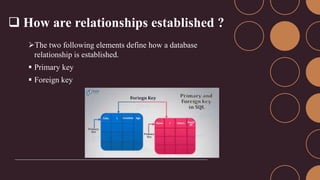
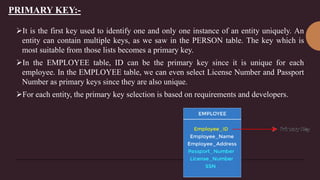
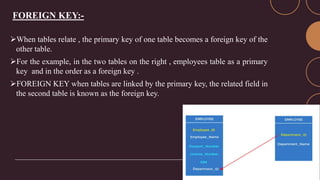
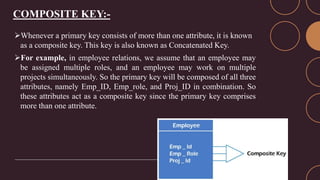
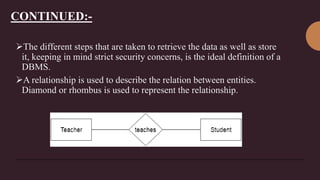
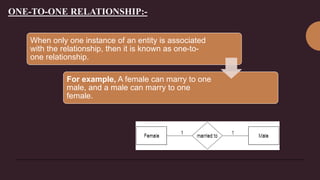
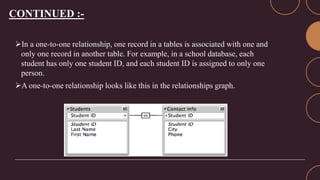
This document discusses relationships in database management systems. It begins by introducing relationships and how they are established through primary and foreign keys. It then describes different types of relationships: one-to-one, one-to-many, many-to-one, and many-to-many. For each relationship type, it provides examples and descriptions of how the relationships are implemented in tables. The document emphasizes that relationships are important for reducing data redundancy, organizing the database, and ensuring referential integrity. It concludes by reiterating the importance of properly defining relationships for effective database functioning.









![ML PROJECT FINAL[1].pptx](https://cdn.slidesharecdn.com/ss_thumbnails/mlprojectfinal1-230504044433-4418a95d-thumbnail.jpg?width=640&height=640&fit=bounds)


![DBMS[1].pptx](https://cdn.slidesharecdn.com/ss_thumbnails/dbms1-230410082711-c24f9c2b-thumbnail.jpg?width=640&height=640&fit=bounds)


