RCA
                     Root Cause Analysis

            Excellence in Problem Solving


                Prepared and Presented by :-
                           Mr. Deepak Kumar Sahoo
Prepared By – Mr. Deepak Kumar Sahoo
What is RCA ?

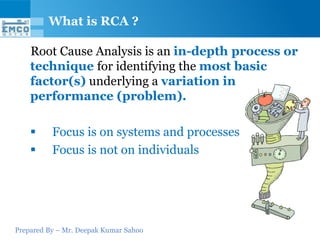
    Root Cause Analysis is an in-depth process or
    technique for identifying the most basic
    factor(s) underlying a variation in
    performance (problem).

         Focus is on systems and processes
         Focus is not on individuals


Prepared By – Mr. Deepak Kumar Sahoo
Types of RCA

• Safety-based RCA
      Investigating accident , occupational safety and health.
      Root causes:- unidentified risks, or inadequate safety engineering, missing safety
       barriers.
• Production-based RCA
      Quality control for industrial manufacturing.
      Root causes:- non-conformance like, malfunctioning steps in production line.
• Process-based RCA
      Extension of Production-based RCA.
      Includes business processes also.
      Root causes:- Individual process failures
• Systems-based RCA
      Hybrid of the previous types
      New concepts includes:- change management, systems thinking, and risk
       management.
      Root causes:- organizational culture and strategic management


Prepared By – Mr. Deepak Kumar Sahoo
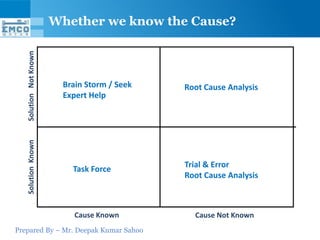
Whether we know the Cause?
   Solution Not Known


                         Brain Storm / Seek   Root Cause Analysis
                         Expert Help
   Solution Known


                           Task Force         Trial & Error
                                              Root Cause Analysis


                            Cause Known         Cause Not Known
Prepared By – Mr. Deepak Kumar Sahoo
RCA Benefits :-

By eliminating the root cause…
                     You save time and money!


• Problems are not repeated
• Reduce rework, retest, re-inspect, poor quality costs, etc…
• Problems are prevented in other areas
• Communication improves between groups and Process
  cycle times improve (no rework loops)
• Secure long term company performance and profits


Prepared By – Mr. Deepak Kumar Sahoo
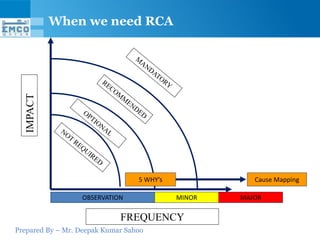
When we need RCA
   IMPACT


                                  5 WHY’s              Cause Mapping

                  OBSERVATION               MINOR   MAJOR

                             FREQUENCY
Prepared By – Mr. Deepak Kumar Sahoo
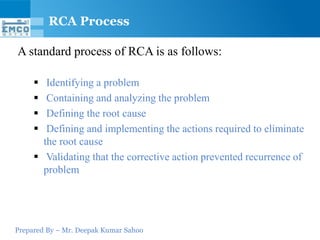
RCA Process

A standard process of RCA is as follows:

       Identifying a problem
       Containing and analyzing the problem
       Defining the root cause
       Defining and implementing the actions required to eliminate
       the root cause
      Validating that the corrective action prevented recurrence of
       problem


Prepared By – Mr. Deepak Kumar Sahoo
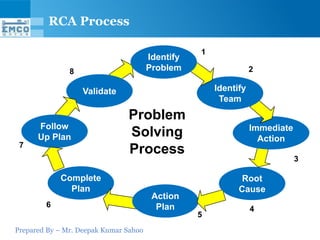
RCA Process

                                                  1
                                       Identify
               8                       Problem                   2

                   Validate                           Identify
                                                       Team
                               Problem
      Follow                                                     Immediate
      Up Plan                  Solving                             Action
 7
                               Process
                                                                             3

            Complete                                         Root
              Plan                                          Cause
                                        Action
        6                                Plan                    4
                                                  5
Prepared By – Mr. Deepak Kumar Sahoo
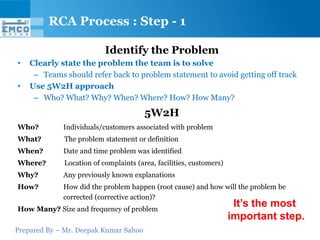
RCA Process : Step - 1

                          Identify the Problem
•   Clearly state the problem the team is to solve
     – Teams should refer back to problem statement to avoid getting off track
•   Use 5W2H approach
     – Who? What? Why? When? Where? How? How Many?
                                       5W2H
Who?         Individuals/customers associated with problem
What?        The problem statement or definition
When?        Date and time problem was identified
Where?       Location of complaints (area, facilities, customers)
Why?         Any previously known explanations
How?         How did the problem happen (root cause) and how will the problem be
             corrected (corrective action)?
How Many? Size and frequency of problem
                                                                     It’s the most
                                                                    important step.
Prepared By – Mr. Deepak Kumar Sahoo
RCA Process : Step - 2

                              Identify Team
  When a problem cannot be solved quickly by an individual,
                         use a team!
 Should consist of domain knowledge experts
 Small group of people (4-10) with process and product
  knowledge, available time and authority to correct the
  problem
 Must be empowered to “change the rules”
 Should have a designated Team leader.
 Membership in team is always changing!


Prepared By – Mr. Deepak Kumar Sahoo
RCA Process : Step – 2 (Continue..)

Key Ideas for Team Success
   Define roles and responsibilities
   Identify external customer needs
   Identify internal customer needs
   Appropriate levels of organization present
   Clearly defined objectives and outputs
   Solicit input from everyone!
   Good meeting location - Near work area for easy access to information.
                                                      Roles and Responsibilities
        Team Leader: Mentor, guide and direct teams, advocate to upper management
        Leader: day-to-day authority, calls meetings, facilitation of team, reports to TL.
        Record Keeper: Writes and publishes minutes
        Participants: Respect all ideas, keep an open mind, know their role within team


Prepared By – Mr. Deepak Kumar Sahoo
RCA Process : Step – 3

                         Immediate Action
 Must isolate effects of problem from customer
 Only temporary until corrective action is implemented
 Must also verify that immediate action is effective


                    Verify Immediate Action
 Immediate action = activity implemented to screen, detect and/or contain
  the problem.
 Must verify that immediate action was effective
    Run Pilot Tests
    Make sure another problem does not arise from the temporary solutions
 Ensure effective screens and detections are in place to prevent further impact
  to customer until permanent solution is implemented.


Prepared By – Mr. Deepak Kumar Sahoo
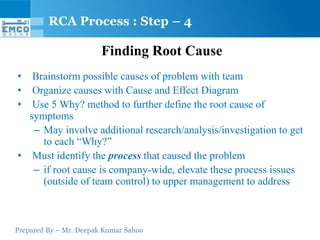
RCA Process : Step – 4

                        Finding Root Cause
•  Brainstorm possible causes of problem with team
•  Organize causes with Cause and Effect Diagram
•  Use 5 Why? method to further define the root cause of
  symptoms
   – May involve additional research/analysis/investigation to get
     to each “Why?”
• Must identify the process that caused the problem
   – if root cause is company-wide, elevate these process issues
     (outside of team control) to upper management to address


Prepared By – Mr. Deepak Kumar Sahoo
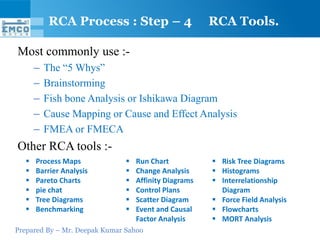
RCA Process : Step – 4                     RCA Tools.

Most commonly use :-
       –   The “5 Whys”
       –   Brainstorming
       –   Fish bone Analysis or Ishikawa Diagram
       –   Cause Mapping or Cause and Effect Analysis
       –   FMEA or FMECA
Other RCA tools :-
      Process Maps               Run Chart            Risk Tree Diagrams
      Barrier Analysis           Change Analysis      Histograms
      Pareto Charts              Affinity Diagrams    Interrelationship
      pie chat                   Control Plans         Diagram
      Tree Diagrams              Scatter Diagram      Force Field Analysis
      Benchmarking               Event and Causal     Flowcharts
                                   Factor Analysis      MORT Analysis
Prepared By – Mr. Deepak Kumar Sahoo
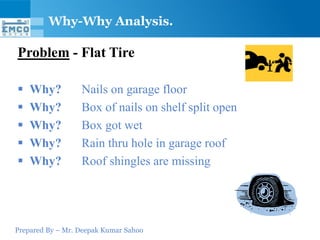
Why-Why Analysis.

Problem - Flat Tire

   Why?          Nails on garage floor
   Why?          Box of nails on shelf split open
   Why?          Box got wet
   Why?          Rain thru hole in garage roof
   Why?          Roof shingles are missing


Prepared By – Mr. Deepak Kumar Sahoo
TIPS for Why-Why Analysis.

 It should be done within 24 hours of problem
  occurrence
 Person who was present when the problem occurred
  should be part of why-why analysis
 Why-Why analysis should be done at the location
  where the problem has occurred
 Stop when the answers become less important.
 Stop when the root cause condition is isolated.
 Ask “Why?” 5 times can extend maximum 7 times. If
  you will not find the possible solution then use Other
  RCA tools.
Prepared By – Mr. Deepak Kumar Sahoo
Why-Why Analysis Examples

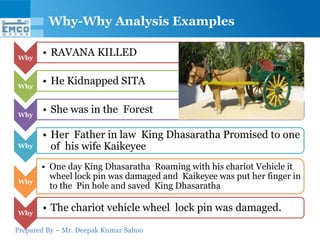
Why
       • RAVANA KILLED


Why
       • He Kidnapped SITA


Why
       • She was in the Forest

       • Her Father in law King Dhasaratha Promised to one
Why      of his wife Kaikeyee
       • One day King Dhasaratha Roaming with his chariot Vehicle it
         wheel lock pin was damaged and Kaikeyee was put her finger in
Why
         to the Pin hole and saved King Dhasaratha

Why
       • The chariot vehicle wheel lock pin was damaged.

Prepared By – Mr. Deepak Kumar Sahoo
Why-Why Analysis Examples

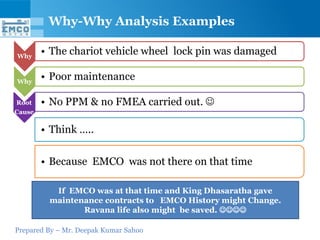
Why
        • The chariot vehicle wheel lock pin was damaged

Why
        • Poor maintenance

Root
 Why
        • No PPM & no FMEA carried out. 
Cause


        • Think …..


        • Because EMCO was not there on that time

          If EMCO was at that time and King Dhasaratha gave
         maintenance contracts to EMCO History might Change.
                Ravana life also might be saved. 

Prepared By – Mr. Deepak Kumar Sahoo
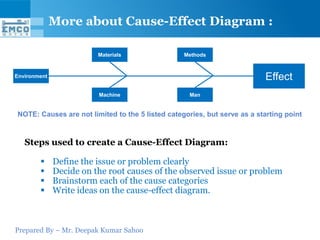
More about Cause-Effect Diagram :

                         Materials                Methods


Environment                                                               Effect
                         Machine                    Man


NOTE: Causes are not limited to the 5 listed categories, but serve as a starting point


   Steps used to create a Cause-Effect Diagram:

             Define the issue or problem clearly
             Decide on the root causes of the observed issue or problem
             Brainstorm each of the cause categories
             Write ideas on the cause-effect diagram.


Prepared By – Mr. Deepak Kumar Sahoo
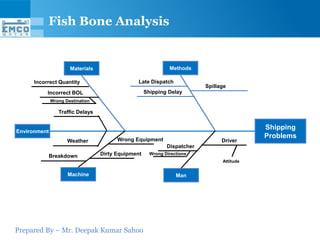
Fish Bone Analysis


                      Materials                               Methods

      Incorrect Quantity                        Late Dispatch
                                                                          Spillage
           Incorrect BOL                            Shipping Delay
              Wrong Destination

                 Traffic Delays

                                                                                           Shipping
Environment
                                        Wrong Equipment
                                                                                           Problems
                     Weather                                                    Driver
                                                             Dispatcher
           Breakdown              Dirty Equipment     Wrong Directions
                                                                                Attitude


                     Machine                                     Man


Prepared By – Mr. Deepak Kumar Sahoo
RCA Process : Step – 5

                                Corrective Action Plan
•   Must verify the solution will eliminate the problem
    – Verification before implementation whenever possible
•   Define exactly…
    – What actions will be taken to eliminate the problem?
    – Who is responsible?
    – When will it be completed?
•   Make certain customer is happy with actions
•   Define how the effectiveness of the corrective action will be measured.
                              Verification vs. Validation
Verification
     – Assures that at a point in time, the action taken will actually do what is intended without
         causing another problem
Validation
     – Provides measurable evidence over time that the action taken worked properly, and
         problem has not recurred

Prepared By – Mr. Deepak Kumar Sahoo
Types of Corrective action.
3 types of Corrective Action:

• Immediate action

     – The action taken to quickly fix the impact of the problem so the
       “customer” is not further impacted

• Permanent root cause corrective action

     – The action taken to eliminate the error on the affected process or product

• Preventive (Systemic) root cause corrective action

     – The action taken to Prevent the error from recurring on any process or
       product


Prepared By – Mr. Deepak Kumar Sahoo
Corrective Action Examples

 Immediate (step #3)
     All current batch of paperwork re-inspected by
     another worker for same type of problem
      Permanent (step #5)
           Form changed to mandate completion of certain fields

            Preventive (step #5)
                     Similar forms with same fields used all over in
                     company are changed to “mandatory”


Prepared By – Mr. Deepak Kumar Sahoo
RCA Process : Step – 6

                        Complete Action Plan

 Make certain all actions that are defined are completed as
  planned

 If one task is still open, verification and validation is pushed
  back

 If the plan is compromised, most likely the solution will not be
  as effective


Prepared By – Mr. Deepak Kumar Sahoo
RCA Process : Step – 7

                             Follow Up Plan

 What actions will be completed in the future to ensure that the
  root cause has been eliminated by this corrective action?
 Who will look at what data?
 How long after the action plan will this be done?
 What criteria in the data results will determine that the problem
  has not recurred?


Prepared By – Mr. Deepak Kumar Sahoo
RCA Process : Step – 8

                     Validate and Celebrate
•   What were the results of the follow up?

•    If problem did reoccur, go back to Step #4 and re-evaluate root
    cause, then re-evaluate corrective action in Step #5

•   If problem did not reoccur, celebrate team success!

•    Document savings to publicize team effort, obtain customer
    satisfaction and continued management support of teams


Prepared By – Mr. Deepak Kumar Sahoo
RCA Example - 1

                            Identify Problem
   A manager walks past the assembly line and notices a puddle of
     water on the floor. Knowing that the water is a safety hazard,
    she asks the supervisor to have someone get a mop and clean up
       the puddle. The manager is proud of herself for “fixing” a
                        potential safety problem.
                           Immediate Action
   Knowing that the water is a safety hazard, the manager asks the
    supervisor to have someone get a mop and clean up the puddle.
                   But What is the Root Cause?
        The supervisor looks for a root cause by asking 'why?’

Prepared By – Mr. Deepak Kumar Sahoo
RCA Example – 1

    WHY          Puddle of water on the floor


    WHY          Leak in overhead pipe


    WHY          Water pressure is set too high


    WHY          Water pressure valve is faulty


 Root Cause Valve not in PPM program


Prepared By – Mr. Deepak Kumar Sahoo
RCA Example – 1

                         Corrective Action

 Permanent – Water pressure valves placed in
  preventative maintenance program.

 Preventive - Developed checklist form to ensure new
  equipment is reviewed for possible inclusion in
  preventative maintenance program.


Prepared By – Mr. Deepak Kumar Sahoo
RCA Example – 2

                   Identify Problem
  Customers are unhappy because they are being shipped
       products that don't meet their specifications.

                      Immediate Action
   Inspect all finished and in-process product to ensure it
                meets customer specifications.

                        Find out the root cause


Prepared By – Mr. Deepak Kumar Sahoo
RCA Example – 2

     WHY         Product doesn’t meet specifications

                 Manufacturing specification is different from what customer and sales
     WHY         person agreed.
                 Sales person tries to expedite work by calling head of manufacturing
     WHY         directly.
                 Manufacturing schedule is not available for sales person to provide
     WHY         realistic delivery date.
                 Confidence in manufacturing schedule is not high enough to
     WHY         release/link with order system

     WHY         Parts sometimes not available thereby creating schedule changes


     WHY         Expediting and priority changes consume parts not planned for

                 Manufacturing schedule does not reflect realistic assembly and test
     WHY         time.

 Root Cause      No ongoing review of manufacturing standards.

Prepared By – Mr. Deepak Kumar Sahoo
RCA Example – 2

Corrective Action
• Permanent – Manufacturing standards reviewed and
  updated.

• Preventive - Regular ongoing review of actuals vs
  standards is implemented.


Prepared By – Mr. Deepak Kumar Sahoo
RCA Example – 3

Identify Problem
Part polarity reversed on circuit board

Immediate Action
 Additional inspection added after this assembly
  process step to check for reversed part defects.

 Last 10 lots of printed circuit boards were re-inspected
  to check for similar errors.


Prepared By – Mr. Deepak Kumar Sahoo
RCA Example – 3

    WHY          Part reversed.


    WHY          Worker not sure of correct part orientation.


    WHY          Part is not marked properly.


    WHY          Engineering ordered it that way from vendor

                 Process didn’t account for possible
 Root Cause
                 manufacturing issues

Prepared By – Mr. Deepak Kumar Sahoo
RCA Example – 3

Corrective Action:-

• Permanent – Changed part to one that can only be
  placed in correct direction (Mistake proofed). Found
  other products with similar problem and made same
  changes.

• Preventive - Required that any new parts selected
  must have orientation marks on them.


Prepared By – Mr. Deepak Kumar Sahoo
RCA Example – 4

                    Identify Problem
      Department didn’t complete their project on time.

                  Immediate Action
 Additional resources applied to help get the project
  team back on schedule
 No new projects started until Root Cause Analysis
  completed

                 Now we will find the root cause
Prepared By – Mr. Deepak Kumar Sahoo
RCA Example – 4

            WHY          Didn’t complete project on time


       Method                            Man
                                                           Lack of worker
                                                             knowledge


                              Poor project                   Lack of resources
                              management
                                 skills

                                                                      Didn’t complete
                                                                      project on time

    Inadequate
     computer
     programs                                        Inadequate
                                                   computer system


      Materials                        Machine

Prepared By – Mr. Deepak Kumar Sahoo
RCA Example – 4

           WHY           Didn’t complete project on time


           WHY           Resources unavailable when needed.


           WHY           Took too long to hire Project Manager


                         Lack of specifics given to
           WHY           Human Resources Department.


         Root Cause      No formal process for submitting job opening


Prepared By – Mr. Deepak Kumar Sahoo
RCA Example – 4

Corrective Action

 Permanent – Hired another worker to meet needs of
  next project team

 Preventive - Developed checklist form with HR for
  submitting job openings in the future.


Prepared By – Mr. Deepak Kumar Sahoo
More on Why-Why analysis ?

   Why People turnover is high in EMCO?
   Why work load is more in QF?
   Why PPM in QF is not so effective ?
   Why Rajnikant is to too famous?
   Why CM has reduced in QF from EMCO side ?


Prepared By – Mr. Deepak Kumar Sahoo
Why-Why Analysis (multiple cause Examples)


                 Employee turnover rate has been
                           increasing


          Why?           Why?              Why?           Why?          Why?


       Employees       Employees        Employees         Other       Demand for
       are leaving       are not       feel that they   employers         such
      for other jobs    satisfied            are        are paying     employees
                                         underpaid        higher     has increased
                                                         salaries    in the market

Prepared By – Mr. Deepak Kumar Sahoo
Thank you !!!


Connect With Me @
Mobile     :- +974 – 3370 8982
Email      :- dksahoo2@gmail.com
LinkedIn :- www.linkedin.com/in/dksahoo
Facebook :- www.facebook.com/dksahoo2
Twitter    :- www.twitter.com/defydeepak
Slideshare :- www.slideshare.net/dksahoo2
 Prepared By – Mr. Deepak Kumar Sahoo