RANGE OF MOTION AND
MUSCLE STRENGTHENING
EXERCISES
PRESENTED BY:
MISS. SHWETA SHARMA
M.SC. NURSING 2nd YEAR
COLLEGE OF NURSING
AIIMS, JODHPUR
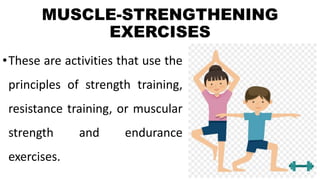
MUSCLE-STRENGTHENING
EXERCISES
•These are activities that use the
principles of strength training,
resistance training, or muscular
strength and endurance
exercises.
TWO TYPES OF EXERCISES
•Isometric exercise is when we tighten our muscles but do
not move our joints. These exercises help to build muscle
without having to move painful joints.
•Isotonic exercise is when we move our joints to make our
muscles stronger.
Purpose of muscle strengthening
exercises:
• To increase muscle strength and endurance.
• To maintain normal physiological function.
• To prevent complications caused by immobility.
• To improve physical activity.
• To increase joint flexibility.
• To increase general physical health.
• For rehabilitation and to address an impairment.
• Strength training protects bone health and muscle mass.
• Strength training helps to develop better body mechanics.
• Strength training can help with chronic disease
management.
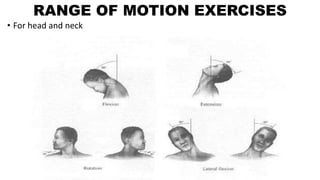
RANGE OF MOTION EXERCISES
• For head and neck
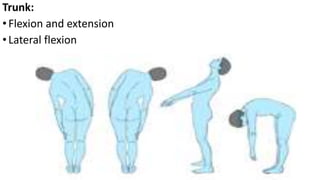
Trunk:
•Flexion and extension
•Lateral flexion
•Arm and shoulder
Elbow:
Wrist:
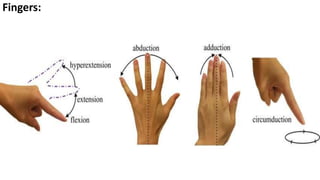
Fingers:
Thumb:
Hip:
Knee:
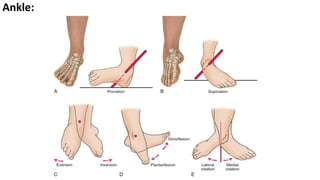
Ankle:
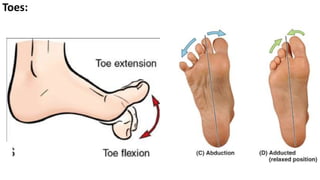
Toes:
Muscle strengthening exercises
•Do it for 30 seconds
Hold for a count of 5 seconds, relax and repeat.
Repeat 10 times on each leg
Glute squeeze
Hold for a count of 5 seconds.
Then relax for 10 seconds
Repeat steps 1-3 10 times.
Heel slides
Repeat steps 10 times on each leg.
Push-ups
Repeat steps 10 times.
Shoulder raise
Repeat steps 10 times.
Others:
• Weight lifting
• Working with resistance bands
• Heavy gardening, such as digging and shovelling
• Climbing stairs
• Hill walking
• Cycling
• Dancing
• Push-ups, sit-ups and squats
• Yoga
Benefits of physical activities in
neurological conditions:
• Balance training with
electromyogram-triggered functional
electrical stimulation to improve
static balance, dynamic balance, and
ankle muscle activation suggest
positive results with stroke patients.
• Exercise improves the physical and
emotional well-being in patients
who already have Alzheimer's
disease.
• Patients with neurological
disorders who exercise experience
less stiffness, as well as reduction in,
and even reversal of muscle wasting.
•Exercise improves gait,
balance, tremor, flexibility,
grip strength and motor
coordination in patients with
Parkinson’s disease.
Patient education
• Always warm-up before beginning exercise
routine and cool down at the end.
• If planning to work out for 30 minutes, start
with 10-minute sessions and work your way
up.
• Exercise facial muscles, jaw, and voice when
possible.
• Sing or read aloud, exaggerating lip
movements.
• Make faces in the mirror.
• Chew food vigorously, avoid swallowing
large pieces. Instead, chew each piece for at
least 20 seconds.
• Work out in a safe environment. Avoid
slippery floors, poor lighting, throw rugs, and
other potential dangers.
• If having difficulty balancing,
exercise within reach of a grab bar or
rail. If having trouble standing or
getting up, try exercising in bed rather
than on the floor or an exercise mat.
• Rest muscles for at least one day
between strength training sessions.
• Stop when experiencing unusual
symptoms or pain.
Range of motion and muscle strengthening exercises