Randomized controlled trials   The Basics
Definition RCT is a study in which a group of investigators studies two interventions in a series of individuals who receive  them in a random order. Intervention to be tested is called the experimental group
The other intervention is regarded as a standard of comparison or control, and the group of participants who receive it is called the control group.  The control can be conventional practice, a placebo, or no intervention at all
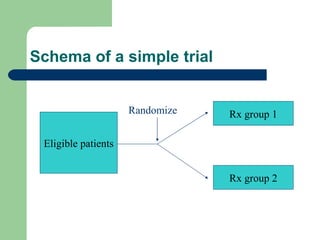
Schema of a simple trial Eligible patients Rx group 1 Rx group 2 Randomize
Why Randomize? Compare groups at the end of the trial Difference is  because  of the Rx For this you need comparable groups Purpose of randomization is to make the treatment groups  comparable Ensures that only difference in groups is due to trial treatments
RCT ‘ the most powerful tool in modern clinical research “ Prospective Controlled unbiased
What is wrong with non-randomized studies? Two main types of study, those with and those without concurrent control groups
Non-randomized studies II Without concurrent controls Uncontrolled  cannot really make much of such studies if there is any variation in outcomes. Historical controls  type of patient may change, due to eligibility criteria environment changes, due to trial data quality often quite different between groups
Non-randomized studies III Non-randomized concurrent controls Alternation Odd/Even hospital no. or date of birth First letter of surname Difficult to argue that one group is different from another but allocation is predictable, so bias can arise from selection of patients so randomization must be unpredictabl e
Random allocation   all participants have the  same chance of being assigned to each of the study groups  the purpose is to keep both groups as similar to each as possible at the start of the trial.
Is coin tossing OK? OK for big trials For small trials, such ‘simple randomization’ can lead to imbalance in group sizes
Example: trial with 30 patients If 30 patients are in a trial randomized using coin tossing there is a 14% chance of 15:15 split For 16:14 chance is 27% ‘ Worse’ than 20:10 is 10% Why ‘worse’? Because imbalance leads to loss of power
But we need randomization to be done properly to ensure similar numbers in groups To  combine with stratification - in large trials-  to ensure comparability for prognostic factors
Pseudo-randomisation Alternating record  number Date of birth Geographical distribution Open list
True randomization Need to separate the person who generates allocation from those who assess eligibility Third party schemes Telephone randomization service Pharmacy randomization Web-based service? Envelopes Sealed envelopes (preferably opaque)
Value of randomization it reduces the risk of serious imbalance in  unknown but important factors that could influence the  clinical course of the participants.
Types of RCTs RCTs according to whether the investigators and participants know which intervention is being assessed  Open trials  Single blind trials  Double blind trials  Triple blind trials
RCTs according to how the participants are exposed to the interventions  Parallel trials  Crossover trials  Trials with factorial design
Blinding The best way to protect a trial against is by keeping the people involved in the trial unaware of the identity of the interventions for as long as possible
Blinding Could be single Could be double Could be triple
Blinding is difficult Having placebo in the same shape , formula and taste is very costly, and time consuming. The drug side effects e.g. local reaction at the site of injection would partially unblind . Impossible if surgical and medical treatments are compared. The need for urgent unblinding code in case of serious side effects
Follow up Adherence to the study protocol Patients compliance with treatment and follow up sufficiently long and complete
Analysis of clinical trials  Analysis of clinical trials Intension to treat analysis Per protocol analysis Sub group analysis
Disadvantages of RCTs expensive: time and money;  volunteer bias;  ethically problematic at times.
Interim Analysis Done in large multicenter RCTs To explore the results after recruiting of half of the participants If marked difference is recognized , then trial should be stopped Examples: WHI trial   Breech Trial   AIDS trial
RCTs The gold standard for therapeutic research Basis for Meta-analysis Search for it first