Downloaded 67 times


![A better partition
• Want to partition an array A[left .. right]
• First, get the pivot element out of the way by swapping it with the last
element. (Swap pivot and A[right])
pivot i j
5 6 4 6 3 12 19 5 6 4 63 1219
swap](https://image.slidesharecdn.com/quicksort-presentation-191209183910/85/Quick-sort-8-320.jpg)
![• When i and j have stopped and i is to the left of j
– Swap A[i] and A[j]
• The large element is pushed to the right and the small element is pushed to
the left
– Repeat the process until i and j cross
swap
i j
5 6 4 63 1219
i j
5 3 4 66 1219](https://image.slidesharecdn.com/quicksort-presentation-191209183910/85/Quick-sort-10-320.jpg)
![• When i and j have crossed
– Swap A[i] and pivot
• Result:
– A[x] <= pivot, for x < i
– A[x] >= pivot, for x > i
i j
5 3 4 66 1219
ij
5 3 4 66 1219
ij
5 3 4 6 6 12 19](https://image.slidesharecdn.com/quicksort-presentation-191209183910/85/Quick-sort-11-320.jpg)

![Quicksort Algorithm
• To sort a[left...right]:
1. if left < right:
1.1. Partition a[left...right] such that:
all a[left...p-1] are less than a[p], and
all a[p+1...right] are >= a[p]
1.2. Quicksort a[left...p-1]
1.3. Quicksort a[p+1...right]
2. Terminate](https://image.slidesharecdn.com/quicksort-presentation-191209183910/85/Quick-sort-13-320.jpg)
![Quick Sort Source Code C++
void QuickSort(int list[], int left, int right) {
int pivot, leftArrow, rightArrow;
leftArrow = left;
rightArrow = right;
pivot = list[(left + right) / 2];
do {
while (list[rightArrow] > pivot)
rightArrow--;
while (list[leftArrow] < pivot)
leftArrow++;
if (leftArrow <= rightArrow) {
Swap_Data(list[leftArrow], list[rightArrow]);
leftArrow++;
rightArrow--;
}
}
while (rightArrow >= leftArrow);
if (left < rightArrow)
QuickSort(list, left, rightArrow);
if (leftArrow < right)
QuickSort(list, leftArrow, right);
}](https://image.slidesharecdn.com/quicksort-presentation-191209183910/85/Quick-sort-14-320.jpg)
![Quick Sort Pseudo Code
• QuickSort(A,start,end)
• { if(start<end)
• { pIndex 🡨 partition(A,start,end)
QuickSort(A,start,Pindex-1)
QuickSort(A,Pindex+1,end)
}
}
• Partition(A,start,end)
• { pivot 🡨 A[end]
Pindex 🡨 start
For i 🡨 start to end-1
{
If(A[i] <= pivot)
{ Swap(a[i],P[pindex])
Pindex 🡨 Pindex+1
}
}
Swap(A[pindex] , A[end])
Return Pindex }](https://image.slidesharecdn.com/quicksort-presentation-191209183910/85/Quick-sort-15-320.jpg)




![A better partition
• Want to partition an array A[left .. right]
• First, get the pivot element out of the way by swapping it with the last
element. (Swap pivot and A[right])
pivot i j
5 6 4 6 3 12 19 5 6 4 63 1219
swap](/p?url=https%3A%2F%2Fimage.slidesharecdn.com%2Fquicksort-presentation-191209183910%2F85%2FQuick-sort-8-320.jpg&__src=https%3A%2F%2Fwww.slideshare.net%2Fslideshow%2Fquick-sort-203686972%2F203686972&__type=image)

![• When i and j have stopped and i is to the left of j
– Swap A[i] and A[j]
• The large element is pushed to the right and the small element is pushed to
the left
– Repeat the process until i and j cross
swap
i j
5 6 4 63 1219
i j
5 3 4 66 1219](/p?url=https%3A%2F%2Fimage.slidesharecdn.com%2Fquicksort-presentation-191209183910%2F85%2FQuick-sort-10-320.jpg&__src=https%3A%2F%2Fwww.slideshare.net%2Fslideshow%2Fquick-sort-203686972%2F203686972&__type=image)
![• When i and j have crossed
– Swap A[i] and pivot
• Result:
– A[x] <= pivot, for x < i
– A[x] >= pivot, for x > i
i j
5 3 4 66 1219
ij
5 3 4 66 1219
ij
5 3 4 6 6 12 19](/p?url=https%3A%2F%2Fimage.slidesharecdn.com%2Fquicksort-presentation-191209183910%2F85%2FQuick-sort-11-320.jpg&__src=https%3A%2F%2Fwww.slideshare.net%2Fslideshow%2Fquick-sort-203686972%2F203686972&__type=image)

![Quicksort Algorithm
• To sort a[left...right]:
1. if left < right:
1.1. Partition a[left...right] such that:
all a[left...p-1] are less than a[p], and
all a[p+1...right] are >= a[p]
1.2. Quicksort a[left...p-1]
1.3. Quicksort a[p+1...right]
2. Terminate](/p?url=https%3A%2F%2Fimage.slidesharecdn.com%2Fquicksort-presentation-191209183910%2F85%2FQuick-sort-13-320.jpg&__src=https%3A%2F%2Fwww.slideshare.net%2Fslideshow%2Fquick-sort-203686972%2F203686972&__type=image)
![Quick Sort Source Code C++
void QuickSort(int list[], int left, int right) {
int pivot, leftArrow, rightArrow;
leftArrow = left;
rightArrow = right;
pivot = list[(left + right) / 2];
do {
while (list[rightArrow] > pivot)
rightArrow--;
while (list[leftArrow] < pivot)
leftArrow++;
if (leftArrow <= rightArrow) {
Swap_Data(list[leftArrow], list[rightArrow]);
leftArrow++;
rightArrow--;
}
}
while (rightArrow >= leftArrow);
if (left < rightArrow)
QuickSort(list, left, rightArrow);
if (leftArrow < right)
QuickSort(list, leftArrow, right);
}](/p?url=https%3A%2F%2Fimage.slidesharecdn.com%2Fquicksort-presentation-191209183910%2F85%2FQuick-sort-14-320.jpg&__src=https%3A%2F%2Fwww.slideshare.net%2Fslideshow%2Fquick-sort-203686972%2F203686972&__type=image)
![Quick Sort Pseudo Code
• QuickSort(A,start,end)
• { if(start<end)
• { pIndex 🡨 partition(A,start,end)
QuickSort(A,start,Pindex-1)
QuickSort(A,Pindex+1,end)
}
}
• Partition(A,start,end)
• { pivot 🡨 A[end]
Pindex 🡨 start
For i 🡨 start to end-1
{
If(A[i] <= pivot)
{ Swap(a[i],P[pindex])
Pindex 🡨 Pindex+1
}
}
Swap(A[pindex] , A[end])
Return Pindex }](/p?url=https%3A%2F%2Fimage.slidesharecdn.com%2Fquicksort-presentation-191209183910%2F85%2FQuick-sort-15-320.jpg&__src=https%3A%2F%2Fwww.slideshare.net%2Fslideshow%2Fquick-sort-203686972%2F203686972&__type=image)


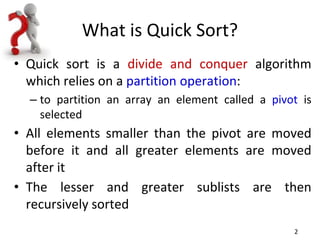
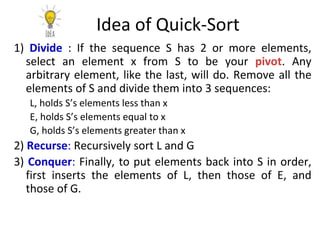
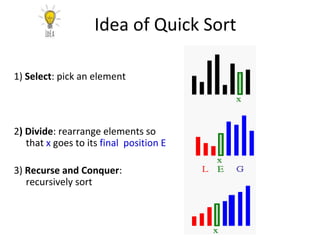
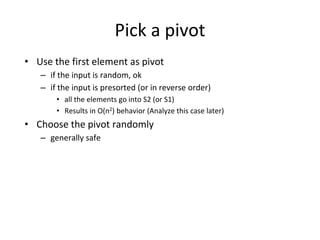
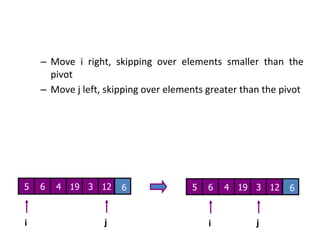
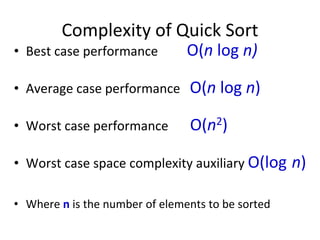
Quicksort is a divide and conquer algorithm that works by partitioning an array around a pivot value and recursively sorting the subarrays. It first selects a pivot element and partitions the array by moving all elements less than the pivot before it and greater elements after it. The subarrays are then recursively sorted through this process. When implemented efficiently with an in-place partition, quicksort is one of the fastest sorting algorithms in practice, with average case performance of O(n log n) time but worst case of O(n^2) time.


