Data Type
String str = ‘message’
Integer number = 20
Floating Point pi = 3.14159
Boolean isParse = True, False
None None
List list = [1, 2, 3]
Dictionary me = {“name”: “Bas”, “No”: 1}
Class instance a = MyClass()
8.
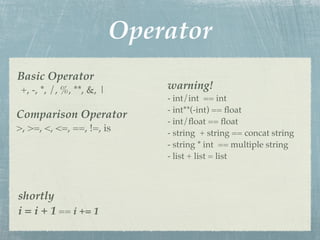
Operator
Basic Operator
+,-, *, /, %, **, &, | warning!
- int/int == int
- int**(-int) == float
Comparison Operator
- int/float == float
>, >=, <, <=, ==, !=, is - string + string == concat string
- string * int == multiple string
- list + list = list
shortly
i = i + 1 == i += 1
9.
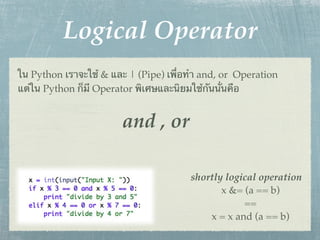
Logical Operator
ใน Pythonเราจะใช้ & และ | (Pipe) เพื่อทํา and, or Operation
แต่ใน Python ก็มี Operator พิเศษและนิยมใช้กันนั่นคือ
and , or
shortly logical operation
x &= (a == b)
==
x = x and (a == b)
10.
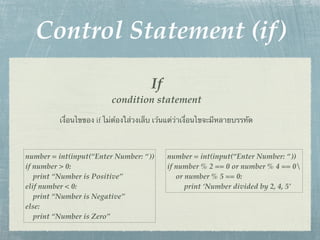
Control Statement (if)
If
condition statement
เงื่อนไขของ if ไม่ต้องใส่วงเล็บ เว้นแต่ว่าเงื่อนไขจะมีหลายบรรทัด
number = int(input(“Enter Number: “)) number = int(input(“Enter Number: “))
if number > 0: if number % 2 == 0 or number % 4 == 0
print “Number is Positive” or number % 5 == 0:
elif number < 0: print ‘Number divided by 2, 4, 5’
print “Number is Negative”
else:
print “Number is Zero”
11.
Control Statement (for)
For (foreach)
loop statement
list = [7, 8, 9, 10]
for x in xrange(10): for index, value in enumerate(list):
print x print index, value
for x in xrange(3, 20):
print x
x=0 Endless Loop
name = [‘a’, ‘b’, ‘c’] while (x <= 10): while True:
for x in name print x if condition:
print x x += 1 break;
12.
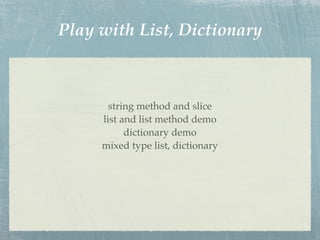
Play with List,Dictionary
string method and slice
list and list method demo
dictionary demo
mixed type list, dictionary
13.
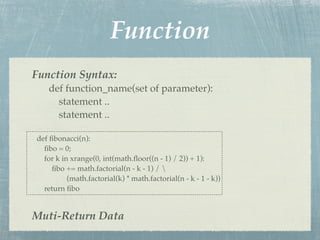
Function
Function Syntax:
def function_name(set of parameter):
statement ..
statement ..
def fibonacci(n):
fibo = 0;
for k in xrange(0, int(math.floor((n - 1) / 2)) + 1):
fibo += math.factorial(n - k - 1) /
(math.factorial(k) * math.factorial(n - k - 1 - k))
return fibo
Muti-Return Data
14.
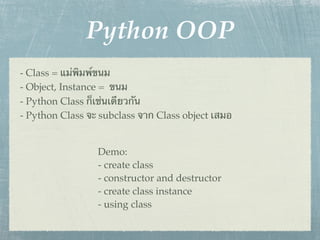
Python OOP
- Class= แม่พิมพ์ขนม
- Object, Instance = ขนม
- Python Class ก็เช่นเดียวกัน
- Python Class จะ subclass จาก Class object เสมอ
Demo:
- create class
- constructor and destructor
- create class instance
- using class
15.
Read and WriteFile
open(‘filename’, ‘mode’)
r = read # เปิดไฟล์เพื่ออ่าน
w = write # เปิดไฟล์เพื่อเขียนทับ
a = append # เปิดไฟล์เพื่อเขียนต่อ
file = open(‘filename.txt’, r)
file.read() # อ่านไฟล์ทั้งหมดเป็น String
file.readline() # อ่านไฟล์ทีละบรรทัด
file.readlines() # อ่านไฟล์ทุกบรรทัดออกมาเป็น List of String
file.write(‘string’) # เขียน String ทั้งหมดลงไฟล์
file.writelines([list of string]) # เขียน List of String ลงไฟล์
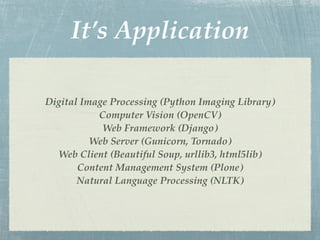
It’s Application
Digital ImageProcessing (Python Imaging Library)
Computer Vision (OpenCV)
Web Framework (Django)
Web Server (Gunicorn, Tornado)
Web Client (Beautiful Soup, urllib3, html5lib)
Content Management System (Plone)
Natural Language Processing (NLTK)

![PEP-8 Overview [1]
‣ 4 white spaces or 1 tab for indentation
‣ อย่าให้แต่ละบรรทัดเกิน 79 ตัวอักษร
‣ คั่นส่วนต่างๆ ของโปรแกรมด้วยการเว้นบรรทัด](https://image.slidesharecdn.com/python101-121108114331-phpapp02/85/Python101-5-320.jpg)
![PEP-8 Overview [2]
import library 1 ตัวต่อ 1 บรรทัด
import ที่ด้านบนของไฟล์เสมอ
import cv
import bs4 Yes:
from subprocess import Popen, PIPE x=1
y=2
Yes: spam(ham[1], {eggs: 2}) long_variable = 3
No: spam( ham[ 1 ], { eggs: 2}) No:
x =1
Yes: dict[‘key’] = list[index] y =2
No: dict [‘key’] = list [index] long_variable = 3
อย่าใช้ whitespace พร่ําเพรื่อ (1 บรรทัดไม่ควรเกิน 79 ตัวอักษร)](https://image.slidesharecdn.com/python101-121108114331-phpapp02/85/Python101-6-320.jpg)
![Data Type
String str = ‘message’
Integer number = 20
Floating Point pi = 3.14159
Boolean isParse = True, False
None None
List list = [1, 2, 3]
Dictionary me = {“name”: “Bas”, “No”: 1}
Class instance a = MyClass()](https://image.slidesharecdn.com/python101-121108114331-phpapp02/85/Python101-7-320.jpg)
![Control Statement (for)
For (foreach)
loop statement
list = [7, 8, 9, 10]
for x in xrange(10): for index, value in enumerate(list):
print x print index, value
for x in xrange(3, 20):
print x
x=0 Endless Loop
name = [‘a’, ‘b’, ‘c’] while (x <= 10): while True:
for x in name print x if condition:
print x x += 1 break;](https://image.slidesharecdn.com/python101-121108114331-phpapp02/85/Python101-11-320.jpg)
![Read and Write File
open(‘filename’, ‘mode’)
r = read # เปิดไฟล์เพื่ออ่าน
w = write # เปิดไฟล์เพื่อเขียนทับ
a = append # เปิดไฟล์เพื่อเขียนต่อ
file = open(‘filename.txt’, r)
file.read() # อ่านไฟล์ทั้งหมดเป็น String
file.readline() # อ่านไฟล์ทีละบรรทัด
file.readlines() # อ่านไฟล์ทุกบรรทัดออกมาเป็น List of String
file.write(‘string’) # เขียน String ทั้งหมดลงไฟล์
file.writelines([list of string]) # เขียน List of String ลงไฟล์](https://image.slidesharecdn.com/python101-121108114331-phpapp02/85/Python101-15-320.jpg)


![PEP-8 Overview [1]
‣ 4 white spaces or 1 tab for indentation
‣ อย่าให้แต่ละบรรทัดเกิน 79 ตัวอักษร
‣ คั่นส่วนต่างๆ ของโปรแกรมด้วยการเว้นบรรทัด](/p?url=https%3A%2F%2Fimage.slidesharecdn.com%2Fpython101-121108114331-phpapp02%2F85%2FPython101-5-320.jpg&__src=https%3A%2F%2Fwww.slideshare.net%2Fslideshow%2Fpython101%2F15087301&__type=image)
![PEP-8 Overview [2]
import library 1 ตัวต่อ 1 บรรทัด
import ที่ด้านบนของไฟล์เสมอ
import cv
import bs4 Yes:
from subprocess import Popen, PIPE x=1
y=2
Yes: spam(ham[1], {eggs: 2}) long_variable = 3
No: spam( ham[ 1 ], { eggs: 2}) No:
x =1
Yes: dict[‘key’] = list[index] y =2
No: dict [‘key’] = list [index] long_variable = 3
อย่าใช้ whitespace พร่ําเพรื่อ (1 บรรทัดไม่ควรเกิน 79 ตัวอักษร)](/p?url=https%3A%2F%2Fimage.slidesharecdn.com%2Fpython101-121108114331-phpapp02%2F85%2FPython101-6-320.jpg&__src=https%3A%2F%2Fwww.slideshare.net%2Fslideshow%2Fpython101%2F15087301&__type=image)
![Data Type
String str = ‘message’
Integer number = 20
Floating Point pi = 3.14159
Boolean isParse = True, False
None None
List list = [1, 2, 3]
Dictionary me = {“name”: “Bas”, “No”: 1}
Class instance a = MyClass()](/p?url=https%3A%2F%2Fimage.slidesharecdn.com%2Fpython101-121108114331-phpapp02%2F85%2FPython101-7-320.jpg&__src=https%3A%2F%2Fwww.slideshare.net%2Fslideshow%2Fpython101%2F15087301&__type=image)


![Control Statement (for)
For (foreach)
loop statement
list = [7, 8, 9, 10]
for x in xrange(10): for index, value in enumerate(list):
print x print index, value
for x in xrange(3, 20):
print x
x=0 Endless Loop
name = [‘a’, ‘b’, ‘c’] while (x <= 10): while True:
for x in name print x if condition:
print x x += 1 break;](/p?url=https%3A%2F%2Fimage.slidesharecdn.com%2Fpython101-121108114331-phpapp02%2F85%2FPython101-11-320.jpg&__src=https%3A%2F%2Fwww.slideshare.net%2Fslideshow%2Fpython101%2F15087301&__type=image)


![Read and Write File
open(‘filename’, ‘mode’)
r = read # เปิดไฟล์เพื่ออ่าน
w = write # เปิดไฟล์เพื่อเขียนทับ
a = append # เปิดไฟล์เพื่อเขียนต่อ
file = open(‘filename.txt’, r)
file.read() # อ่านไฟล์ทั้งหมดเป็น String
file.readline() # อ่านไฟล์ทีละบรรทัด
file.readlines() # อ่านไฟล์ทุกบรรทัดออกมาเป็น List of String
file.write(‘string’) # เขียน String ทั้งหมดลงไฟล์
file.writelines([list of string]) # เขียน List of String ลงไฟล์](/p?url=https%3A%2F%2Fimage.slidesharecdn.com%2Fpython101-121108114331-phpapp02%2F85%2FPython101-15-320.jpg&__src=https%3A%2F%2Fwww.slideshare.net%2Fslideshow%2Fpython101%2F15087301&__type=image)


![Java Programming [12/12] : Thread](https://cdn.slidesharecdn.com/ss_thumbnails/chapter12-130103210519-phpapp02-thumbnail.jpg?width=640&height=640&fit=bounds)


