Psalms 1:1
1 wanderean ©2024
Psalms 1:1-2
Blessed is the man that walketh not in the counsel of the
ungodly, nor standeth in the way of sinners, nor sitteth in the
seat of the scornful. But his delight is in the law of the LORD;
and in his law doth he meditate day and night.
Psalms 1:1-2
“Blessed” - see how this Book of Psalms opens with a
benediction, even as did the famous Sermon of our Lord upon
the Mount! The word translated “blessed” is a very expressive
one. The original word is plural, and it is a controverted matter
whether it is an adjective or a substantive. Hence we may learn
the multiplicity of the blessings which shall rest upon the man
whom God hath justified, and the perfection and greatness of
the blessedness he shall enjoy. We might read it, “Oh, the
blessedness!” and we may well regard it (as Ainsworth does)as
a joyful acclamation of the gracious man's felicity. May the like
benediction rest on us!
Here the gracious man is described both negatively (Psa 1:1)
and positively (Psa 1:2); He is a man who does not walk in the
counsel of the ungodly. He takes wiser counsel, and walks in the
commandments of the Lord his God. To him the ways of piety
are paths of peace and pleasantness. His footsteps are ordered
by the Word of God, and not by the cunning and wicked devices
of carnal men. It is a rich sign of inward grace when the
outward walk is changed, and when ungodliness is put far from
our actions. Note next, he standeth not in the way of sinners.
His company is of a choicer sort than it was. Although a sinner
himself, he is now a blood-washed sinner, quickened by the
Holy Spirit, and renewed in heart. Standing by the rich grace of
God in the congregation of the righteous, he dares not herd with
the multitude that do evil. Again it is said, “nor sitteth in the
seat of the scornful.” He finds no rest in the atheist's scoffings.
Let others make a mock of sin, of eternity, of hell and heaven,
and of the Eternal God; this man has learned better philosophy
than that of the infidel, and has too much sense of God's
presence to endure to hear his name blasphemed, The seat of
Psalms 1:1
2 wanderean ©2024
the scorner may be very lofty, but it is very near to the gate of
hell; let us flee from it, for it shall soon be empty, and
destruction shall swallow up the man who sits therein. Mark the
gradation in the first verse:
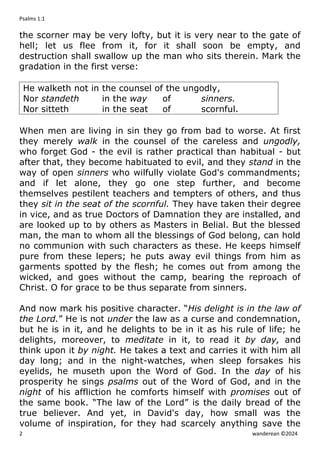
He walketh not in the counsel of the ungodly,
Nor standeth in the way of sinners.
Nor sitteth in the seat of scornful.
When men are living in sin they go from bad to worse. At first
they merely walk in the counsel of the careless and ungodly,
who forget God - the evil is rather practical than habitual - but
after that, they become habituated to evil, and they stand in the
way of open sinners who wilfully violate God's commandments;
and if let alone, they go one step further, and become
themselves pestilent teachers and tempters of others, and thus
they sit in the seat of the scornful. They have taken their degree
in vice, and as true Doctors of Damnation they are installed, and
are looked up to by others as Masters in Belial. But the blessed
man, the man to whom all the blessings of God belong, can hold
no communion with such characters as these. He keeps himself
pure from these lepers; he puts away evil things from him as
garments spotted by the flesh; he comes out from among the
wicked, and goes without the camp, bearing the reproach of
Christ. O for grace to be thus separate from sinners.
And now mark his positive character. “His delight is in the law of
the Lord.” He is not under the law as a curse and condemnation,
but he is in it, and he delights to be in it as his rule of life; he
delights, moreover, to meditate in it, to read it by day, and
think upon it by night. He takes a text and carries it with him all
day long; and in the night-watches, when sleep forsakes his
eyelids, he museth upon the Word of God. In the day of his
prosperity he sings psalms out of the Word of God, and in the
night of his affliction he comforts himself with promises out of
the same book. “The law of the Lord” is the daily bread of the
true believer. And yet, in David's day, how small was the
volume of inspiration, for they had scarcely anything save the
Psalms 1:1
3 wanderean ©2024
first five books of Moses! How much more, then, should we prize
the whole written Word which it is our privilege to have in all
our houses! But, alas, what ill-treatment is given to this angel
from heaven! We are not all Berean searchers of the Scriptures.
How few among us can lay claim to the benediction of the text!
Perhaps some of you can claim a sort of negative purity,
because you do not walk in the way of the ungodly; but let me
ask you - Is your delight in the law of God? Do you study God's
Word? Do you make it the man of your right hand - your best
companion and hourly guide? If not, this blessing belongeth not
to you.
Psalms 1:1-2
BLESSEDNESS AND PRAISE
Psa 1:1-2; Psa 150:6
The Psalter is the echo in devout hearts of the other portions of
divine revelation. There are in it, indeed, further disclosures of
God‟s mind and purposes, but its especial characteristic is-the
reflection of the light of God from brightened faces and believing
hearts. As we hold it to be inspired, we cannot simply say that it
is man‟s response to God‟s voice. But if the rest of Scripture
may be called the speech of the Spirit of God to men, this book
is the answer of the Spirit of God in men.
These two verses which I venture to lay side by side present in
a very remarkable way this characteristic. It is not by accident
that they stand where they do, the first and last verses of the
whole collection, enclosing all, as it were, within a golden ring,
and bending round to meet each other. They are the summing
up of the whole purpose and issue of God‟s revelation to men.
The first and second psalms echo the two main portions of the
old revelation-the Law and the Prophets. The first of them is
taken up with the celebration of the blessedness and fruitful,
stable being of the man who loves the Law of the Lord, as
contrasted with the rootless and barren life of the ungodly, who
is like the chaff. The second is occupied with the contemplation
of the divine „decree‟ by which the coming King is set in God‟s
Psalms 1:1
4 wanderean ©2024
„holy hill of Zion,‟ and of the blessedness of „all they who put
their trust in Him,‟ as contrasted with the swift destruction that
shall fall on the vain imaginations of the rebellious heathen and
banded kings of earth.
The words of our first text, then, may well stand at the
beginning of the Psalter. They express the great purpose for
which God has given His Law. They are the witness of human
experience to the substantial, though partial, accomplishment of
that purpose. They rise in buoyant triumph over that which is
painful and apparently opposed to it; and in spite of sorrow and
sin, proclaim the blessedness of the life which is rooted in the
Law of the Lord.
The last words of the book are as significant as its first. The
closing psalms are one long call to praise-they probably date
from the time of the restoration under Ezra and Nehemiah,
when, as we know, „the service of song‟ was carefully re-
established, and the harps which had hung silent upon the
willows by the rivers of Babylon woke again their ancient
melodies. These psalms climb higher and higher in their
rapturous call to all creatures, animate and inanimate, on earth
and in heaven, to praise Him. The golden waves of music and
song pour out ever faster and fuller. At last we hear this
invocation to every instrument of music to praise Him,
responded to, as we may suppose, by each, in turn as
summoned, adding its tributary notes to the broadening river of
harmony-until all, with gathered might of glad sound blended
with the crash of many voices, unite in the final words, „Let
every thing that hath breath praise the Lord. Praise ye the Lord.‟
I. We have here a twofold declaration of God’s great
purpose in all His self-revelation, and especially in the
Gospel of His Son.
Our first text may be translated as a joyful exclamation, „Oh!
the blessedness of the man-whose delight is in the law of the
Lord.‟ Our second is an invocation or a command. The one then
Psalms 1:1
5 wanderean ©2024
expresses the purpose which God secures by His gift of the Law;
the other the purpose which He summons us to fulfil by the
tribute of our hearts and songs-man‟s happiness and God‟s
glory.
His purpose is Man‟s blessedness.
That is but another way of saying, God is love. For love, as we
know it, is eminently the desire for the happiness of the person
on whom it is fixed. And unless the love of God be like ours,
however it may transcend it, there is no revelation of Him to our
hearts at all. If He be love, then He „delights in the prosperity‟ of
His children.
And that purpose runs through all His acts. For perfect love is
all-pervasive, and even with us men, it rules the whole being;
nor does he love at all who seeks the welfare of the heart he
clings to by fits and starts, by some of his acts and not by
others. When God comes forth from the unvisioned light, which
is thick darkness, of His own eternal, self-adequate Being, and
flashes into energy in Creation, Providence, or Grace, the Law of
His Working and His Purpose are one, in all regions. The unity of
the divine acts depends on this-that all flow from one deep
source, and all move to one mighty end. Standing on the height
to which His own declarations of His own nature lift our
feebleness, we can see how the „river of God that waters the
garden‟ and „parts‟ into many „heads,‟ gushes from one fountain.
One of the psalms puts what people call the „philosophy‟ of
creation and of providence very clearly, in accordance with this
thought-that the love of God is the source, and the blessedness
of man the end, of all His work: „To Him that made great lights;
for His mercy endureth for ever. To Him that slew mighty kings;
for His mercy endureth for ever.‟
Creation, then, is the effluence of the loving heart of God.
Though the sacred characters be but partially legible to us now,
what He wrote, on stars and flowers, on the infinitely great and
the infinitely small, on the infinitely near and the infinitely far
off, with His creating hand, was the one inscription-God is love.
Psalms 1:1
6 wanderean ©2024
And as in nature, so in providence. The origination, and the
support, and the direction of all things, are the works and the
heralds of the same love. It is printed in starry letters on the
sky. It is graven on the rocks, and breathed by the flowers. It is
spoken as a dark saying even by sorrow and pain. The
mysteries of destructive and crushing providences have come
from the same source. And he who can see with the Psalmist
the ever-during mercy of the Lord, as the reason of creation and
of judgments, has in his hands the golden key which opens all
the locks in the palace chambers of the great King. He only hath
penetrated to the secret of things material, and stands in the
light at the centre, who understands that all comes from the one
source-God‟s endless desire for the blessedness of His
creatures.
But while all God‟s works do thus praise Him by testifying that
He seeks to bless His creatures, the loftiest example of that
desire is, of course, found in His revelation of Himself to men‟s
hearts and consciences, to men‟s spirits and wills. That
mightiest act of love, beginning in the long-past generations,
has culminated in Him in whom „dwelleth the whole fulness of
the Godhead bodily,‟ and in whose work is all the love-the
perfect, inconceivable, patient, omnipotent love of our
redeeming God.
And then, remember that this is not inconsistent with or
contradicted by the sterner aspects of that revelation, which
cannot be denied, and ought not to be minimised or softened.
Here, on the right hand, are the flowery slopes of the Mount of
Blessing; there, on the left, the barren, stern, thunder-riven,
lightning-splintered pinnacles of the Mount of Cursing. Every
clear note of benediction hath its low minor of imprecation from
the other side. Between the two, overhung by the hopes of the
one, and frowned upon and dominated by the threatenings of
the other, is pitched the little camp of our human life, and the
path of our pilgrimage runs in the trough of the valley between.
And yet-might we not go a step farther, and say that above the
parted summits stretches the one overarching blue, uniting
Psalms 1:1
7 wanderean ©2024
them both, and their roots deep down below the surface
interlace and twine together? That is to say, the threatenings
and rebukes, the acts of retributive judgment, which are
contained in the revelation of God, are no limitation nor
disturbance of the clear and happy faith that all which we behold
is full of blessing, and that all comes from the Father‟s hand.
They are the garb in which His Love needs to array itself when it
comes in contact with man‟s sin and man‟s evil. The love of God
appears no less when it teaches us in grave sad tones that „the
wages of sin is death,‟ than when it proclaims that „the gift of
God is eternal life.‟
Love threatens that it may never have to execute its threats.
Love warns that we may be wise in time. Love prophesies that
its sad forebodings may not be fulfilled. And love smites with
lighter strokes of premonitory chastisements, that we may
never need to feel the whips of scorpions.
Remember, too, that these sterner aspects both of Law and of
Gospel point this lesson-that we shall very much misunderstand
God‟s purpose if we suppose it to be blessedness for us men
anyhow, irrespective altogether of character. Some people seem
to think that God loves us so much, as they would say-so little,
so ignobly, as I would say-as that He only desires us to be
happy. They seem to think that the divine love is tarnished
unless it provides for men‟s felicity, whether they are God-loving
and God-like or no. Thus the solemn and majestic love of the
Father in heaven is to be brought down to a weak good nature,
which only desires that the child shall cease crying and be
happy, and does not mind by what means that end is reached.
God‟s purpose is blessedness; but, as this very text tells us, not
blessedness anyhow, but one which will not and cannot be given
by God to those who walk in the way of sinners. His love desires
that we should be holy, and „followers of God as dear children‟-
and the blessedness which it bestows comes from pardon and
growing fellowship with Him. It can no more fall on rebellious
hearts than the pure crystals of the snow can lie and sparkle on
the hot, black cone of a volcano.
Psalms 1:1
8 wanderean ©2024
The other text that I have read sets forth another view of God‟s
purpose. God seeks our praise. The glory of God is the end of all
the divine actions. Now, that is a statement which no doubt is
irrefragable, and a plain deduction from the very conception of
an infinite Being. But it may be held in such connections, and
spoken with such erroneous application, and so divorced from
other truths, that instead of being what it is in the Bible, good
news, it shall become a curse and a lie. It may be so understood
as to describe not our Father in heaven, but an almighty devil!
But, when the thought that God‟s purpose in all His acts is His
own glory, is firmly united with that other, that His purpose in
all His acts is our blessing, then we begin to understand how full
of joy it may be for us. His glory is sought by Him in the
manifestation of His loving heart, mirrored in our illuminated
and gladdened hearts. Such a glory is not unworthy of infinite
love. It has nothing in common with the ambitious and hungry
greed of men for reputation or self-display. That desire is
altogether ignoble and selfish when it is found in human hearts;
and it would be none the less ignoble and selfish if it were
magnified into infinitude, and transferred to the divine. But to
say that God‟s glory is His great end, is surely but another way
of saying that He is love. The love that seeks to bless us
desires, as all love does, that it should be known for what it is,
that it should be recognised in our glad hearts, and smiled back
again from our brightened faces. God desires that we should
know Him, and so have Eternal Life; He desires that knowing
Him, we should love Him, and loving should praise, and so
should glorify Him. He desires that there should be an
interchange of love bestowing and love receiving, of gifts
showered down and of praise ascending, of fire falling from the
heavens and sweet incense, from grateful hearts, going up in
fragrant clouds acceptable unto God. It is a sign of a Fatherly
heart that He „seeketh such to worship Him‟. He desires to be
glorified by our praise, because He loves us so much. He
commences with an offer, He advances to a command. He gives
first, and then (not till then) He comes seeking fruit from the
„trees‟ which are „the planting of the Lord, that He might be
Psalms 1:1
9 wanderean ©2024
glorified.‟ His plea is not „the vineyard belongs to Me, and I have
a right to its fruits,‟ but „what could have been done more to My
vineyard, that I have not done in it?-judge between Me and My
vineyard.‟ First, He showers down blessings; then, He looks for
the revenue of praise!
II. We may also take these passages as giving us a
twofold expression of the actual effects of God’s
revelation, especially in the Gospel, even here upon
earth.
The one text is the joyful exclamation built upon experience and
observation. The other is a call which is answered in some
measure even by voices that are often dumb in unthankfulness,
often broken by sobs, often murmuring in penitence.
God does actually, though not completely, make men blessed
here. Our text sums up the experience of all the devout hearts
and lives whose emotions are expressed in the Psalms. He who
wrote this psalm would preface the whole book by words into
which the spirit of the book is distilled. It will have much to say
of sorrow and pain. It will touch many a low note of wailing and
of grief. There will be complaints and penitence, and sighs
almost of despair before it closes. But this which he puts first is
the note of the whole. So it is in our histories. They will run
through many a dark and desert place. We shall have bitterness
and trials in abundance, there will be many an hour of sadness
caused by my own evil, and many a hard struggle with it. But
high above all these mists and clouds will rise the hope that
seeks the skies, and deep beneath all the surface agitations of
storms and currents there will be the unmoved stillness of the
central ocean of peace in our hearts. In the „valley of weeping‟
we may still be „blessed‟ if „the ways‟ are in our hearts, and if we
make of the very tears „a well,‟ drawing refreshment from the
very trials. With all its sorrows and pains, its fightings and fears,
its tribulations in the world, and its chastenings from a Father‟s
hand, the life of a Christian is a happy life, and „the joy of the
Lord‟ remains with His servants.
Psalms 1:1
10 wanderean ©2024
More than twenty centuries have passed since that psalm was
written. As many stretched dim behind the Psalmist as he sang.
He was gathering up in one sentence the spirit of the past, and
confirming it by his own life‟s history. And has any one that has
lived since then stood up and said-‟Behold! I have found it
otherwise. I have waited on God, and He has not heard my cry.
I have served Him, and that for nought. I have trusted in Him,
and been disappointed. I have sought His face-in vain. And I
say, from my own experience, that the man who trusts in Him is
not blessed‟? Not one, thank God! The history of the past, so far
as this matter is concerned, may be put in one sentence „They
looked unto Him and were lightened, and their faces were not
ashamed,‟ and as for the present, are there not some of us who
can say, „This poor man cried, and the Lord heard him, and
saved him out of all his troubles‟?
Brethren! make the experiment for yourselves. Test this
experience by your own simple affiance and living trust in Jesus
Christ. We have the experience of all generations to encourage
us. What has blessed them is enough for you and me. Like the
meal and the oil, which were the Prophet‟s resource in famine,
yesterday‟s supply does not diminish to-morrow‟s store. We,
too, may have all that gladdened the hearts and stayed the
spirits of the saints of old. „Oh! taste and see that God is good.‟
„Blessed is the man that trusteth in Him.‟
So, too, God‟s gift produces man‟s praise.
What is it that He desires from us? Nothing but our thankful
recognition and reception of His benefits. We honour God by
taking the full cup of salvation which He commends to our lips,
and by calling, while we drink, upon the name of the Lord. Our
true response to His Word, which is essentially a proffer of
blessing to us, is to open our hearts to receive, and, receiving,
to render grateful acknowledgment. The echo of love which
gives and forgives, is love which accepts and thanks. We have
but to lift up our empty and impure hands, opened wide to
receive the gift which He lays in them-and though they be
Psalms 1:1
11 wanderean ©2024
empty and impure, yet „the lifting up of our hands‟ is „as the
evening sacrifice‟; our sense of need stands in the place of all
offerings. The stained thankfulness of our poor hearts is
accepted by Him who inhabits the praises of eternity, and yet
delights in the praises of Israel. He bends from heaven to give,
and all He asks is that we should take. He only seeks our
thankfulness-but He does seek it. And wherever His grace is
discerned, and His love is welcomed, there praise breaks forth,
as surely as streams pour from the cave of the glacier when the
sun of summer melts it, or earth answers the touch of spring
with flowers.
And that effect is produced, notwithstanding all the complaints
and sighs and tears which sometimes choke our praise. It is
produced even while these last; the psalms of thanksgiving are
not all reserved for the end of the book. But even in those which
read like the very sobs of a broken heart, there is ever present
some tone of grateful acknowledgment of God‟s mercy. He
sends us sorrow, and He wills that we should weep-but they
should be tears like David‟s, who, at the lowest point of his
fortunes, when he plaintively besought God, „Put Thou my tears
into Thy bottle‟-could say in the same breath, „Thy vows are
upon me, O God: I will render praises unto Thee.‟ God works on
our souls that we may have the consciousness of sin, and He
wills that we should come with broken and contrite hearts, and
like the king of Israel wail out our confessions and supplications-
‟Have mercy upon me, O God! according to Thy loving-
kindness.‟ But, like him, we should even in our lowliest
abasement, when our hearts are bruised, be able to say along
with our contrition, „Open Thou my lips, and my mouth shall
show forth Thy praise.‟ Our sorrows are never so great that they
hide our mercies. The sky is never so covered with clouds that
neither sun nor stars appear for many days. And in every
Christian heart the low tones of lamentation and confession are
blended with grateful praise. So it is even in the darkest
moments, whilst the blast of misfortune and misery is as a
storm against the wall.
Psalms 1:1
12 wanderean ©2024
But a brighter hope even for our life here rises from these
words, if we think of the place which they hold in the whole
book. They are the last words. Whatever other notes have been
sounded in its course, all ends in this. The winter‟s day has had
its melancholy grey sky, with many a bitter dash of snow and
rain-but it has stormed itself out, and at eventide, a rent in the
clouds reveals the sun, and it closes in peaceful clearness of
light.
The note of gladness heard at the beginning, „Oh! the
blessedness of the man that delights in the law of the Lord,‟
holds on persistently, like a subdued and almost bewildered
undercurrent of sweet sound amid all the movements of some
colossal symphony, through tears and sobs, confession and
complaint, and it springs up at the close triumphant, like the
ruddy spires of a flame long smothered, and swells and
broadens, and draws all the intricate harmonies into its own
rushing tide. Some of you remember the great musical work
which has these very words for its theme. It begins with the
call, „All that hath life and breath, praise ye the Lord,‟ and
although the gladness saddens into the plaintive cry of a soul
sick with hope deferred, „Will the night soon pass?‟ yet, ere the
close, all discords are reconciled, and at last, with assurance
firmer for the experience of passing sorrows, loud as the voice
of many waters and sweet as harpers harping with their harps,
the joyful invocation peals forth again, and all ends, as it does in
a Christian man‟s life, and as it does in this book, with „Praise ye
the Lord.‟
III. We have here also a twofold prophecy of the
perfection of Heaven.
Whilst it is true that both of these purposes are accomplished
here and now, it is also true that their accomplishment is but
partial, and that therefore for their fulfilment we have to lift our
eyes beyond this world of imperfect faith, of incomplete
blessedness, of interrupted praise. Whether the Psalmist looked
forward thus we do not know. But for us, the very shortcomings
of our joys and of our songs are prophetic of the perfect and
Psalms 1:1
13 wanderean ©2024
perpetual rapture of the one, and the perfect and perpetual
music of the other. We know that He who has given us so much
will not stay His hand until He has perfected that which concerns
us. We know that He who has taught our dumb hearts to
magnify His name will not cease till „out of the lips of babes and
sucklings, He has perfected praise.‟ We know that the pilgrims
in whose hearts are the ways are blessed, and we are sure that
a fuller blessedness must belong to those who have reached the
journey‟s end.
And so these words give us a twofold aspect of that future on
which our longing hopes may well fix.
It is the perfection of man‟s blessedness. Then the joyous
exclamation of our first text, which we have often had to strive
hard not to disbelieve, will be no more a truth of faith but a
truth of experience. Here we have had to trust that it was so,
even when we could scarce cleave to the confidence. There,
memory will look back on our wanderings through this great
wilderness, and, enlightened by the issue of them all, will speak
only of Mercy and Goodness as our angel guides all our lives.
The end will crown the work. Pure unmingled consciousness of
bliss will fill all hearts, and break into the old exclamation, which
we had sometimes to stifle sobs ere we could speak on earth.
When He says, „Come in! ye blessed of My Father,‟ all our tears
and fears, and pains and sins, will be forgotten, and we shall but
have to say, in wonder and joy, „Blessed are they that dwell in
Thy house; they will be still praising Thee.‟
It is the perfection of God‟s praise. We may possibly venture to
see in these wonderful words of our text a dim and far-off hint
of a possibility that seems to be pointed at in many parts of
Scripture-that the blessings of Christ‟s mighty work shall, in
some measure and manner, pass through man to his dwelling-
place and its creatures. Dark shadows of evil-the mystery of
pain and sorrow-lie over earth and all its tribes. „We look for
new heavens and a new earth wherein dwelleth righteousness.‟
And the statements of Scripture which represent creation as
Psalms 1:1
14 wanderean ©2024
suffering by man‟s sin, and participant in its degree in man‟s
redemption, seem too emphatic and precise, as well as too
frequent, and in too didactic connections, to be lightly brushed
aside as poetic imagery. May it not be that man‟s transgression
‘Broke the fair music that all creatures made
To their great Lord, whose love their motion swayed,’
and that man‟s restoration may, indeed, bring back all that hath
life and breath to a harmonious blessedness-according to the
deep and enigmatical words, which declare that „the creature
itself also shall be delivered from the bondage of corruption into
the liberty of the glory of the children of God‟? Be that as it
may, at all events our second text opens to us the gates of the
heavenly temple, and shows us there the saintly ranks and
angel companies gathered in the city whose walls are salvation
and its gates praise. They harmonise with that other later vision
of heaven which the Seer in Patmos beheld, not only in setting
before us worship as the glad work of all who are there, but in
teaching the connection between the praises of men, and the
answering hymns of angels. The harps of heaven are hushed to
hear their praise who can sing, „Thou hast redeemed us to God
by Thy blood,‟ and, in answer to that hymn of thanksgiving for
unexampled deliverance and resorting grace, the angels around
the throne break forth into new songs to the Lamb that was
slain-while still wider spread the broadening circles of
harmonious praise, till at last „every creature which is in heaven,
and on the earth, and under the earth, and such as are in the
sea, and all that are in them,‟ join in the mighty hymn of
„Blessing, and honour, and glory, and power, unto Him that
sitteth upon the throne, and to the Lamb for ever and ever.‟
Then the rapturous exclamation from human souls redeemed,-
‟Oh! the blessedness of the men whom Thou hast loved and
saved,‟ shall be answered by choral praise from everything that
hath breath.
And are you dumb, my friend, in these universal bursts of
praise? Is that because you have not chosen to take the
Psalms 1:1
15 wanderean ©2024
universal blessing which God gives? You have nothing to do but
to receive the things that are freely given to you of God-the
forgiveness, the cleansing, the life, that come from Christ by
faith. Take them, and call upon the name of the Lord, And can
you refuse His gifts and withhold your praise? You can be
eloquent in thanks to those who do you kindnesses, and in
praise of those whom you admire and love, but your best Friend
receives none of your gratitude and none of your praise. Ignoble
silence and dull unthankfulness-with these you requite your
Saviour! „I tell you that, if these should hold their peace, the
stones would immediately cry out!‟
Psalms 1:1-2
Introduction
It is with gratitude to our God and Father that we are hereby
permitted to offer the reader a commentary on Psalms. In
writing this commentary, we have become increasingly aware of
the great privilege God has given His people – both His earthly
people, Israel, and His heavenly people, the church – by making
this book part of His inspired Word.
Being engaged with the book of Psalms gives one a burning
heart. The Emmaus disciples say to one another, after the Lord
Jesus came to them and walked with them to Emmaus: “Were
not our hearts burning within us while He was speaking to us on
the road, while He was explaining the Scriptures to us?” (Luk
24:32). They were sad at first, but because He opened the
Scriptures to them, in which He Himself is presented (Luk 24:27
Luk 24:44), their sorrow has turned to joy (cf. Joh 16:20 Joh
16:22 Joh 20:20).
We often see this change of feelings in Psalms. This is also
recognizable in our own lives. We cry out to the Lord from the
depths of our distress and He comforts us through the
Scriptures: “For whatever was written in earlier times was
written for our instruction, so that through perseverance and
the encouragement of the Scriptures we might have hope” (Rom
15:4).
Psalms 1:1
16 wanderean ©2024
We have experienced something of this as we examined this
part of the Scriptures, or rather, were examined by this part of
the Scriptures. We hope and pray that it will not be a passing
experience for ourselves. We hope and pray that the reader,
while reading and examining, may also experience this.
Ger de Koning / Tony Jonathan Middelburg / Arnhem,
Translation February 2022
Psalms 1:1-2
Introduction to Psalms
The book of Psalms, like all the other books of the Old
Testament, is a testimony about the Lord Jesus Christ (Joh
5:39). The Lord Jesus puts it this way: “All things which are
written about Me in the Law of Moses and the Prophets and the
Psalms must be fulfilled” (Luk 24:44). The explanation of Psalms
is found in the New Testament. There we see that the psalms
are not only applied to the Lord Jesus, but are also and
especially fulfilled in Him. They were given with that prophetic
purpose. We see this, for example, in some quotes from Psalms
that are fulfilled in Christ on the cross (Joh 19:24 Joh 19:28 ;
Psa 22:18 Psa 22:15). It says with these quotes that is was “to
fulfill the Scripture” which shows that the Lord Jesus Himself is
speaking in the psalms. The Man Jesus Christ experienced the
feelings described in Psalms perfectly and at their deepest.
Directly connected to this, we find in this book prophetically the
condition and experiences of the Jewish believing remnant in the
end time. The Messiah has a special connection with them. The
remnant gains its experiences in the way God goes with them
toward the goal He has determined. As a result, they encounter
all kinds of diverse circumstances in which faith is tested and
refined. This is not only true of the faithful believers of the Old
Testament, but also for New Testament believers. The result is
one grand praise of God by all that has breath, as described in
the last psalm (Psa 150:1-6).
Psalms 1:1
17 wanderean ©2024
This book stands at the center of the Bible, forming its heart, as
it were. In this book we hear, so to speak, the beating of the
heart of believers who walk with God in this world. The words of
the psalms have echoed and vibrated in the hearts of countless
believers throughout the years. They have been of support to
believers in the greatest need. They express the feelings of their
hearts. For example, Psalm 23, which is probably the best
known psalm, is for many a much-loved chapter in the Bible.
The closing verse of the second part of the book says: “The
prayers of David the son of Jesse are ended” (Psa 72:20). We
can infer that David‟s previous psalms have the character of
“prayers”. There is also one single mention of “[A Psalm] of
Praise, of David” (Psa 145:1), whereby the word “praise” in
Hebrew, tehilla, is the singular of the Hebrew title of Psalms,
tehillim. These two features, prayer and praise, are the two
typical features of the believer who walks with God in this world.
He prays for help and salvation in and out of hardship, and then
he praises God for that help and salvation.
Psalms received its Hebrew name sefer tehillim from the Jewish
rabbis. The name means „the book of praise‟. That name was
given because of the use of this book in the services in the
temple of Solomon. Later, in the second or first century BC, the
Old Testament, Psalms included, was translated into Greek (the
Septuagint). The book was then given the Greek title psalmoi,
which means „song accompanied by an instrument‟.
The book of Psalms is a collection of 150 songs written by
different writers over a period of about a 1,000 years. The
oldest psalm, Psalm 90, is of Moses (Psa 90:1), which means
that is written about 1500 BC. The (probably) youngest psalm,
Psalm 137, is written during the Babylonian exile (Psa 137:1),
that is about 600 BC. It may even be that Psalm 126 was
written after the return from exile (Psa 126:1), that is in 500
BC. Already at the time of Ezra and Nehemiah we find that the
psalms are sung (Ezr 3:10-12 ; Neh 7:44 Neh 12:24 Neh 12:36
Neh 12:45-46).
Psalms 1:1
18 wanderean ©2024
The order of the chapters in Psalms is not arbitrary. We can
infer from Paul‟s speech in the synagogue at Pisidian Antioch
that each psalm is in its proper place. In that speech, Paul
quotes a verse from Psalms and says that this verse is written in
“the second Psalm” (Act 13:33).
The Old Testament is called TeNaCh in Hebrew. This word is
called an „acronym‟, which is a word formed by the initial letters
of a number of words. TeNaCh is a word made up of the initial
letters of the three parts of the Old Testament. These parts are
successively: the Torah (law of Moses), the Nevi‟im (the
prophets) and the Chetuvim (the scriptures or psalms).
This division is mentioned by the Lord Jesus (Luk 24:44). In
fact, the book of Psalms is one of the many books of the
Chetuvim (the scriptures). But because this book is both the
first and the largest book of the Chetuvim, this third part of the
Old Testament is called psalms instead of the scriptures.
The most quotes in the New Testament are from the book of
Psalms, along with the book of Isaiah. Of the approximately 283
direct quotations from the Old Testament in the New Testament,
116 come from Psalms.
The Writers of Psalms
Many thousands of psalms were written during the Old
Testament period. From King David we know many psalms. He
is the principal writer. He wrote most of the psalms. That is why
in the Codex Sinaiticus this book is called „the Psalms of David‟.
King Solomon, David‟s son, also wrote songs or psalms, even a
1,005 (1Kg 4:32). One of them, Psalm 127, is found in the book
of Psalms (Psa 127:1). In addition, there are several other
composers – we list them below – who wrote one or more
psalms.
Of the thousands of psalms, the Holy Spirit has inspired 150.
Psalms 1:1
19 wanderean ©2024
Together they form a part of the Word of God: the book of
Psalms. Of most of the psalms, we know who the author is.
1. David wrote at least 73 psalms; these are the psalms that
bear his name in the heading: Psalms 3-32; 34-41; 51-65; 68-
70; 86; 101; 103; 108-110; 122; 124; 131; 133; 138-145. To
these are added Psalm 2 and Psalm 95. These psalms have no
name in the heading in the book of Psalms. However, the New
Testament quotes from them, stating that both psalms are
written by David (Act 4:25 ; Psa 2:1 ; Heb 4:7 ; Psa 95:7-8).
That brings the total of psalms that are definitely written by
David to 75, which is half of all psalms.
2. Asaph wrote twelve psalms: Psalms 50; 73-83.
3. The sons of Korah wrote eleven psalms: Psalms 42-49; 84;
85; 87.
4. Heman the Ezrahite, wrote one: Psalm 88.
5. Ethan, also an Ezrahite, wrote one: Psalm 89.
6. Moses wrote one: Psalm 90.
7. Solomon wrote two: Psalms 72; 127.
David is called in the Bible “the man … the sweet psalmist of
Israel“ (2Sa 23:1). According to what we read in Amos, David
did “improvise to the sound of the harp” (Amo 6:5). He also
gave instructions about music in the service of the temple (Ezr
3:10 ; Neh 12:24).
Like Joseph and Moses, David is also a type of Christ. All three
exhibit in their lives these two aspects: suffering through
rejection and glorification afterwards. They experienced what
Christ says of Himself: “Was it not necessary for the Christ to
suffer these things and to enter into His glory?” (Luk 24:26).
Thus the psalms many times interpret Christ‟s feelings and
experiences.
Hebrew Poetry
One of the features of Hebrew poetry is the use of „parallelism‟.
Psalms 1:1
20 wanderean ©2024
This is a style of writing in which a particular message given in
the first line of the verse is repeated or elaborated upon in
different terms in the next line of the verse. This can be done
with or without extending the message, with a contrast or with
a climax. In stories, prose, and especially in poetry, parallel
sentences are often found. In doing so, the verses can also
exhibit a variety of patterns that will not be elaborated upon
here.
Several types of parallelism can be distinguished. We will
mention two of them, through which the meaning becomes
clear:
1. Parallels that correspond to each other, also called
synonymous parallelism. We find this especially in „teaching
psalms‟, psalms that contain teaching. In this case, a thought
from the first line of the verse is expressed in the next line with
different words and sometimes a little more elaborately. It is
two sentences representing one thought. An example is: “Why
are the nations in an uproar
And the peoples devising a vain thing?” (Psa 2:1).
2. Parallels that are opposite, that form a contrast, also called
antithetical parallelism. In this case, a thought from the first line
of the verse is expressed in opposite terms in the next line of
the verse. This is often indicated by the word “but” at the
beginning of the second line of the verse. An example of this is:
“For the LORD knows the way of the righteous,
but the way of the wicked will perish” (Psa 1:6).
In addition to parallel phrases, many linguistic tools are used in
Hebrew literature, some of which we will mention in the
explanation.
It is important to realize each time that God is speaking in this
book and speaking to us. This means that we find in it the
intercourse between God and man. To portray this intercourse,
Psalms 1:1
21 wanderean ©2024
He has used the psalm writers. We see this, for example, in
Psalm 45, where the Holy Spirit is at work in the psalmist when
he says: “My heart overflows with a good theme; I address my
verses to the King; my tongue is the pen of a ready writer” (Psa
45:1).
The meaning of the psalms for the Christian
Many Christians do not understand the meaning of the psalms
because they do not know their New Testament position in
Christ. They forget that the Old Testament is about an earthly
people, Israel, before the work of the Lord Jesus on the cross.
These people have no assurance of faith, an assurance so
characteristic of the heavenly people of God, the church, in the
New Testament. In their life of faith they are guided by the
psalms, whereas these are characteristic of the life of faith of
the Old Testament believers. The experience of their faith runs
up and down with their feelings. The cause of this is not
knowing the certainty of salvation by faith. By the Spirit of God
every child of God can possess that certainty.
That assurance is that the relationship to God depends on faith
in the accomplished work of Christ and not on feelings. The Old
Testament believer knows nothing of this, for that work was not
yet accomplished at that time. Hence, there can be no question
yet of resting in that work, which is the privilege of the New
Testament believer. Feelings are part of the life of faith, but
they are not the foundation of it. The faithful acceptance of
Christ and His work determines the relationship to God Who is
thereby known as Father.
Through the prophets God speaks to man. In the psalms we
hear man speaking to God in the midst of circumstances that
are also future events to which the prophets have referred. The
psalms are prophecy from the heart of the God-fearing person
to God and not the other way around, which is common for the
prophets, who speak to man on behalf of God. They are
expressions of trust. The psalms presuppose knowledge of the
Psalms 1:1
22 wanderean ©2024
prophecies.
In addition to the Lord Jesus, we find believers speaking in this
book. These are prophetically the faithful of the end time, the
faithful remnant of Israel that is closely connected to the Lord
Jesus. The feelings of the psalmists that they had in their day
and what they expressed will be present in the hearts of the
faithful in the end time in the future.
The book of Psalms clearly has a prophetic character. This is
evident from what Peter says in his speech on the day of
Pentecost: “For David says of Him, „I SAW THE LORD ALWAYS
IN MY PRESENCE; FOR HE IS AT MY RIGHT HAND, SO THAT I
WILL NOT BE SHAKEN. „THEREFORE MY HEART WAS GLAD AND
MY TONGUE EXULTED; MOREOVER MY FLESH ALSO WILL LIVE
IN HOPE; BECAUSE YOU WILL NOT ABANDON MY SOUL TO
HADES, NOR ALLOW YOUR HOLY ONE TO UNDERGO DECAY.
„YOU HAVE MADE KNOWN TO ME THE WAYS OF LIFE; YOU WILL
MAKE ME FULL OF GLADNESS WITH YOUR PRESENCE.‟
“Brethren, I may confidently say to you regarding the patriarch
David that he both died and was buried, and his tomb is with us
to this day. And so, because he was a prophet and knew that
GOD HAD SWORN TO HIM WITH AN OATH TO SEAT [one] OF
HIS DESCENDANTS ON HIS THRONE, he looked ahead and
spoke of the resurrection of the Christ, that HE WAS NEITHER
ABANDONED TO HADES, NOR DID His flesh SUFFER DECAY”
(Act 2:25-31 ; Psa 16:8-11).
The psalms point to events that will take place in the future.
They are about Israel and Zion and the Lord Jesus as King over
His people. The psalms cannot apply prophetically to the church.
We have a clear example in the so-called revenge psalms, in
which the God-fearing Jews ask for judgment on their enemies
(Psa 69:22-28 Psa 137:7-9). This is not the language of the
church of God. Following the Lord, it befits us, believers of the
church, to pray for those who persecute and harm us (Mat 5:43-
44 ; Luk 23:34 ; Act 7:60).
Psalms 1:1
23 wanderean ©2024
The psalms cannot tell us anything of the fundamental truths of
Christendom, simply because they have not yet been revealed.
The horizon of the psalms is earthly; they deal with the feelings
of people who are under the law. In the New Testament, the
psalms are also seen as part of the law. After Paul quotes a
number of verses from the psalms, he says of them that this is
all “whatever the Law says” (Rom 3:19).
Many Christians find their feelings reflected in the psalms
because they have wrongfully placed themselves under the law.
The book lets us hear the feelings of believers who want to keep
the law of God, but discover time and again that they are
transgressing the law. Such a person is described in Romans 7
(Rom 7:7-25). As indicated above, the book does not describe
the feelings of the Christian who knows the Father and what his
position before God is, but of the pious Jew who does not have
free access into the sanctuary. In the Old Testament, access to
God has not yet been made known.
Our position, through the eternal life we have been given, is
connected with the revelation of the Father‟s heart declared by
the Lord Jesus when He came to earth. This is unknown at the
origin of the psalms. Israel does know God as Father, but in the
sense of Creator, as the Origin of His people (Deu 32:6 ; Isa
63:16 Isa 64:8 ; Mal 2:10). We know God as the Father of the
Lord Jesus Who is our life, the Father of the Son.
Added to this is the testimony the Holy Spirit gives of the Lord
Jesus sitting at the right hand of God in heaven and what our
place in connection with Him there is. The Holy Spirit dwells in
the New Testament believer who has accepted the gospel of his
salvation (1Co 15:1-4 ; Eph 1:13). Old Testament believers
know the Holy Spirit, but do not have Him indwelling. He
worked on earth during Old Testament times, but He did not
dwell on earth. The Holy Spirit has come to dwell on earth in the
church and in the believer only after the Lord Jesus is glorified
in heaven (Joh 7:37-39 ; 1Co 3:16 1Co 6:19).
Psalms 1:1
24 wanderean ©2024
Another difference is the knowledge of salvation. The New
Testament believer knows that the Lord Jesus has obtained an
eternal redemption, which makes a repetition of His sacrifice
unnecessary. The Old Testament believer does not know a once
for all accomplished sacrifice and must come up with a sacrifice
every time he has sinned. This proves that he does not know a
complete redemption, for there is not yet a once for all time
accomplished work (Heb 10:1-3 Heb 10:11-14).
So, what value do the psalms have then for us, Christians?
Much, in every respect. First, we find in the psalms the feelings
of the Lord Jesus in connection with His earthly people. We get
to know His feelings, His suffering and compassion for His own
who are in trouble and tribulation. Precisely because it is about
Him, we, Christians, want to know more about that. We want to
know Him better.
Second, through the psalms we get to know the feelings of the
faithful remnant in the end time. Because the Lord Jesus also
passed through great and deep suffering, He suffers with the
remnant. This concerns all the suffering they undergo on the
part of men.
Third, the same applies to all that is written in the book of
Psalms, which also applies to the entire Old Testament: “For
whatever was written in earlier times was written for our
instruction, so that through perseverance and the
encouragement of the Scriptures we might have hope” (Rom
15:4). Although our position before God and our relationship to
God is different, higher, than that of the Old Testament
believers, we do share a lot with them. For the God of David is
also our God and Abraham‟s faith in God is also our faith.
We also share with them our love for God and His Word and the
confidence that He will fulfill all His promises. Like them, we
experience the enmity of people who hate God and who
therefore also hate His own, us. Like them, we go through much
trouble and sorrow. With us, as with them, that can be the
Psalms 1:1
25 wanderean ©2024
result of our own unfaithfulness. It can also, like them, happen
that we don‟t understand why certain things happen to us and
we have our questions about that. We recognize many of the
feelings of God-fearing Israelites in our lives with the Lord. Their
faith and the experience of it are an example for us.
The Lord Jesus and His Own
Yet another aspect of our keen interest in the psalms is that we
are directly involved in the great end result of all God‟s ways
that the Spirit reveals in Psalms. New Testament believers are
joined to Christ in the closest way possible, namely, as a body
with a head. As a result, they will reign with Him over the
nations in the realm of peace. He, Who is the Messiah of His
earthly people and the worldwide Lord and King, has been given
by God as Head above all things to the church (Eph 1:10 Eph
1:22-23). Therefore, they take the greatest interest in Him,
even when it comes to His connection with His earthly people.
In all ages there have been faithful ones in Israel who have
always had the same feelings in their hearts that we find here.
But they have always been individuals, never the multitude. The
Lord Jesus makes Himself one with the remnant. The suffering
of the people and the suffering of the Lord Jesus are found in
this book. Even today He makes Himself one with all who suffer
for His Name.
With regard to the suffering of the Lord Jesus in connection with
His people, it is good to see that there are several aspects to
that suffering. First, He suffers as atonement with God on behalf
of all, on the day of atonement, represented by the first goat
that is brought as a sin offering (Lev 16:15-19). This implies
that on the basis of the work of the Lord Jesus, atonement can
be offered to all people. Second, He also suffers as
substitute for His people. This is shown on the day of atonement
when the high priest laid both of his hands on the head of the
second goat which is presented as the send away goat, the goat
for Azazel (Lev 16:20-22). This implies that the Lord Jesus,
Psalms 1:1
26 wanderean ©2024
through His work on the cross, actually reconciled with God all
who accepted the offer of reconciliation.
This atoning suffering with its two aspects is always in singular
in the New Testament. It is a suffering suffered by the Lord
Jesus alone, just as on the day of atonement all the work is
done by the high priest, alone. This illustrates what happened
on the cross in the three hours of darkness. Then He was all
alone, even forsaken by God.
Another aspect of His suffering is a suffering that He endures
together with His people. This is the case in the suffering
inflicted on His people from the side of men. This suffering in
the New Testament is always in plural. That suffering is aptly
rendered as follows: “In all their affliction He was afflicted” (Isa
63:9). We see a picture of this in the furnace of blazing fire into
which Daniel‟s friends are thrown because of their faithfulness to
God. He joins them in the midst of the fire (Dan 3:23-25). This
is suffering for the sake of righteousness, suffering because of
the fact that they are doing God‟s will, bearing witness to Him in
the world.
There is another side to the suffering of His people, namely the
suffering – plural in the New Testament – into which God brings
them in order to purify them. This suffering was not necessary
with the Lord, He was the Holy One and the blameless and
unstained Lamb. His suffering in His earthly life and on the cross
on the part of men was necessary just to show us that He was
the Holy One, Who was qualified to be offered as a sin offering
for atonement.
The remnant suffers inwardly, in their conscience, when they
see what the Lord Jesus has done for them to deliver them from
their sins. They become aware of their guilt. Their comfort is
that they become aware of the forgiveness of their sins. The
remnant also suffers on the part of those who persecute them
because of their connection to Christ. Then they plead their
innocence. Their comfort is that the Lord Jesus knows their
Psalms 1:1
27 wanderean ©2024
suffering and shares in it.
Division of Psalms
The book of Psalms can be divided into five books:
Book 1 consists of Psalms 1-41
Book 2 consists of Psalms 42-72
Book 3 consists of Psalms 73-89
Book 4 consists of Psalms 90-106
Book 5 consists of Psalms 107-150
This division is evident from the ending of books 1-4, each of
which is characterized by the same praise (Psa 41:13 Psa 72:19
Psa 89:52 Psa 106:48). In doing so, we find a double “amen” in
books 1-3 (Psa 41:13 ; Psa 72:19 Psa 89:52) and an “Amen.
Hallelujah” (Psa 106:48). The book of Psalms closes with five
„hallelujah-palms‟, all of which begin and end with “hallelujah”
(Psalms 146-150).
Because of the division of the collection of the psalms into five
books, it has already been called by the Jews „the Pentateuch of
David‟. Pentateuch means „five-piece‟. Known is the Pentateuch
of Moses, which are the books Genesis through Deuteronomy.
The Pentateuch of Moses can be compared to the five books into
which the psalms can be divided. This division supports the
observation made above that there is a clear order in the
psalms:
Book 1 Psalms 1-41 / Genesis
Book 2 Psalms 42-72 / Exodus
Book 3 Psalms 73-89 / Leviticus
Book 4 Psalms 90-106 / Numbers
Book 5 Psalms 107-150 / Deuteronomy
1. Book 1 mentions most about the Lord Jesus and also about
the remnant in connection with Him. The Lord Jesus is the
center of God‟s counsels and the source of blessing for the
faithful remnant of Israel.
In this first book of Psalms, as in Genesis, it is about the Son of
Psalms 1:1
28 wanderean ©2024
Man, Who created all things and to Whom all things are subject
(Gen 1:1 ; Joh 1:3 ; Psa 8:4 Psa 8:7).
2. Book 2 deals with the remnant from the two tribes. This
remnant has fled from Jerusalem because of the antichrist who
is introducing idolatry (Mat 24:15-16). Their fleeing is because
of the antichrist and is used by God to purify their faith.
The second book of Psalms begins with crying out to God in
great distress and ends with the glory of God. We also see this
in Exodus.
3. Book 3 deals with the history of the ten tribes. They are
brought back into the land. The division of the people into two
and ten tribes is undone. There is one people under one King,
their Messiah. Here we see Israel connected to the sanctuary. In
the third book of Psalms we often hear about the sanctuary,
where God dwells. This is also the theme of Leviticus.
4. In book 4 we see that after the failure of the first man,
through the second Man, Christ, the promises made to Israel
are fulfilled. There is blessing not only for restored Israel, but
through them for all mankind. All blessing is the result of
Christ‟s work on the cross and of His government.
The fourth book of Psalms speaks of the journey of the people of
God through the wilderness. This is also the subject of Numbers.
5. In book 5 we are given a review of all God‟s ways and we are
shown their final fulfillment. This is also what the book of
Deuteronomy shows us. In book 5 of Psalms we see the full
result, where God and the people have been brought together in
harmony. Also, we see the foundation on which the people
stand before God.
Introduction to book 1 (Psalms 1-41)
Book 1 is the book of Genesis of Psalms. Like Genesis, book 1
shows us the principles of the counsels of God in Christ. In
Genesis we find how God created man and for what purpose. In
book 1 of Psalms we see the way of the perfect Man according
Psalms 1:1
29 wanderean ©2024
to God‟s thoughts.
In book 1 we can see the following subdivisions:
1. In Psalms 1-8 we see Christ in His ministry and His work. His
ministry as King over Israel in Psalm 2 culminates in His glory
as Son of Man Who rules over all creation in Psalm 8. We can
consider these psalms as an introduction to the entire book of
Psalms.
a. In Psalms 1-2 the Son of God, the King of Israel.
b. In Psalms 3-7 the faithful remnant.
c. In Psalm 8 the Son of Man, to Whom all things are subjected.
2. In Psalms 9-15 we see the enemy and the antichrist, the
tribulation and the redemption.
3. In Psalms 16-41 we see Christ amidst His own, to reveal God
and sanctify His own.
a. In Psalm 16 we see Christ impeccable and immaculate. He is
the foundation for the prayer for salvation in Psalm 17 and the
answer to this prayer in Psalm 18.
b. In Psalm 22 we recognize Christ‟s work as a sin offering,
while Psalm 40 describes His work as a burnt offering.
c. Psalm 41 shows that the two paths of Psalm 1 will culminate
in the contrast between believing and not believing in the work
of Christ on the cross.
Introduction
Psalms 1 and 2 form the general introduction to the whole book.
Psalm 1 shows the ways of God, Psalm 2 shows the counsel or
purpose of God.
Psalms 1:1
30 wanderean ©2024
Psalm 1 is about the faithfulness of the single person. He trusts
in God and finds his joy in the meditation in His Word. It is
someone who is under God‟s law. Even more, we see here the
One Who can say: “Your Law is within my heart” (Psa 40:8).
While this description should appeal to every Israelite, indeed to
every believer, it applies especially to the king of Israel. In
particular, he has the task of meditating in the law of God (Deu
17:19).
In Psalm 2 we see the content of the Word of God: the Messiah
and the firm counsel of God to make Him, the born King, His
Son, King. His kingship is over His inheritance, Israel, and
through Israel over the ends of the earth. God will achieve that
goal.
Features of the Righteous One
Psalm 1 is the splendid introduction to the book of Psalms. It is
a wisdom psalm, a psalm where teaching is given or
summarized about the two paths man can choose in his life: the
way of the righteous (Psa 1:1-3) or the way of the wicked (Psa
1:4-6). We see these two elements repeated throughout this
book and in fact throughout the Bible. It is the choice between
the way of blessing and the way of curse, the way with lasting
fruit and the way where everything is blown away, the way of
life and the way of death (cf. Deu 30:19).
It is in fact the difference between the way of Christ and the
way of the antichrist. Christ is the Righteous One par excellence.
He is the Only One Who could say: “I always do the things that
are pleasing to Him” (Joh 8:29). The antichrist is the wicked and
lawless one par excellence, the man of sin, the man who says in
his heart: “There is no God” (Psa 14:1). He lives without regard
to God in any respect.
The righteous is spoken of in the singular and the wicked in the
plural. It is the God-fearing individual in the midst of and in
Psalms 1:1
31 wanderean ©2024
opposition to the ungodly, apostate multitude. It is the few who
walk the narrow way as opposed to the many who walk the
broad way.
This first psalm is about the features of the God-fearing remnant
of Israel. These are the features in particular of the Lord Jesus
that will also be seen in the believing remnant in the end time.
Those features are perfectly present in Him and are most
definitely seen whenever and wherever He displays them. The
remnant is not perfect, but they can demonstrate those features
as a result of their connection with Him, because His Spirit
works that in them.
We too, believers who belong to the church, have the task and
the opportunity to show the features of the Lord Jesus in
accordance with our heavenly position. It is written of us that
we have put on “the new man which … has been created in
righteousness and holiness of the truth” (Eph 4:24). The
features of the new man are identical to those of the Lord Jesus.
The new man becomes visible wherever believers show the
features of the Lord Jesus.
Psalm 1 begins, and with it the entire book of Psalms, by
pronouncing “blessed” or “happy”. In the sermon on the Mount,
the Lord Jesus uses the same expression – translated from the
Hebrew, asre, into the Greek,
makarios (Mat 5:3-11). It is an exclamation of deep and abiding
happiness and joy of God about the believer who lives amidst
evil in fear of Him.
This first encounter with the God-fearing emphasizes that he
lives in circumstances where God is not taken into account. In
those circumstances he walks with God. God likes to identify
with him and He will continue to give him His rest and peace.
God particularly appreciates that he does not succumb to the
pressure, but instead remains faithful to Him. God‟s “well done”
is a great encouragement to all who want to be faithful when
the apostasy of the faith manifests itself more and more clearly.
Psalms 1:1
32 wanderean ©2024
It is noteworthy that the first features of the God-fearing
believer are features that distinguish them from “the wicked”,
the “sinners”, and the “scoffers”. Such people comprise the
mass of God‟s people. They are in charge in God‟s people, just
as they are today. The God-fearing lives in the midst of them,
but has no fellowship with them. He lives separated from them,
he does not participate with them.
The first feature of the righteous who walks with God is that he
“does not walk in the counsel of the wicked”. This refers to the
way he deliberates and by which he takes up his actions. There
is no room for God in the deliberations of the wicked. A wicked
person lives without involving God in his life, let alone giving
Him authority over it. The principle of his life is that everything
is centered around himself.
He “walks” in it, that is, his ungodly behavior results from his
depraved way of thinking, which in turn results from excluding
God in his decision-making. He devises sinful, selfish things in
order to achieve satisfaction of his lusts at any cost. The God-
fearing does not walk in the counsel of the wicked, he does not
allow himself to be seduced or coerced into a way of
deliberation or consultation in which God has no place, but he
considers what God wants, he involves God in his deliberations.
The second feature of the man who walks with God is that he
“does not stand in the path of sinners”. The word “stand” here is
not a passive state, something like standing still. The word
means to actively take a position, to deliberately stand
somewhere. Sinners ignore God. They take that position
consciously. By “the path” is meant, as usual, the path of life
with its end. Sinners are people who have no interest in God‟s
purpose for their lives.
The meaning of the word “sin” is “to miss the goal”. Sinners
miss God‟s purpose with their lives. They live their lives as they
see fit. That can be debauched, but it also can be very decent.
Psalms 1:1
33 wanderean ©2024
Whatever they choose, they ask nothing of God, but decide for
themselves what they do. It is “the broad way”, the easy and
entertaining way of life, “that leads to destruction” (Mat 7:13).
The God-fearing does not live this way, he does not stand in
their path, but responds to God‟s intention for his life.
The third feature of the man who walks with God is that he
“does not sit in the seat of the scoffers”. The scoffers are people
who ridicule God by ridiculing believers. Their rejection of God
takes the crudest form, that of mocking God. Their sin is that of
the tongue. They are the boasters, the overconfident, the
frivolous. They sit glued to their own seat, their own throne, and
put on a big mouth against God. Sitting in a seat shows pride
and hardening. The mockery that is uttered is done deliberately.
The God-fearing loathes that seat, and puts God in charge of his
life.
We see an ascendancy in evil: Those who, as the wicked, do not
reckon with God, will, as sinners, ignore their obligation to do
what God says, leading to an open scoffing at God and His will.
Psa 1:2 tells why it is that the things mentioned in Psa 1:1 are
not present with the God-fearing. It is because he finds his joy
“in the law of the LORD” in which he “meditates day and night”
(cf. Psa 26:4-8). It is impossible for anyone to be “blessed”
without engaging in the Word of God. Not the acting according
to the law is in the foreground, but loving the law, finding one‟s
joy in it. Acting according to the law without love and joy we see
with the Pharisees. The heart of the God-fearing is occupied
with it day and night, that is, constantly, unceasingly.
The “law” is not limited to the five books of Moses or even to
the Old Testament as a whole. The Hebrew word for law, torah,
implies all teaching that comes from God. The law is also God‟s
demand to live by His commandments to be justified thereby
(Lev 18:5). However, the psalmist is not speaking here of the
deadly effects that the law has for every person because he
cannot keep it. He is speaking of the life-giving aspects of the
Psalms 1:1
34 wanderean ©2024
law. He who walks with God and lives in fellowship with Him
because he has new life, finds his deepest joy in always being
engaged in the teaching of God, for this gives him the deepest
happiness.
It is a joy for the God-fearing to read God‟s Word and to
meditate in it day and night (cf. Psa 19:7-10). He has an
insatiable hunger for it and is like the believers in Berea, of
whom we read: “They received the word with great eagerness,
examining the Scriptures daily [to see] whether these things
were so” (Act 17:11). It is not a meditation at a certain time of
day, but a day and night activity. He reads a text, takes it to his
heart and carries it with him all day. And if he can‟t sleep at
night, he continues to meditate in it. Regardless of the time of
day or the circumstances, the God-fearing responds to life in
accordance with God‟s Word.
We must remember by “and in His law he meditates day and
night” that the Spirit of God works through the Word of God. We
cannot separate them. The Word of God without the Spirit of
God is dead orthodoxy, merely intellectual, without new,
spiritual life. Likewise, the Spirit without the Word is an
impossibility. If that happens, the spirit, that is, the spirit of
man, will try to imitate the working of the Holy Spirit, and that
will only lead to unbridled fanaticism.
„Day and night‟ does not mean that the believer studies the
Bible twenty-four hours a day and stop doing other things. The
believer who finds his joy in the Word day and night can be
compared to a young man in love who constantly thinks about
his beloved during all the activities of the day. During all the
activities of the day, everything is permeated with the
contemplation of the Word. What we read of Mary, the mother
of the Lord Jesus, indicates that meaning: “But Mary treasured
all these things, pondering them in her heart” (Luk 2:19).
What is written in Psa 1:1-2 has been perfectly fulfilled in and
through the Lord Jesus. What will be true of every Israelite in
Psalms 1:1
35 wanderean ©2024
the realm of peace (Jer 31:33-34 ; Heb 8:10) is perfectly true of
Christ. The ideal of the final state is already seen in Him. In no
way did He let Himself to be guided by the counsel of the
wicked, never did He stand in the path of sinners, and of course
was not sitting in the seat of scoffers. During His life on earth,
He is in the midst of people who exclude God, while He is
completely separated from them.
During His life on earth, His joy is in the law of Yahweh, which is
in His heart (Psa 40:8). He has done what is said to Joshua:
“This book of the law shall not depart from your mouth, but you
shall meditate on it day and night, so that you may be careful to
do according to all that is written in it” (Jos 1:8). He did all that
the law commanded and He did nothing that the law forbade (cf.
Mat 5:17).
Psalms 1:1
36 wanderean ©2024
References: