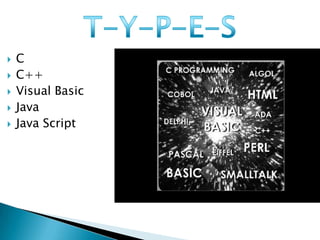
Popular third generation languages include C++, Visual Basic, and Java. C++ is widely used for hardware design. Visual Basic is relatively easy to learn with an
NAME ROLL NO.
VARAIYA AKASH 39.
SUBMITTED TO:-PROF.HUZEFA PAKITWALA
3.
A programming language is an artificial language designed to
communicate instructions to a machine, particularly
a computer. Programming languages can be used to
create programs that control the behavior of a machine
and/or to express algorithms precisely.
A programming language is a set of words, symbols and
codes that enables humans to communicate with computers.
5.
Computer programming language is an language used to
write computer programs, which involve a computerperforming some kind
of computation or algorithm and possibly control external devices such
as printers, disk drives, robots, and so on.
Programming languages differ from natural languages in that
natural languages are only used for interaction between
people, while programming languages also allow humans to
communicate instructions to machines.
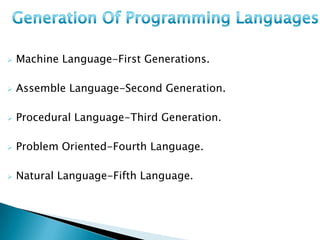
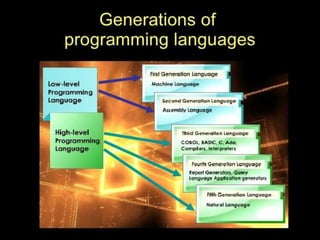
First generation languagesor 1GL
Represent the very early, primitive
computer languages that consisted
entirely of 1's and 0's - the actual
language that the computer
understands (machine language).
9.
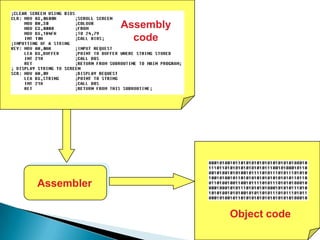
Second generation languages (2GL)
Represent a step up from the first generation
languages. Allow for the use of symbolic
names instead of just numbers. Second
generation languages are known as assembly
languages. Code written in an assembly
language is converted into machine language
(1GL).
Third generation languages
(3GL) With the languages
introduced by the third
generation of computer
programming, words and
commands (instead of just
symbols and numbers) were
being used. These languages
therefore, had syntax that was
much easier to understand.
Third generation languages are
known as & quot;high level
languages " and include C,
C++, Java, and Javascript,
among others.
C++ is one of the
most popular
programming
languages and is
implemented on a
wide variety of
hardware and
operating system
platforms.
C++ is
used for hardware
design.
15.
Visual Basic (VB) is
the third-
generation event-
driven programming
language and integrat
ed development
environment (IDE)
from Microsoft for
its COM programming
model. Visual Basic is
relatively easy to learn
and use.
16.
These are simple to adopt he Program written in high
due to their english like level language are less
structure of statements. efficient as they take more
Computational Speed is execution time.
very fast. The compiler also
Directly understandable by consumes some memory as
computer it is required for the
Help to create new translation process.
softwares. The compiler also
consumes some memory as
it is required for the
translation process.
Error correction is more.