Problem Solving Skills
Problems are only opportunities in work
clothes.
– Henry Kaiser (American
industrialist)
Outline
 Why do we need problem solving mind?
 What is a problem?
 Steps of problem solving.
 Problem solving tools and techniques.
Why do we need problem solving
mind?
 Problem-solving skills help you to resolve
obstacles in a situation. ...
 Problem- solving skills are traits that
enable you to do that. ...
 As a problem solver, you need to be able to
identify the cause of the issue and understand
it fully.
 You can ... Keep specific examples in mind of
times you solved a problem.
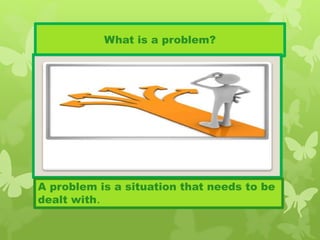
What is a problem?
A problem is a situation that needs to be
dealt with.
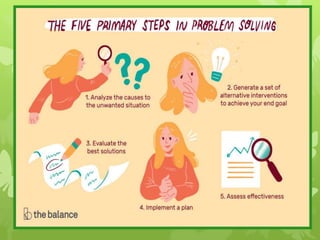
Steps of Problem Solving
 Defining the Problem
 Generating Alternatives
 Choosing the best alternative
 Feedback
First Defining the problem
“If I had an hour to solve a problem I'd
spend 55 minutes thinking about the
problem and 5 minutes thinking about
solutions.”
-Albert Einstein
How to define a problem?
 The 5 whys
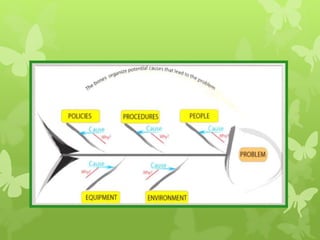
 Cause & Effect Analysis
 CATWOE
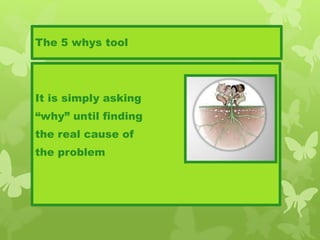
The 5 whys tool
It is simply asking
“why” until finding
the real cause of
the problem
Benefits of the 5 whys
 Simple technique
 Flexible
 Offers counter measures rather than
causes.
 Uncovers the deepest causes of the
problem
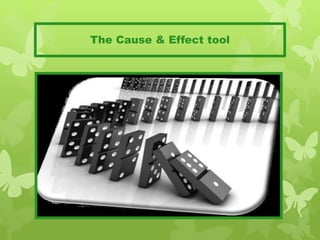
The Cause & Effect tool
How to use the tool?
 Identify the problem.
 Work out the major factors involved.
 Identify possible causes for each of the
factors.
 Analyze the diagram.
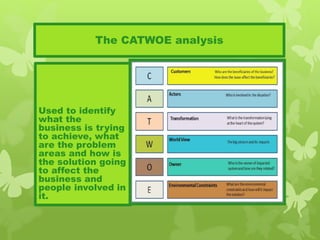
The CATWOE analysis
Used to identify
what the
business is trying
to achieve, what
are the problem
areas and how is
the solution going
to affect the
business and
people involved in
it.
Clients
• Who is on the receiving end?
• What problem do they have now?
• How will they react to what you
are proposing?
• Who are the winners and losers?
Actors
• Who will carry out the solution?
• What is the impact on them?
• How might they react?
Transformation
• What is the process for
transforming inputs into outputs?
• What are the inputs? Where do
they come from?
• What are the outputs? Where do
they go to?
• What are all the steps in
between?
World View
• What is the bigger picture?
• What is the real problem you are working on?
• What is the wider impact of any solution?
The Owner
• Can they help you or stop you?
•What would cause them to get in your way?
• What would lead them to help you?
Environmental constraints
• What are the boarder constraints of your idea?
• Resources limit, code of ethics and other constraints.
• What are the effects on your idea, can you bypass them?
Understanding Complexity
A problem Varies from a simple small
problem to a complex and big problem.
How to simplify things?
 Affinity Diagram
 Cause & Effect Diagram
 Flow Chart
Affinity Diagrams Sample
 An affinity diagram is the organization of ideas into a natural or
common relationship. For example, bananas, apples, and oranges
would be grouped as fruits, while green beans, broccoli, and carrots
would be grouped as vegetables. Affinity diagrams aid teams in
tapping into their creativity and gut instincts.
FLOW CHART SAMPLE
Problem Solving Process
 Using Tools and Techniques to help you more in solving
the problem
 Simplex Inquiry
 Appreciative
Inquiry
 Soft Systems
 Methodology
Decision Making Skills
“Perhaps our
greatest
distinction as a
species is our
capacity, unique
among animals,
to make counter
evolutionary
choices.”
Factors that affects decision
making
 Uncertainty
 Complexity
 High-risk consequences
 Alternatives
 Interpersonal issues
Steps of decision making
 Creating a
constructive
 environment
 Generating,
exploring &
choosing
 alternatives

Checking &
verifying decision
 Action &
communication
Creating a constructive environment
 Creating a productive environment for
generating alternatives.
 Establishing the objective
 Agree on the process
 Involving the right people
 Ask the Right questions
 Use Creativity tools
 Generating Ideas
Looking at the problem from
different angles, always tell
yourself that:” there must be
another solution out there.”
How to Generate Ideas?
 Brainstorming & reverse
brainstorming
 Charette procedure
 Crawford Slip Writing
Technique
 Concept fan Technique
 Affinity Diagrams
Crawford Slip Writing Technique
Exploring Alternatives
Tools & techniques of Analysis
 Risk Analysis
Threats associated
Probabilities
Worst case scenario technique
 Implication analysis
Six Thinking hats
Impact Analysis
 Validation analysis
Star bursting technique
Force field analysis
Cost benefit analysis
The Starbursting technique
“When your values are
clear to you, making
decisions becomes
easier.”
Roy E. Disney
Choosing the best alternative
It is the step of making the “decision”
Tools & techniques of choosing
 Decision matrix
 Paired comparison
 Analysis Decision Trees
 Voting
Decision Tree Sample
Checking & verifying the choice
It is a crucial step, which involves
testing, error finding and
applicability of the choice
Taking action
 The final step in decision making
process, is to communicate the results
and take action, in executing the
“solution” to the problem.
Thank You