UNIVERSITY OF MYSORE

  Presentation On International Financial Management
PRESENTED TO
Prof.B.Nagraju
Professor In Department Of
 Studies In Commerce
Manasagangothri
Mysore
INTRODUCTION
   Every country is not gifted with all the
    resources , so there is need of International
    Business in order to export the resources or any
    goods/service which is abundant in our country
    & to import the resources which is not abundant
    our country,
THE INTERNATIONAL FINANCIAL
ENVIRONMENT
                Multinational Corporation (MNC)


                     Foreign Exchange Markets


                            Dividend
                            Remittance
  Exporting                 & Financing           Investing
  & Importing                                     & Financing


 Product Markets            Subsidiaries          International
                                                  Financial
                                                  Markets
WHAT ARE MNC’S?
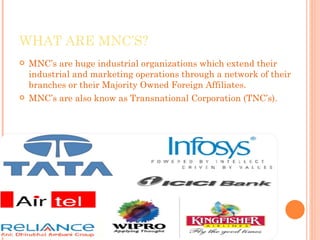
   MNC’s are huge industrial organizations which extend their
    industrial and marketing operations through a network of their
    branches or their Majority Owned Foreign Affiliates.
   MNC’s are also know as Transnational Corporation (TNC’s).
DEFINITION
   According to Franklin Root (1994), an MNC is a
    parent company that:

 engages in foreign production through its affiliates
  located in several countries,
 exercises direct control over the policies of its
  affiliates,
 implements business strategies in production,
  marketing, finance and staffing that transcend
  national boundaries.
OBJECTIVES
   To expand the business beyond the
    boundaries of the home country.

   Minimize cost of production, especially
    labour cost.

   Avail of competitive advantage
    internationally.

   Establish an international corporate image.
OBJECTIVES
   Achieve greater efficiency by producing in
    local market and then exporting the products.

   Make best use of technological advantages
    by setting up production facilities abroad.
MNC IN INDIA
 MNC in India are attracted to:
 India’s large market potential

 Labor competiveness

 FDI attractiveness
MNC IN INDIA(CONTD…)
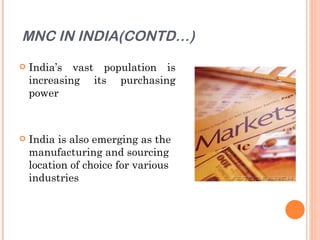
   India’s vast population is
    increasing its purchasing
    power


   India is also emerging as the
    manufacturing and sourcing
    location of choice for various
    industries
TRENDS OF MNC’S IN INDIA…
   First MNC in INDIA was DUTCH EAST INDIA Co.
    in 1600.

   American companies accounts for around 37% of the
    turnover of the top 20 firms operating in India.

   The scenario for 'MNC in India' has changed a lot in
    recent years, since more and more firms from
    European Union like Britain, Italy, France, Germany,
    Netherlands, Finland, Belgium etc have outsourced
    their work to India.

   Finnish mobile handset manufacturing giant Nokia is
    the largest Multinational Corporation In India.
TRENDS OF MNC’S IN INDIA…
(CONTD..)
   A host of automobile companies like Fiat Motors,
    from Italy have opened shop in India with R&D
    wing attached.

   Oil companies, Infrastructure builders from
    Middle East are also flocking in India to catch
    the boom.

   South Korean electronics giants Samsung and
    LG Electronics and small and mid-segment car
    major Hyundai Motors are doing excellent
    business and using India as a hub for global
    delivery.
TRENDS OF MNC’S IN INDIA…(CONTD..)
   Also insurance companies like AIG and Max New York
    Life Insurance doing business in India.
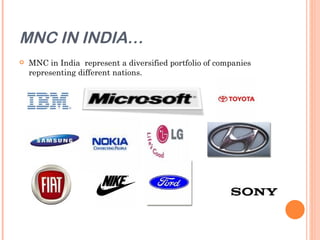
MNC IN INDIA…
   MNC in India represent a diversified portfolio of companies
    representing different nations.
THE INDIAN MNCS
………………
 Paints – Asian Paints
 Auto & Components – Tata Motors,
  Bharat Forge
 Chemicals – Tata Chemicals, United
  Phosphorus
 Metals – Sterlite Industries, TISCO

 Packaging – Essel

 Pharmaceuticals – Ranbaxy, Wockhardt,
  Sun, DRL
 Oil & Gas – ONGC
MULTINATIONAL CORPORATE
STRUCTURE
   Horizontally integrated multinational corporations
    manage production establishments located in different
    countries to produce the same or similar products.
    (example: McDonald's)
   Vertically integrated multinational corporations
    manage production establishment in certain
    country/countries to produce products that serve as input
    to its production establishments in other country/countries.
    (example: Adidas)
   Diversified multinational corporations manage
    production establishments located in different countries
    that are neither horizontally nor vertically. (example:
    Microsoft or Siemens )
ADVANTAGES OF MNC’S

   MNC’s have become vehicles of technology to the developing
    countries
   Greater employment and career opportunities are provided by
    these MNC’s.
   MNC’s make commendable contribution to inventions and
    innovations in the host country.
   Practice of MNC’s bring to the host country, the latest
    technique in the field of management.
   Varity of goods and services produced for local customers.
DISADVANTAGES OF
MNC’S
   MNC’s create monopolies in the market and eliminate local
    competitors.
   MNC’s may create depletion of resources due to its continues use
    by these overseas companies.
   MNC’s generally carry out their R&D in their home country and
    supply to the host country.
   Slow down in the growth of employment in the home country
.
CONSTRAINTS
INTERFERING WITH THE MNC’S
GOAL

   As MNC managers attempt to maximize their
    firm’s value, they may be confronted with various
    constraints.
     Environmental constraints.
     Regulatory constraints.
     Ethical constraints.
THEORIES OF
INTERNATIONAL BUSINESS

Why are firms motivated to expand
their business internationally?

 Theory of Comparative Advantage
    Specialization by countries can increase production
     efficiency.
 Imperfect Markets Theory
    The markets for the various resources used in production
     are “imperfect.”
 Product Cycle Theory
    As a firm matures, it may recognize additional
     opportunities outside its home country.
INTERNATIONAL
BUSINESS METHODS
There are several methods by which firms can
conduct international business.

   International trade is a relatively conservative approach
    involving exporting and/or importing.
      The internet facilitates international trade by enabling
        firms to advertise and manage orders through their
        websites.
   Licensing allows a firm to provide its technology in exchange
    for fees or some other benefits.
   Franchising obligates a firm to provide a specialized sales or
    service strategy, support assistance, and possibly an initial
    investment in the franchise in exchange for periodic fees.
INTERNATIONAL
    BUSINESS METHODS
   Firms may also penetrate foreign markets by engaging in a
    joint venture (joint ownership and operation) with firms
    that reside in those markets.
   Acquisitions of existing operations in foreign countries
    allow firms to quickly gain control over foreign operations
    as well as a share of the foreign market.
   Firms can also penetrate foreign markets by establishing
    new foreign subsidiaries.
   In general, any method of conducting business that
    requires a direct investment in foreign operations is
    referred to as a direct foreign investment (DFI).
   The optimal international business method may depend on
    the characteristics of the MNC.
VALUATION MODEL FOR AN MNC
 An MNC’s financial decisions include how much
  business to conduct in each country and how
  much financing to obtain in each currency.
 Its financial decisions determine its exposure to
  the international environment.
VALUATION MODEL FOR AN
MNC

Domestic Model

                         n
                               E ( CF$, t )
             Value = ∑
                        t =1    (1 + k )   t


            E (CF$,t )    =      expected cash flows to
            be received at the end of period t
            n      =      the number of periods into the
            future in which cash flows are received
            k      =      the required rate of return by
            investors
VALUATION MODEL FOR AN
MNC
   Valuing International Cash Flows


                    m                               
                 n ∑
                       [E (CFj , t ) ×E (ER j , t )] 
                                                    
       Value = ∑ j =1                               
               t =1        (1 + k )  t
                                                     
                    
                                                    
                                                     
              E (CFj,t )   =        expected cash flows
              denominated in currency j to be received by the U.S.
              parent at the end of period t
              E (ERj,t )   =        expected exchange rate at
              which currency j can be converted to dollars at the
              end of period t
EXPOSURE TO INTERNATIONAL
RISK

International business usually
increases an MNC’s exposure to:
 exchange rate movements
    Exchange rate fluctuations affect cash flows and
     foreign demand.
 foreign economies
    Economic conditions affect demand.
 political risk
    Political actions affect cash flows.
VALUATION MODEL FOR AN
    MNC
Impact of New International Opportunities
on an MNC’s Value

                  Exposure to
                  Foreign                       Exchange Rate
                  Economies                     Risk


                      m                                      
                   n ∑
                             [E ( CFj , t ) × E (ER j , t ) ] 
                       j =1                                  
         Value = ∑                                           
                 t =1             (1 + k )   t
                                                              
                      
                                                             
                                                              
                               Political Risk
CONCLUSION

   MNCs are beneficial for India and its also
    give disadvantages to India.

   They give us employment, growth,
    development etc. but they also creates
    monopoly in market thus small sectors
    which exists in market getting closed.
THANK YOU
                      FROM
            Raghunath.D
                 4thSemester
                     M.F.A.M
            Manasagangothri
                     Mysore