Presentation Skills
                      By : Gihan Aboueleish
Gihan aboueleish
Learning Objectives
      What is Communication ?
      The Communication Cycle
       Impact of a message
       Styles of Communication
       What is a skill?
      Designing Effective PowerPoint Presentation.
      Types of Instructional Tools.
      Some Final Words
Gihan aboueleish
Why Communication ..?


 Communication
 Miss-communication

 Communication Skills.


Gihan aboueleish
What is Communication?

The dictionary defines communication as
      a process by which information is exchanged
      between individuals through a common
      system of symbols, signs or behaviors.


Gihan aboueleish
Functions of Communication


 Control
 Motivation

 Emotional Expression

 Information
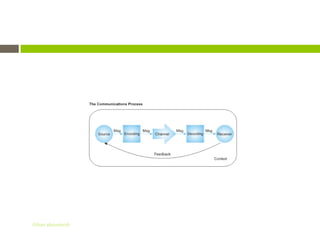
Process of Communication


Gihan aboueleish
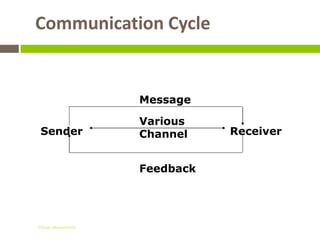
Communication Cycle


                   Message

                   Various
 Sender            Channel    Receiver


                   Feedback


Gihan aboueleish
Cultural Difference “video”
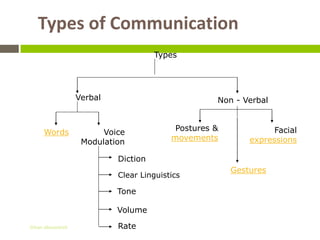
Types of Communication
                                      Types


                   Verbal                           Non - Verbal


                                           Postures &             Facial
     Words               Voice
                                          movements         expressions
                    Modulation

                            Diction
                                                        Gestures
                            Clear Linguistics

                            Tone

                            Volume

Gihan aboueleish            Rate
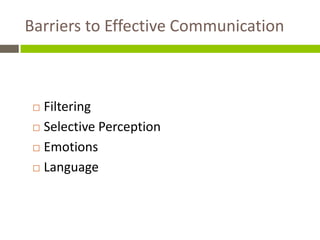
Barriers to Effective Communication


  Filtering
  Selective Perception

  Emotions

  Language
Cultural Misunderstanding “Video”
Key Communication Skills

   Listening Skills

   Feedback Skills

   Presentation skills
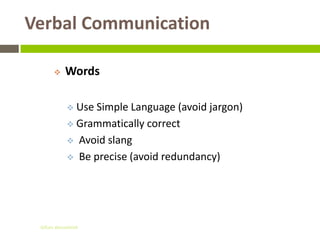
Verbal Communication

          Words

             UseSimple Language (avoid jargon)
             Grammatically correct

             Avoid slang

             Be precise (avoid redundancy)


 Gihan aboueleish
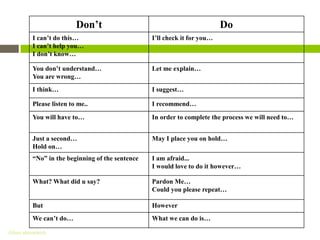
Don’t                                            Do
          I can’t do this…                        I’ll check it for you…
          I can’t help you…
          I don’t know…

          You don’t understand…                   Let me explain…
          You are wrong…
          I think…                                I suggest…

          Please listen to me..                   I recommend…
          You will have to…                       In order to complete the process we will need to…


          Just a second…                          May I place you on hold…
          Hold on…
          “No” in the beginning of the sentence   I am afraid...
                                                  I would love to do it however…

          What? What did u say?                   Pardon Me…
                                                  Could you please repeat…

          But                                     However
          We can’t do…                            What we can do is…

Gihan aboueleish
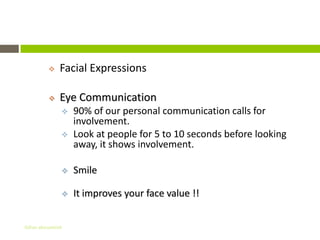
Non – Verbal Communication
             Facial Expressions

             Eye Communication
                  90% of our personal communication calls for
                   involvement.
                  Look at people for 5 to 10 seconds before looking
                   away, it shows involvement.

                  Smile

                  It improves your face value !!


Gihan aboueleish
Non – Verbal Communication
                  Gestures

                  Are you aware how you look to others?

                  Find out your habits

                  Find your nervous gestures


Gihan aboueleish
Non – Verbal Communication
      Posture And Movement

      Stand Tall.

      The difference between towering and cowering is totally a
      matter of inner posture.

      It’s got nothing to do with height, it costs nothing and its
      more fun.


Gihan aboueleish
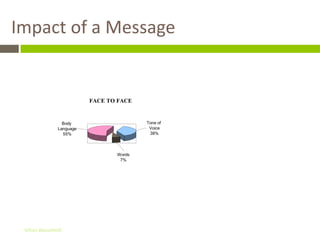
Impact of a Message


                          FACE TO FACE


                 Body                    Tone of
               Language                   Voice
                 55%                      38%


                                 Words
                                  7%


 Gihan aboueleish
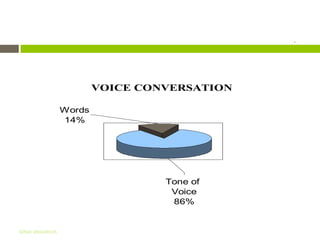
Impact of a Message
                                                -


                           VOICE CONVERSATION

                   Words
                   14%


                                    Tone of
                                     Voice
                                     86%


Gihan aboueleish
Cultural Shock “Video”
Feedback Skills


    Positive vs. Negative Feedback
    Positive feedback is more readily and accurately
     perceived than negative feedback.
    Positive feedback fits what most people wish to
     hear and already believe about themselves.
    Negative feedback is most likely to be accepted
     when it comes from a credible source if it is
     objective in form.
    Subjective impressions carry weight only when
     they come from a person with high status and
Developing Effective Feedback Skills


    Focus on specific behaviors.
    Keep feedback impersonal
    Keep feedback goal oriented
    Make feedback well timed
    Ensure understanding
    Direct feedback toward behavior that is
     controllable by the recipient
Group Think


   Phenomena in which the norm for consensus
    overrides the realistic appraisal of alternative
    course of action
Styles Of Communication


        Aggressive communication

        Submissive communication

        Assertive communication


Gihan aboueleish
Aggressive communication
    Those who communicate in an aggressive manner are
     generally perceived as selfish and unwilling to
     compromise. This style is usually linked to a desire to hurt
     others or exact revenge, or may reflect poor emotional
     development.
    It usually attacks the other person instead of expressing a
   need:

     Ex; "You never spend any time with me“
   versus
    "I need to spend more time with you".


Gihan aboueleish
Passive Communication


      Passive communication is based on compliance and
       hopes to avoid confrontation at all costs. In this
       mode we don't talk much, question even less, and
       actually do very little. We just don't want to rock
       the boat. Passives have learned that it is safer not
       to react and better to disappear than to stand up
       and be noticed.


Gihan aboueleish
Assertive communication
   The most effective and healthiest form of
    communication. It's how we naturally express
    ourselves when our self-esteem is intact, giving us
    the confidence to communicate without games and
    manipulation.

  When we are being assertive, we work hard to
   create mutually satisfying solutions. We
   communicate our needs clearly. We care about the
   relationship and insist for a win/win situation. We
   know our limits and refuse to be pushed beyond
Gihan aboueleish
   them just because someone else wants or needs
Situations


       Have a look at these situations and decide how...
        ...an aggressive person would react

       Situation # 01.

       Situation # 02.

Gihan aboueleish
Situations

     You are trying to concentrate on some important work.
     However, a few of your co-workers are laughing and
     horsing around. What do you do?

    You are the head of your department. A young lady who
     works for you has started coming to work late everyday
     and is extremely moody. What do you do?


    Gihan aboueleish
What is a Skill?


                   Skill is defined as a learned
                   power of doing something
                   competently.

                  It is a developed aptitude
                   or ability.


Gihan aboueleish
Listening Skills


An open ear is the only believable sign
of an open heart.

                                          David Augsburger


  Gihan aboueleish
Types of Listening

            Listening are of 3 types:

            Hearing

            Passive listening

            Active listening


Gihan aboueleish
Barriers to Active Listening


 *   Environmental barriers
 *   Physiological barriers
 *   Psychological barriers
 *   Selective Listening
 *   Negative Listening Attitudes
 *   Personal Reactions
 *   Poor Motivation
How to Be an Effective Listener

  What You Think about Listening ?

 *   Understand the complexities of listening
 *   Prepare to listen
 *   Adjust to the situation
 *   Focus on ideas or key points
 *   Capitalize on the speed differential
 *   Organize material for learning
How to Be an Effective Listener (cont.)


 * What You Feel about Listening ?

 *   Want to listen
 *   Delay judgment
 *   Admit your biases
 *   Don’t tune out “dry” subjects
 *   Accept responsibility for understanding
 *   Encourage others to talk
How to Be an Effective Listener (cont.)


 * What You Do about Listening ?

 *   Establish eye contact with the speaker
 *   Take notes effectively
 *   Be a physically involved listener
 *   Avoid negative mannerisms
 *   Exercise your listening muscles
 *   Follow the Golden Rule
Important Details
      Be calm and collected at all times

      Be loud enough to be easily heard

      Use words with accurate diction & correct pronunciation

      Speak slowly and make use of pauses to stress important
      ideas.


 Gihan aboueleish
Important Details

  Use a confident tone and a level clear vocabulary.

  Be vibrant and enthusiastic – avoid a dull, monotonous
   tone.

  Know what you are talking about and accept the limitations
   of your knowledge.


Gihan aboueleish
Finally, remember that
   interpersonal communication is a
   multitude of skills. Also remember
   that skills can be learned and
   practiced. It is our hope that you
   are on your way to mastering the

         ART OF COMMUNICATION.
Gihan aboueleish
Assignment


       Create a presentation about ;

            Motivating people in boring jobs
            Advertising may influence the consumer behavior.
            Ethics in science …is a barrier or helper ?
            Movies and their impact on mindsets
            Current lifestyle evil.
            HSCB think global & act local.

        Your presentation should not exceed 15 Min with Maximum
        20 slides.
Gihan aboueleish
DESIGNING EFFECTIVE
“POWERPOINT PRESENTATIONS”


       By : Gihan aboueleish
Presentation Skills


 Ideas, concepts or issues talked about or
   spoken to a group or audience

 Public speaking is one of the most feared
   things
       “I could make such a fool of myself”

 Skills required to give a good presentation can
   be developed “ Preparation is the Key”
Presentation Skills
*   Preparation/ Planning is the first step on the ladder to
    success

*   Aspects in the development of a good presentation
      *   Self Centered (Self)
      *   Audience Centered (Audience)
      *   Subject Centered (Material)


*   “I want (who) to (what) (where, when and how) because
    (why)”
Presentation Skills

   Helpers

What do you want to present (content)?
Why do you want to present (purpose)?
Where will you be presenting (place)?
How do you want to present (words to be used or not,
  slides to be used)
Who is your audience?
Presentation Skills

*   Preparation: Audience Analysis

*   What is the audience interested in
*   What does the audience want
*   What does the audience already know and needs to
    know
*   What are their needs, expectations from this
    presentation
*   How will the audience benefit from this presentation
Presentation Skills

   Structuring the presentation
               Opening/Beginning
               Middle section
               Closing/End
               5 min. , Questions
Presentation Skills

*     The Beginning
    - Should be carefully designed.

*    Get attention
     - shock, humor, question, story, facts &figures

*    Motivate audience to listen
     - listen to their needs
Presentation Skills


*   Preparation – Structure
*   Sequence should be logical & understandable
*   Summaries- Recaps
*   Value of visual aids-flip charts, handouts etc.
Presentation Skills

*   Prepare Closing
*   Last 2 to 2.5 minutes are as critical as the first
    five minutes for a successful presentation
*   Summarize- highlight important points
*   Suggest action- what to do and when, where and
    how to do it
Presentation Skills

*   Effective Delivery
*   Be active - move
*   Be purposeful - controlled gestures
*   Variations – vocal (pitch, volume, rate)
*   Be natural
*   Be direct – don’t just talk in front of the
    audience talk to them
Presentation Skills

Handling Questions

 Do not get confused
 You are not supposed to know everything

 Anticipate and keep answers ready

 Sometime questions themselves give you a lead
  to highlight your point of view
Presentation Skills
 Visual Aids
 While using an over head projector face the
  audience while talking
 Point with a pen

 Appropriate lighting

 Watch the colors

 Ensure clear visibility

 06 lines, 07 words per line
Presentation Skills


So to conclude :

           Always prepare
           Control your fear
          Interact with your audience
Tips for public presentation “Video”
Designing Effective PowerPoint
   Presentation


                   Big           Progressive


          Consistent                 Simple


                         Clear             Summary

Gihan aboueleish
MAKE IT   BIG
Gihan aboueleish
Make it Big (Text)
      This is Arial 12

      This is Arial 18
      This is Arial 24
      This is Arial 32
      This is Arial 36
      This is Arial 44


Gihan aboueleish
Make it Big (Text)
   This is Arial 12

   This is Arial 18
                       Too Small
   This is Arial 24
   This is Arial 32
   This is Arial 36
   This is Arial 44


Gihan aboueleish
Make It Big (How to Estimate)

                   Look at it from 2 metres away   
                        2m


Gihan aboueleish
KEEP IT SIMPLE
Gihan aboueleish
Keep It Simple (Text)
     Too many colours
     Too Many Fonts and Styles
     The 6 x 7 rule
        No more than 6 lines per slide
        No more than 7 words per line


Gihan aboueleish
Keep It Simple (Text)
Instructional Technology:
  A complex integrated process involving people,
  procedures, ideas, devices, and organization, for
  analyzing problems and devising, implementing,
  evaluating, and managing solutions to those
  problems in situations in which learning is
                     Too detailed !
  purposive and controlled
  (HMRS 5th ed.)


  Gihan aboueleish
Keep It Simple (Text)

    Instructional Technology:
   A process involving people, procedures & tools
   for solutions
   to problems in learning
   (HMRS 5th ed.)   Much Simpler


 Gihan aboueleish
Falling Leaves Observed

                          Delhi       Mumbai       Goa
         January         11,532,234 14,123,654     3,034,564
         February         1,078,456 12,345,567    16,128,234
         March           17,234,778   6,567,123   16,034,786
         April           16,098,897 10,870,954     7,940,096
         May              8,036,897 10,345,394    14,856,456
         June
         July
                        Too detailed !
                         16,184,345    678,095
                          8,890,345 15,347,934
                                                   4,123,656
                                                  18,885,786
         August           8,674,234 18,107,110    17,230,095
         September        4,032,045 18,923,239     9,950,498
         October          2,608,096   9,945,890    5,596,096
         November         5,864,034    478,023     6,678,125
Gihan aboueleish
             December    12,234,123   9,532,111    3,045,654
Falling Leaves in Millions

              In 106         Delhi   Mumbai   Goa
              January          11        14     3
              February          1        12    16
              March            17         6    16
              April            16        10     7
              May
              June        Much Simpler
                                8
                               16
                                         10
                                          0
                                               14
                                                4
              July              8        15    18
              August            8        18    17
              September         4        18     9
              October           2         9     5
              November          5         0     6
              December         12         9     3
Gihan aboueleish
Falling Leaves
      50
                                                                                                 Goa
      45
                                                                                                 Mumbai
      40
                                                                                                 Delhi
      35
      30
      25                                 Too detailed !
      20
      15
      10
       5
Gihan aboueleish

       0
        January    February   March   April   May   June   July   August   September   October   November December
Falling Leaves
 50
                                                      Goa
                                                      Mumbai
                                                      Delhi
 40


 30
                           Much Simpler
 20


 10

Gihan aboueleish
   0
   January         March    May   July   September   November
Keep It Simple (Picture)

           Art work may distract your audience
          Artistry does not substitute for content


Gihan aboueleish
Keep It Simple (Sound)
   Sound effects may distract too


    Use sound only when necessary


Gihan aboueleish
Keep It Simple (Transition)
   This transition is annoying, not enhancing


     "Appear" and "Disappear" are better
Keep It Simple (Animation)


                           2m


                   Simple & to the point


Gihan aboueleish
MAKE IT CLEAR
Gihan aboueleish
Make It Clear (Capitalisation)
      ALL CAPITAL LETTERS ARE DIFFICULT TO READ

      Upper and lower case letters are easier


Gihan aboueleish
Make It Clear (Fonts)


   Z               Times/Arial   Z   Serif

                   clear         busy
Gihan aboueleish
Make It Clear (Fonts)
         Serif or Script fonts are difficult to read on screen
         Arial or Times fonts are clearer
         Italics are difficult to read on screen
         Normal or bold fonts are clearer
         Underlines may signify hyperlinks
         Instead, use colours to emphasise


Gihan aboueleish
Make It Clear (Numbers)
 Use numbers for lists with sequence
 For example:

 How to put an elephant into a fridge?

 1. Open the door of the fridge
 2. Put the elephant in
 3. Close the door


Gihan aboueleish
Make It Clear (Numbers)
How to put a giraffe into a fridge?

1.   Open the door of the fridge
2.   Take out the elephant
3.   Put the giraffe in
4.   Close the door


Gihan aboueleish
Make It Clear (Bullets)
Use bullets to show a list without
 Priority

 Sequence

 Hierarchy, …..


 Gihan aboueleish
Make It Clear (Colours)
    Use contrasting colours
    Light on dark vs dark on light
    Use complementary colours


Gihan aboueleish
Make It Clear (Contrast)
   Use contrasting colours
   Light on dark vs dark on light
   Use complementary colours
                                     high contrast

                                      low contrast


Gihan aboueleish
Make It Clear (Contrast)
   Use contrasting colours
   Light on dark vs dark on light
   Use complementary colours


      This is light on dark

Gihan aboueleish
Make It Clear (Contrast)
   Use contrasting colours
   Light on dark vs dark on light
   Use complementary colours


                       This is dark on light

    Gihan aboueleish
Make It Clear (Complement)


    Use contrasting colours
   Light on dark vs dark on light
   Use complementary colours

These colours do not complement


Gihan aboueleish
Make It Clear (Complement)


   Use contrasting colours
 Light on dark vs dark on light
 Use complementary colours

           These colours complement


Gihan aboueleish
Make It Clear (Size)
      Size implies importance


Gihan aboueleish
Make It Clear (Size)

   Size implies importance


Gihan aboueleish
Make It Clear (Focal Points)
      Focal points direct attention


Gihan aboueleish
Make It Clear (Focal Points)
      Focal points direct attention


Gihan aboueleish
BE PROGRESSIVE
Gihan aboueleish
Types of Instructional Tools
                              Discovery
                               Learning
                                                 Individual                         Social
                                                Constructive                      Constructive
                                                   Tools                             Tools


                                            Too many in one go!
Mode of Instruction


                                  Guided
                                  Inquiry                       Informational Tools


                                                  Individual                        Social
                                                  Instructive                    Communicative
                                                     Tools                          Tools
                                  Direct
                             Instruction

                                               Individual              Pair              Group

                      Gihan aboueleish                           Complexity of Interactions
Types of Instructional Tools
                       Discovery
                        Learning
                                       Individual                         Social
                                      Constructive                      Constructive
                                         Tools                             Tools
 Mode of Instruction


                          Guided
                                                      Informational Tools
                                       Progressive &
                          Inquiry


                                        Individual                        Social
                                       thus focused
                                        Instructive
                                           Tools
                                                                       Communicative
                                                                          Tools
                            Direct
                       Instruction

                                     Individual              Pair              Group

       Gihan aboueleish                                Complexity of Interactions
Understanding Technology

Mouse                             I/O Error

Main Storage                       CPU

 Function key   Too many & not User interface
Software            focused   Debugger

Floppy disk                         Backup system
Understanding Technology

Mouse                           I/O Error

Main Storage                    CPU

 Function key   Progressive &    User interface

Software        thus focused    Debugger

Floppy disk                       Backup system
BE CONSISTENT
Gihan aboueleish
Be Consistent
   Differences draw attention

   Differences may imply importance

   Use surprises to attract not distract


Gihan aboueleish
Be Consistent

Differences draw attention
   Differences may imply importance
   Use surprises to attract not distract


       This tick draws attention


Gihan aboueleish
Be Consistent
Differences draw attention
 Differences may imply importance
o   Use surprises to attract not distract


            These differences distract!


Gihan aboueleish