Art and Artisans
Production
Process Medium
Technique
Curation
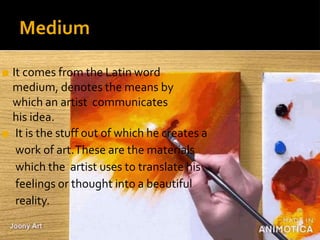
Medium
■ It comes from the
Latin word medium,
denotes the means
by which an artist
communicates his
idea.
■ It is the stuff out of which he
creates a work of art.These
are the materials which the
artist uses to translate his
feelings or thought into a
beautiful reality.
■ It comes from the Latin word
medium, denotes the means by
which an artist communicates
his idea.
■ It is the stuff out of which he creates a
work of art.These are the materials
which the artist uses to translate his
feelings or thought into a beautiful
reality.
■ On the basis of medium, the arts
are primarily classified as:Visual
andAuditory
■ The artist thinks feels and
gives shape to his vision in
terms of his mediums.
When an artist chooses
his medium, he believes
that this can best express
the idea he wants t
convey. Most often an
artist employs more than
one medium to give
meaning to his creative
production.
The Artist and His
Mediums
Technique
■ Technique is the manner in
which the artist controls his
medium to achieve the
desired effect. It is the
ability with which he fulfills
the technical requirement s
of his particular work of art.
It has to do with the way he
manipulates the work of art.
It has to do with the way he
manipulates his medium to
express his ideas.
■ Watercolor- as a medium is difficult to handle
because it is difficult to produce warm and
rich tones.While changes may be made once
the paint has been applied such changes
normally tend to make the color less
luminous.This defect however are rendered
by watercolor artists through some
techniques.
The Mediums ofVisual Arts
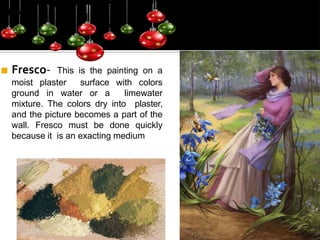
■ Fresco- This is the painting on a
moist plaster surface with colors
ground in water or a limewater
mixture. The colors dry into plaster,
and the picture becomes a part of the
wall. Fresco must be done quickly
because it is an exacting medium
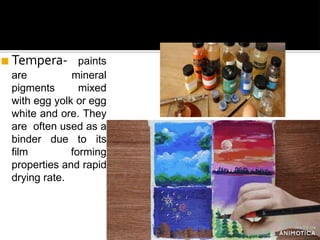
■ Tempera- paints
are mineral
pigments mixed
with egg yolk or egg
white and ore. They
are often used as a
binder due to its
film forming
properties and rapid
drying rate.
Italian Renaissance Art - Tempera
Painting
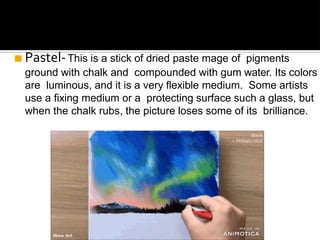
■ Pastel-This is a stick of dried paste mage of pigments
ground with chalk and compounded with gum water. Its colors
are luminous, and it is a very flexible medium. Some artists
use a fixing medium or a protecting surface such a glass, but
when the chalk rubs, the picture loses some of its brilliance.
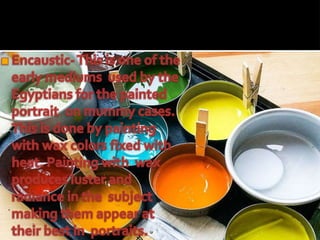
■ Encaustic-This is one of the early mediums
used by the Egyptians for the painted portrait
on mummy cases.This is done by painting
with wax colors fixed with heat. Painting with
wax produces luster and radiance in the
subject making them appear at their best in
portraits.
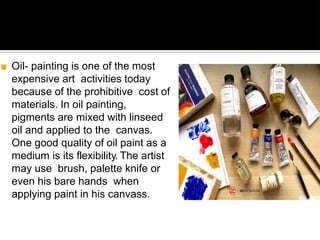
■ Oil- painting is one of the most
expensive art activities today
because of the prohibitive cost of
materials. In oil painting,
pigments are mixed with linseed
oil and applied to the canvas.
One good quality of oil paint as a
medium is its flexibility. The artist
may use brush, palette knife or
even his bare hands when
applying paint in his canvass.
■ Acrylic- This medium is
used popularly by
contemporary painters
because of the
transparency and quick
drying characteristics of
water color and the
flexibility of oil combined.
This synthetic paint is mixed
with acrylic emulsion as
binder for coating the
surface of the artwork.
■ Mosaic- art is a picture or
decoration made of small
pieces of inlaid colored stones
or glass called “tesserae”
which most often are cut in into
squares glued on a surface with
plaster or cement. Mosaic is
usually classified as painting.
Although the medium used is
not strictly pigment.
■ StainedGlass- as an artwork is common in
GothicCathedrals and churches.This is made
by combining many small pieces of colored
glass which are held together by bands of
lead.
■ Tapestry –This is a fabric consisting of a warp upon
which colored threads are woven by hand to produce a
design, often pictorial and for wall hangings and furniture
covering. During the middle Ages, they were hung on the
walls of palaces and in Cathedrals on festive occasions to
provide warmth.
■ Drawing- is usually done on paper,
using pencil pen and ink, or charcoal. It is
the most fundamental of all skills necessary
in the arts
■ Drawing can be done with different kinds of
mediums and the most common is pencil which
comes in different degrees of hardness or
softness, with the pencil lead (graphite)
depending on the kind of drawing the artists will
undertake. For line work, hard pencil lead is
applied. Ink, one of the oldest mediums still in
use, offers a great variety of qualities, depending
on the tools and techniques used in applying the
ink on the surface.
■ Bistre- is a brown pigment extracted from the
soot of wood, and often used in pen and wash
drawings.
■ Crayons- are pigments bound by wax and
compressed into painted sticks used for
drawing especially among children in the
elementary grade.They adhere better on
paper surface.
■ Charcoal-These are carbonaceous materials
obtained by heating wood or other organic
substances in the absence of air.Charcoal is used
in representing broad masses of light and
shadow.
■ Silverpoint- In this medium, the artist has
technique of drawing with a silver stylus on
specially prepared paper to produce a thin grayish
line that was popular during the Renaissance
period.
■ Print making- a print is anything printed on a
surface that is a direct result from a
duplicating process. Ordinarily, the painting
or graphic image, is done in black ink on
white paper and becomes the artist’s plate.
Five MajorTypes of Prints
■ 1)Woodcut -As the name implies, this is
made from a piece of wood.The design
stands as a relief, the remaining surface of
the block being cut away.A woodblock prints
just as do the letters of a typewriter.The lines
of the design are wood, so they are very f
■ 2) Engraving-This is the art of forming designs by cutting,
corrosion by acids. In engraving, the lines of the designs are cut
into a metal plate with ink and transferred from the plate to the
paper.The lines of an engraving are cut by hand with an instrument
called burin, a steel tool with an oblique point and rounded handle
for carving stone and engraving metal.
■ 3) Intaglio Is a printing
process in which the
design or the text is
engraved into the surface
of the place and the ink is
transferred to paper from
the groover.The design is
engraved or etched into a
metal plate.
■ 4)Stencil Printing Is a very common art
activity done by high school students these days
as a part of their practical arts courses. It is a
process which involves the cutting of the design
on special paper cardboard or metal sheet in such
a way that when ink is rubbed over it, the design is
reproduced on the surface
■ 5) Relief Involves the cutting away from a block of wood or
linoleum the parts of the design that the artist wants to be seen.
Leaving the portion of a design to stand out wants to be seen,
leaving the portion of a design to stand out on a block or on the
linoleum.
■ Artist- Leonardo
Davinci
■ Medium-Oil Paint
■ Technique- porated."Creating imperceptible
transitions between light and shade, and
sometimes between colors, he blended
everything "without borders, in the manner
of smoke," his brush strokes so subtle as to be
invisible to the naked eye.
■ Curation- Mona Lisa, also called Portrait of Lisa
Gherardini, wife of Francesco del Giocondo, Italian La
Gioconda, or French La Joconde, oil painting on a
poplar wood panel by Leonardo daVinci, probably the
world’s most famous painting. It was painted sometime
between 1503 and 1519, when Leonardo was living in
Florence, and it now hangs in the Louvre Museum, in
Paris, where it remained an object of pilgrimage in the
21st century.The sitter’s mysterious smile and her
unproven identity have made the painting a source of
ongoing investigation and fascination.
PRELIM_ART-and-ARTISAN ppt.pptx