A Source of Law
Precedents
By Shreyas Kaaparthi
Meaning of
Precedents
• Can be termed as a principle or law
laid down in Landmark legal cases or
• A rule or a principle used by the court
while deciding other cases
• Based on a Latin Doctrine “Stare
Decisis” – which obligates the Lower
Courts to follow historical cases
passed by the Apex Courts while
passing decision in similar cases.
Why are
Precedents
Important
 In order to maintain stability.
 In order to maintain Predictability and
 Maintain Integrity
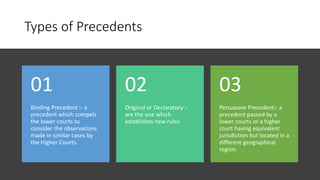
Types of Precedents
Binding Precedent :- a
precedent which compels
the lower courts to
consider the observations
made in similar cases by
the Higher Courts.
01
Original or Declaratory :-
are the one which
establishes new rules
02
Persuasive Precedent:- a
precedent passed by a
lower courts or a higher
court having equivalent
jurisdiction but located in a
different geographical
region.
03
Advantages
of Precedent
It promotes stability and
uniformity
The individual whims and
fancies of a judge are
brought under check
It is based on the
principle like cases should
be decided a like.
It helps in interpretation
of statutes
It saves time for future
rulings
It helps to prevent
mistakes occurring
Disadvantages
of Precedents
It adds multiple
layer complexities
It would create
uncertainty that can
never be resolved
until next ruling is
passed and the
people may not
agree with the same
Precedents can
introduce
unnecessary
restriction into the
legal system
It is based on old
thoughts and does
pave way to new
ideologies