Government Engineering
College, Bikaner
Submitted by:-
Virendra Singh Ruhela
Branch- Computer Science & Engg.
Submitted to:-
Department of Computer Science
Engineering College Bikaner
Cloud Deployment
Plan
 Introduction
 What is Cloud Computing?
 Why Cloud Computing?
 History and Origins
 Essential Characteristics of Cloud Computing
 Cloud service models
Software as a Service SaaS
Platform as a Service PaaS
Infrastructure as a Service IaaS
 Cloud implementation types
 Conclusion
Introduction
What is Cloud Computing?
“Cloud computing is a style of computing where
massively scalable IT-related capabilities are provided
as a service across the Internet to multiple external
customers”
“Cloud computing: A pool of abstracted, highly
scalable, and managed infrastructure capable of
hosting end-customer applications and billed by
consumption”
“Cloud computing is Web-based processing,
whereby shared resources, software, and
information are provided to computers and other
devices (such as smart phones) on demand over
the Internet.”
What is Cloud Computing?
Computing and software resources that are
delivered on demand, as service..
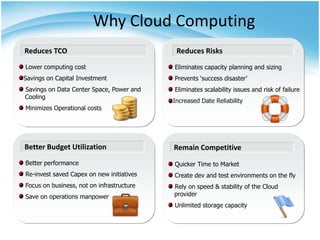
Why Cloud Computing
Eliminates capacity planning and sizing
Prevents ‘success disaster’
Eliminates scalability issues and risk of failure
Increased Date Reliability
Lower computing cost
Savings on Capital Investment
Savings on Data Center Space, Power and
Cooling
Minimizes Operational costs
Reduces TCO Reduces Risks
Better performance
Re-invest saved Capex on new initiatives
Focus on business, not on infrastructure
Save on operations manpower
Better Budget Utilization
Quicker Time to Market
Create dev and test environments on the fly
Rely on speed & stability of the Cloud
provider
Unlimited storage capacity
Remain Competitive
History and Origins
S3 Launches/EC2
Launch of Amazon web services
The arrival of Salesforce.com
Supercomputers/Mainframe
2006
2002
1990
1960
Google App / Azure
2008 - 2009
The first milestone for Cloud Computing
Launches of Google App
Engine/Windows Azure Beta
Openstack
Essential characteristics of Cloud Computing
• On-demand self-service
• Ubiquitous network access
• Resource pooling (advanced virtualization)
• Rapid elasticity
• Flexible pricing - Pay per use
• On-demand self-service
• Ubiquitous network access
• Resource pooling (advanced virtualization)
• Rapid elasticity
• Flexible pricing - Pay per use
Cloud service models
Cloud Service Layers
Cloud Service models - Definitions
• SaaS is a software delivery methodology that provides
licensed multi-tenant access to software and its
functions remotely as a Web-based service.
Software as a
Service (SaaS)
• PaaS provides all of the facilities required to support
the complete life cycle of building and delivering web
applications and services entirely from the Internet.
Platform as a
Service (PaaS)
• IaaS is the delivery of technology infrastructure as an
on demand scalable service.
Infrastructure as
a Service (IaaS)
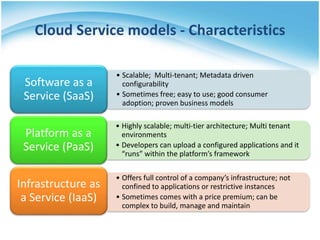
Cloud Service models - Characteristics
• Scalable; Multi-tenant; Metadata driven
configurability
• Sometimes free; easy to use; good consumer
adoption; proven business models
Software as a
Service (SaaS)
• Highly scalable; multi-tier architecture; Multi tenant
environments
• Developers can upload a configured applications and it
“runs” within the platform’s framework
Platform as a
Service (PaaS)
• Offers full control of a company’s infrastructure; not
confined to applications or restrictive instances
• Sometimes comes with a price premium; can be
complex to build, manage and maintain
Infrastructure as
a Service (IaaS)
Inside a Cloud
Virtualized CPUs and Storage
Physical Servers across the Globe
Software Platform
The Cloud Platform
Software as a
Service (SaaS)
Platform as a
Service (PaaS)
Infrastructure as a
Service (IaaS)
Virtual Servers
Virtual Storage
Network Routers
Java Runtime
Web 2.0 Runtime
LAMP / WAMP
Corporate Email
Business Processes
CRM, ERP, HR
Physical Servers
Cloud Providers – A Birds Eye View
Infrastructure
as a Service
Platform
as a Service
Software
as a Service
Cloud Service models - Comparison
Cloud implementation types
Public Cloud
• Owned and managed by service provider
• Made available to the general public or a large industry group
Private Cloud
• Operated solely for an organization
• May be managed by the organization or a third party
• Limits access to enterprise and partner network
• Retains high degree of control, privacy and security
Community Cloud
• Shared infrastructure by several organizations which have
shared concerns
• May be managed by the organizations or a third party
• Costs are spread over fewer users than a public cloud but
more than a single tenant
Hybrid Cloud
• Composition of two or more clouds (private, community, or
public) bound together by standardized or proprietary
technology that enables data and application portability
Conclusion
Cloud Computing is the fastest growing
part of network based computing . It Provides
tremendous benefits to customers of all sizes:
simple users, developers, enterprises and all
types of organizations.
Thank-You! you!