GETTING QUALITY BY
INCLUSIVE MANAGEMENT
A model to train and increase number of teacher
through learning center and A model to include local people
for implementing existing schemes that will provide quality
primary education to rural students.
Team - Power Within
Nishchay Raj Chaurasia
Shyambir
Nilay Kant
Roopnarayan Pal
Rahul Kumar Gautam
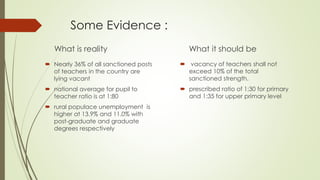
Some Evidence :
What is reality
 Nearly 36% of all sanctioned posts
of teachers in the country are
lying vacant
 national average for pupil to
teacher ratio is at 1:80
 rural populace unemployment is
higher at 13.9% and 11.0% with
post-graduate and graduate
degrees respectively
What it should be
 vacancy of teachers shall not
exceed 10% of the total
sanctioned strength.
 prescribed ratio of 1:30 for primary
and 1:35 for upper primary level
Quality problem
 While 61.89% of the students in
class 3 passed in mathematics,
only 42.71% passed the subject in
class 8
 An NCERT paper says the B.Ed
programme is too short and
focuses on “rote memorization”
rather than “teaching for
understanding”.
 50% of rural children enrolled in
standard five can fluently read a
standard two text book.
Management problem
 School Development Plans are
barely functional in the school
management committees(SMCs)
and that members are unaware of
their responsibilities.
 95% of schools in the country do not
comply with RTE guidelines
 While teacher absence rates were
over 24% in rural India in 2003
 There is large irregularities found in
Mid day mill scheme
BASIC IDEA
 With the available schemes like Sarva Skisha Abhiyan, Mid Day Meal & RTE,
we have all the facilities to make a government school in par with the
private school, but we have to implement these polices very rigorously.
 TRANSFER OF TEACHING SKILLS :
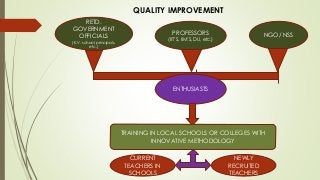
All the best colleges in India like IIT’s, IIM’s, DU etc. & all the concerned
highly educated people should give time to train the existing teachers &
newly recruited graduates & post graduates.
 Helping DIOS by framing no. of committees at regional level to inspect the
quality of education in the primary school at-least twice a month.
 Providing incentive/awareness to parents for the education of their ward.
MANAGEMENT STRUCTURE
DIOS
+ 5 member committee
(retd. Educated people, members of civil society)
DISTRICT LEVEL
1 government appointed person +
5 regional concerned people
(professors from colleges, NGO’s/NSS, local people)
EDUCATIONAL
REGION (ER)
VOLUNTEERS
(students from school/colleges, parents, school
authority)
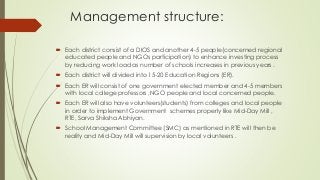
Management structure:
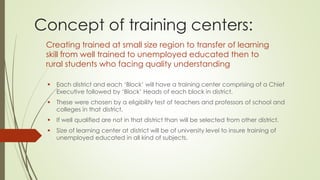
 Each district consist of a DIOS and another 4-5 people(concerned regional
educated people and NGOs participation) to enhance investing process
by reducing work load as number of schools increases in previous years .
 Each district will divided into 15-20 Education Regions (ER).
 Each ER will consist of one government elected member and 4-5 members
with local college professors ,NGO people and local concerned people.
 Each ER will also have volunteers(students) from colleges and local people
in order to implement Government schemes properly like Mid-Day Mill ,
RTE, Sarva Shiksha Abhiyan.
 School Management Committee (SMC) as mentioned in RTE will then be
reality and Mid-Day Mill will supervision by local volunteers .
PROFESSORS
(IIT’S, IIM’S, DU, etc.)
NGO/ NSS
RETD.
GOVERNMENT
OFFICIALS
(K.V. school principals,
etc.)
ENTHUSIASTS
TRAINING IN LOCAL SCHOOLS OR COLLEGES WITH
INNOVATIVE METHODOLOGY
CURRENT
TEACHERS IN
SCHOOLS
NEWLY
RECRUITED
TEACHERS
QUALITY IMPROVEMENT
Quality improvement:
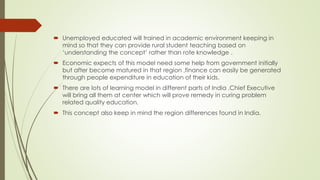
 There will be a stay of educational routine in best recognized
institutions(IIT,IIM,JNU,DU….) of about 3 months.
 Most professors from these institutions and civil society will distributed in different
district for giving innovative training to recruited graduates and post graduates
and current school teachers .
 They will stay in district universities and colleges. Training will be held at these
institutions.
 Such movement will be held at every 4-5 year.
 Contents of training will ensure ‘knowledge to be imparted to rural students’
should based on ‘understanding the concepts’ rather than Rote knowledge .
 Content and ‘method of teaching’ will more like what is used in private schools .
 Also there are very many innovative methods and content like ‘Judo-
Maths’,’Gyan lab’,etc. developed by different organizations and NGOs .
SELECTION PROCESS
• STEP1: All the interested candidates have to appear for written test (same
as the current one).
• STEP2: All candidates who have cleared 1st round will have to get a
teaching certificate from at-least two NGO’s/NSS (working in the city)who
are really concerned about primary education.
• NGO’s/NSS will issue certificate on the basis of the ability of candidate to
teach children.
• Hence, the recruitment process is completed.
INCENTIVE FOR PARENTS TO SEND CHILDREN TO SCHOOL.
• A student of the “government school” after completing his/her 12th can become
a government teacher in the same school if he/she clears a special exam mainly
focusing on his/her ability to teach primary children. This will work as an incentive
for parents to focus on the education of children.
• Prize distribution on the basis of evaluation carried out on a regular basis.
FINANCIAL REQUIREMENTS
 Incentive in the form of money will be provided to the faculty going to train
teachers.
 Money will be required to provide prizes to students on the regular basis.
 Above mentioned money will be worth spending if we are providing quality
education to the needy.
References:
• Unemployment rate is higher amongst highly educated rural Indians-a dnaindia
report
• 95% schools don't comply with RTE guidelines: Study –dnaindia report
• Annual Status of Education Report(ASER)
• UK-based Consortium for Research on Educational Access, Transitions and Equity
(CREATE)
• The Annual Status of Education Report (ASER)
• The Programme for International Student Assessment (PISA)
• National council for educational research and training(NCERT)