Presented by:
Akshay Pai - 11
Ankur Patil - 14
Rohan Salian - 32
 Poka-yoke (ポカヨケ) is a Japanese term that means "mistake-
proofing". A poka-yoke is any mechanism in a lean
manufacturing process that helps an equipment operator avoid
(yokeru) mistakes (poka).
 The concept was formalised, and the term adopted, by Shigeo
Shingo as part of the Toyota Production System. It was originally
described as baka-yoke, but as this means "fool-proofing" (or
"idiot-proofing") the name was changed to the milder poka-yoke.
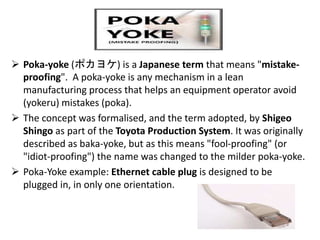
 Poka-Yoke example: Ethernet cable plug is designed to be
plugged in, in only one orientation.
Poka Yoke over Errors
 Help operators avoid mistakes in their work caused by choosing
the wrong part, leaving out a part, installing a part backwards,
etc.
 Involves the implementation of fail-safe ways methods that
detect or prevent human and machine error at or near the
source.
 Provides instant feedback and prevention of quality problems
Poka-Yoke as a...
 Poka Yoke as Prevention Device: Examples: Part locators, Part
present sensors.
 Poka Yoke as Detection Device: Examples: Vision system,
Limit sensors
Poka-Yoke as a…
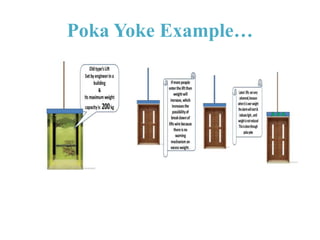
Poka Yoke Example…
Why is it important ??
 Helps people and processes
 Refers to techniques that make it impossible to make
mistakes.
 Helps drive defects out of products and processes and
substantially improve quality and reliability.
 Used to fine tune improvements and process designs from six-
sigma.
 Use the ideas and methods in product and process design
which can eliminate both human and mechanical errors.
Why is it important ??
When to use it?
 It is a technique, a tool that can be applied to any type of
process be it in manufacturing or the service industry.
 Poka-yoke can be used wherever something can go wrong or
an error can be made.
 Errors can be of any type –
• Processing Error
• Setup Error
• Missing Part
• Improper part/item
• Operations Error
• Measurement Error
How to use it?
 Step by step process in applying Poka-yoke:
 1. Identify the operation or process
 2. Analyze the 5-Ws and understand the ways a process can fail.
 3. Decide the right Poka-yoke approach, such as using a,
• Shut out Type: Preventing an error being made, or
• Attention Type: Highlighting that an error has been made.
 4. Determine whether a
• Contact Method
• Constant Number or Counting Method
• Motion-Sequence Method
 5. Trial the method and see if it works.
 6. Train the operator, review performance and measure success.
Methods in Detail
 Contact Methods:- The contact method identifies product defects
by testing the product's shape, size, color, or other physical
attributes.
 Constant Number or Counting Method:- The fixed-
value (or constant number) method alerts the operator if a
certain number of movements are not made.
 Motion-Sequence Method:- The motion-step (or sequence)
method determines whether the prescribed steps of the process
have been followed.
Day to Day Examples of Poka-
Yoke Disk
 File cabinets, opening one drawer locks all the rest, reducing the
chance of the file cabinet tipping.
 Sinks
 Microwaves
 Washing machines
 Central locking in modern cars
 Key locks in mobiles
 Refrigerators
 Beeps in automobiles if key is left in ignition
Characteristics of Poka-Yoke devices
 Simple and cheap
 Part of the process, permitting 100% inspection
 Placed close to where the mistakes occur, providing quick
feedback
 Designed to stop a particular mistake
 It will catch the errors before a defective part is manufactured
100% of the time.
Poka yoke presentation