
 Plastics(polymers) are formed when small organic molecules
are stitched together to form a long chain. This process is
called polymerization.
 Those organic molecules suitable for polymerization are called
monomers.
 A monomer is the single building block used in creating the
polymer.
 It is necessary for a monomer to be at least
bifunctional(capable of forming two covalent bond) to
polymerize.
 Some monomers are polyfunctional, capable of forming three
or more bonds. These can form three-dimensional
arrangements of chain called a network.
polymerization is generally of two types:
 Addition polymerization
 Condensation polymerization
 It consists of breaking the double carbon bond (C=C) in
bifunctional polymers so that the chain can be formed.
 Addition polymerization to produce thermoplastic materials.
Some plastic materials made by AP-
I. Poly- styrene(CH2=CH-C6H5)
II. Poly -vinyl chloride(CH2=CHCl)
III. Ploy- propylene(CH3CH=CH2)
IV. Poly-methyle methacrylate(CH2=CC3O2H4)
V. Poly-vinyl acetate(CH3COOCH=CH2)
VI. Poly-ethylene(CH2=CH2)
Conti…..
 In this polymerization, two different organic molecules react to
form a plastic molecules. The reaction generally results in the
separation of a small molecules such as H2O as a by-product.
 Typical plastic materials formed by CP:
I. Poly-epoxy(araldite)
II. Poly-phenol formaldehyde(Bakelite)
III. Polyamide(Nylon)
IV. Poly-urathane
A no. of additives are normally used with plastic materials to modify
their behaviour, improve properties or reduce the overall cost thereby
increasing the range of application of plastic.
Examples:
 Plasticizers: these are mixed with plastic to improve their flow
characteristics & decrease their brittleness.
 Fillers: these are inexpensive materials that are added to plastic to
reduce their cost.
 Flame retardants: these are added to plastic to reduce the
flammability of plastic by preventing oxygen reaction & charring.
 Reinforcing agent: these are the materials that are specifically added
to plastic materials to raise their mechanical properties.
 Stabilizers: are used to stabilize the properties of the plastic
throughout its useful life
 Colourants: are used to give colour to the plastics.
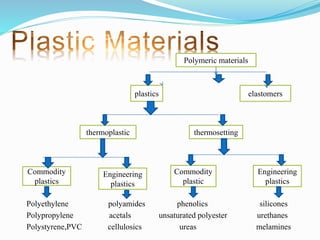
Polyethylene polyamides phenolics silicones
Polypropylene acetals unsaturated polyester urethanes
Polystyrene,PVC cellulosics ureas melamines
Polymeric materials
plastics elastomers
thermoplastic thermosetting
Commodity
plastics
Engineering
plastics
Commodity
plastic
Engineering
plastics
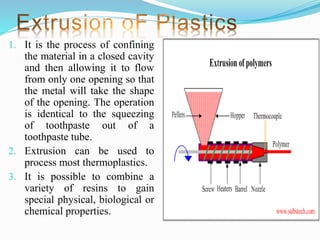
1. It is the process of confining
the material in a closed cavity
and then allowing it to flow
from only one opening so that
the metal will take the shape
of the opening. The operation
is identical to the squeezing
of toothpaste out of a
toothpaste tube.
2. Extrusion can be used to
process most thermoplastics.
3. It is possible to combine a
variety of resins to gain
special physical, biological or
chemical properties.
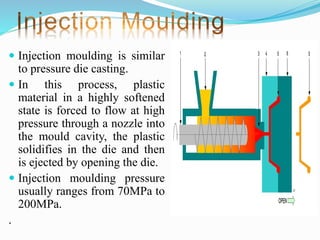
 Injection moulding is similar
to pressure die casting.
 In this process, plastic
material in a highly softened
state is forced to flow at high
pressure through a nozzle into
the mould cavity, the plastic
solidifies in the die and then
is ejected by opening the die.
 Injection moulding pressure
usually ranges from 70MPa to
200MPa.
.
Plastic processing