PERJETA® is a first-line treatment for HER2positive metastatic breast cancer.
• PERJETA is an FDA-approved
treatment for HER2-positive
metastatic breast cancer. It is
a targeted therapy used as
part of a first-line HER2positive metastatic breast
cancer treatment plan, in
combination with Herceptin
(trastuzumab) and docetaxel
(chemotherapy).
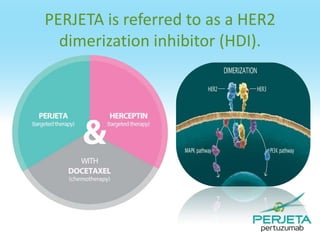
PERJETA is referred to as a HER2
dimerization inhibitor (HDI).
PERJETA is referred to as a HER2
dimerization inhibitor (HDI).
• Learn more about HDIs.
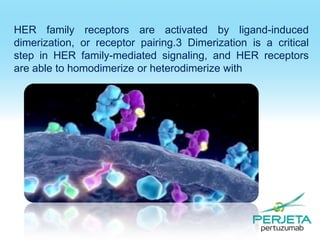
HER family receptors are activated by ligand-induced
dimerization, or receptor pairing.3 Dimerization is a critical
step in HER family-mediated signaling, and HER receptors
are able to homodimerize or heterodimerize with
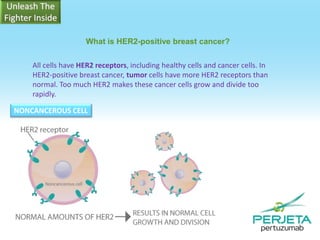
What is HER2-positive breast cancer?
All cells have HER2 receptors, including healthy cells and cancer cells. In
HER2-positive breast cancer, tumor cells have more HER2 receptors than
normal. Too much HER2 makes these cancer cells grow and divide too
rapidly.
NONCANCEROUS CELL
What is HER2-positive breast cancer?
All cells have HER2 receptors, including healthy cells and cancer cells. In HER2-positive breast
cancer, tumor cells have more HER2 receptors than normal. Too much HER2 makes these
cancer cells grow and divide too rapidly.
HER2-POSITIVE CANCER CELL

Cancer treatments called HER2-targeted therapies have been
developed to target the HER2 receptor.
PERJETA is one of those HER2-targeted therapies.
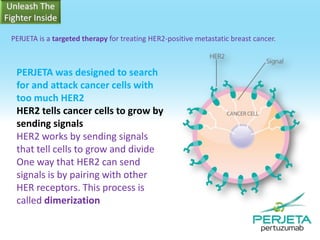
PERJETA is a targeted therapy for treating HER2-positive metastatic breast cancer.

PERJETA was designed to search
for and attack cancer cells with
too much HER2
HER2 tells cancer cells to grow by
sending signals
HER2 works by sending signals
that tell cells to grow and divide
One way that HER2 can send
signals is by pairing with other
HER receptors. This process is
called dimerization
PERJETA is a targeted therapy for treating HER2-positive metastatic breast cancer.

PERJETA works with Herceptin to target
HER2
PERJETA and Herceptin both target HER2
but work in different ways
PERJETA is thought to block one method
of signaling so that certain receptors are
unable to pair (dimerization) with HER2
Together, PERJETA and Herceptin are
thought to create a stronger blockade
against HER2 signals, helping to slow
down cancer cell growth

HER2 signaling could inhibit the growth of tumors.
PERJETA is proven to help control cancer growth
Adding PERJETA to Herceptin and docetaxel (chemotherapy) increased the time people
lived without their cancer growing or spreading by an average of 50%, compared with
people who took Herceptin and docetaxel (chemotherapy) alone
ERJETA helped people live longer
On average, people who were given PERJETA, Herceptin, and docetaxel
(chemotherapy) lived significantly longer than people given only Herceptin and
docetaxel (chemotherapy)

PERJETA is proven to shrink tumors
80% of people taking the PERJETA combination had their tumors shrink, compared to
69% of people taking Herceptin and docetaxel (chemotherapy) alonePeople who had
their tumors shrink maintained this response, on average, for 62% longer on the
PERJETA combination compared with people taking only Herceptin and docetaxel
(chemotherapy) (20.2 months vs 12.5 months)
PERJETA is taken together with Herceptin, another HER2 therapy
PERJETA is a targeted therapy used as part of a first-line HER2-positive metastatic
breast cancer treatment plan. This treatment plan includes Herceptin and docetaxel, a
type of chemotherapy. PERJETA and Herceptin both target HER2 but are believed to
work in complementary ways. The combination may increase death of cancer cells.
THE BREAST
I. Introduction/General Information

A. Embryologically: belong to integument
B. Functionally: part of reproductive
system
1. Respond to sexual stimulation

2. Feed babies
Breast, continued …

C. Modified apocrine sweat glands
- apex of cell becomes part of secretion
and breaks off
D. Present in males and females
II. Anatomy
A. Position and Attachment
1. Lateral aspect of pectoral region
2.
3.
4.
5.

Located between ribs 3 and 6/7
Extend form sternum to axilla
Surrounded by superficial fascia
Rest on deep fascia
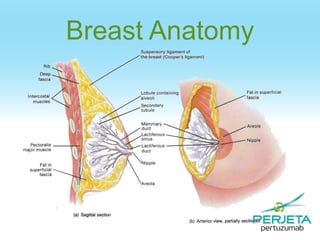
Breast Anatomy
Position & attachment, continued ….

6. Fixed to skin & underlying
fascia by fibrous C.T. bands
a. Cooper’s (Suspensory)
Ligaments
b. Ligaments may retract when
breast tumors are present
Cooper’s Suspensory Ligaments
Position & attachment, continued …

6. Left breast is usually slightly larger
7. Base is circular, either flattened or
concave
8. Separated from pectoralis major
muscle by fascia, retromammary

space
Retromammary Space

Retromammary
Space
Anatomy, continued …
B. Structure
1. Outer surface convex, skin covered
2. Nipple:
a. At fourth intercostal space
b. Small conical/cylindrical
prominence below center
Nipple location

4th intercostal
space
Structure, continued …
c. Surrounded by areola: pigmented
ring of skin
d. Thin skinned region lacking hair,
sweat glands
e. Contains areolar glands
Structure, continued …
3. Areola: contains dark pigment that
intensifies with pregnancy
a. Circular and radial smooth muscle fibers
b. Cause nipple erection
Areola
Structure, continued …

4. Each breast consists of ~ 20 lobes
of secretory tissue
a. Each lobe has one lactiferous duct
b. Lobes (and ducts) arranged radially
c. Embedded in connective tissue &
adipose of superficial fascia
d. Lobes composed of lobules
e. Lobules comprise alveoli
Lobes and Lobules
Structure, continued …
5. Excretory (lactiferous) ducts
converge toward areola
a. Form ampullae (collection sites of
lactiferous sinuses)

b. Ducts become contracted at base of
nipple
Excretory (lactiferous) ducts
Structure, continued …

6. Secretory epithelium
a. Changes with hormonal signals
b. Onset of menstruation
c. Pregnancy (glands begin to enlarge at 2nd month)
d. After birth, 1st secretion is colostrom (contain
antibodies)
Structure, continued …

7. “Tail of Spence” = axillary tail
a. prolongation of upper, outer
quadrant in axillary direction
b. Passes under axillary fascia
c. May be mistaken for axillary lymph
nodes
“Tail of Spence”
Axillary Tail
Structure, continued …

8. Fatty Tissue: surrounds surface, fills
spaces between lobes
a. Determines form & size of breast
b. No fatty deposit under nipple &
areola
Breast: Fatty Tissue
Structure, continued …
C. Vessels & nerves
1. Arteries: derived from thoracic
branches of three pairs of arteries
a. Axillary arteries

1) continuous with subclavian a.
2) gives rise to external mammary
( = lateral thoracic) artery
Vessels & Nerves, continued …
b. Internal mammary (thoracic) arteries

1) first descending branch of
subclavian artery
2) supply intercostal spaces & breast
3) used for coronary bypass surgery

c. Intercostal arteries:
1) numerous branches from internal
& external mammary arteries
2) supply intercostal spaces & breast
Arterial Supply to the Breast

Subclavian a.

Axillary a.

External
mammary
(thoracic) a.

Internal
mammary
(thoracic) a.
Vessels & Nerves, continued …
2. Veins:
a. form a ring around the base of the
venosus”)

nipple (“circulus

b. Large veins pass from circulus venosus to circumference of
mammary gland, then to
c. External mammary v to axillary v
or
d. Internal mammary v to subclavian v
Veins draining the Breast

Subclavian vein

External
mammary vein
Breast Anatomy, con’t…
3. Innervation: derived from:
a. anterior & lateral cutaneous
nerves of thorax
b. spinal segments T3 – T6
Structure, continued …

4. Lymphatics: clinically significant!
a. Glandular lymphatics drain into anterior axillary (pectoral)
nodes 
central axillary nodes  apical nodes 
deep cervical nodes 
subclavicular (subclavian) nodes

b. Medial quadrants drain into parasternal nodes
Lymph Nodes of the Breast

Subclavian
nodes
Axillary
nodes
Lateral
pectoral
nodes

Parasternal
nodes
Lymphatics, continued …
c. Superficial regions of skin, areola, nipples:
-form large channels & drain into pectoral nodes

d. NOTE: axillary nodes also drain lymph from arm
Lymph Nodes and Lymph Drainage

Axillary
Nodes
Routes of Metastasis
• From medial lymphatics to parasternal nodes
– Then to mediastinal nodes

• Across the sternum in lymphatics to
opposite side via cross-mammary pathways
– Then to contralateral breast

• From subdiaphragmatic lymphatics to nodes in
abdomen
– Then to liver, ovaries, peritoneum
Major Routes of Metastasis

Channels to Contralateral Breast

Axillary Lymph Channels

Subdiaphragmatic Lymph Channels
Structure, continued …
D. Anomalies
1. Inverted nipple: congenital or due
to cancer
2. Ectopic nipple:
a. “polythelia” or “hyperthelia”
b. additional nipples along milk line

3. Amastia
4. Micromastia
Anomalies, continued …
5. Macromastia
6. Gynecomastia
a. breast development of male in areolar region
b. noted in males who smoke marijuana at
puberty
III. Diseases of the Breast
A. Most are readily detectable
B. Etiology unknown, influencing factors

1. Sex
2. Heredity
Diseases of the breast, continued …
3. Endocrine influence
a. Menstruation – tenderness from fluid engorgement
b. Post-menopause
1) decrease of fibro-cystic disease
2) increase in cancer
c. Pregnancy
Diseases of the Breast, continued …

C. General symptoms & signs
1. Nipple discharge
a. always significant if not pregnant.

b. May be due to benign pituitary tumor.

2. Local pain, tenderness
3. Duration of lesion
4. Size, rate of growth
Symptoms & Signs, continued …

5. Retraction sign: “dimpling” involving
skin, nipple or areola
6. Mobility of mass
a. Benign = movable
1) not attached
2) not invasive
b. Malignant = attached
1)May grow into bone
Symptoms & Signs, continued …
7. Consistency of mass
a. Cysts = fluctuant; compressible
b. Fibroadenoma = rubbery
c. Carcinoma = firm, hard (like gravel)

8. Axillary area lymph node enlargement
D. Benign breast conditions
1. Infection = usually during or after
lactation
a. Recurrent, subareolar abscess
b. TB of the breast

2. Trauma = contusion
3. Hypertrophy = seen in either sex at adolescence
a. Gynecomastia = in males
Hypertrophy, continued …
b.

Other causes
1) testicular or pituitary tumor
2) cirrhosis
3) hypogonadism = not enough testosterone
4) estrogen administration for prostate cancer
Breast Cancer
Breast cancer originates in breast
tissue and arises from the ductal
tissue of the breast and, less
commonly, the lobulartissue. There
are several forms of breast cancer
based, in part, on cellular and
genetic characteristics,
Types of Breast Cancer
HER2-Positive
Overabundance of the HER2 protein
classifies the breast cancer as HER2positive and causes breast cancer
cells to multiply, spread more rapidly,
and survive longer than other
breast cancers
Ductal Carcinoma in situ (DCIS)

Ductal
cancer
cells

Carcinoma refers to any
cancer that begins in the
skin or other tissues that
cover internal organs
63
Illustration © Mary K. Bryson

Normal
ductal
cell
Hormone Receptor-Positive
Breast cancer cells that express
hormone receptors for estrogen
(ER) and/or progesterone (PR)
are dependent on the signaling
of those receptors
Invasive Ductal Carcinoma (IDC –
80% of breast cancer)

Ductal cancer cells
breaking through
the wall

• The cancer has spread to the
surrounding tissues
65
Illustration © Mary K. Bryson
67

Illustration © Mary K. Bryson

Range of
Ductal Carcinoma in situ
Invasive Lobular Carcinoma (ILC)

Lobular cancer
cells breaking
through the wall
68
Illustration © Mary K. Bryson
Cancer Can also Invade Lymph or
Blood Vessels

Cancer cells
invade
lymph duct
Cancer cells
invade
blood vessel
69

Illustration © Mary K. Bryson
Mammography
• Use a low-dose x-ray system to examine
breasts
• Digital mammography replaces x-ray
film by solid-state detectors that
convert x-rays into electrical signals.
These signals are used to produce images
that can be displayed on a computer
screen (similar to digital cameras)
• Mammography can show changes in the
breast up to two years before a
physician can feel them
72
Computer-Aided Diagnosis
• Mammography allows for efficient
diagnosis of breast cancers at an
earlier stage
• Radiologists misdiagnose 10-30%
of the malignant cases
• Of the cases sent for surgical
biopsy, only 10-20% are
actually malignant

CAD systems
can assist
radiologists to
Reduce these
problems

National Cancer Institute

73
What Mammograms Show
Two of the most important mammographic
indicators of breat cancers
– Masses

– Microcalcifications: Tiny flecks of calcium – like
grains of salt – in the soft tissue of the breast
that can sometimes indicate an early cancer.

74
Detection of Malignant Masses
Malignant masses have a more spiculated
appearance
benign
malignant

75
Mammogram – Difficult Case
• Heterogeneously dense breast
• Cancer can be difficult to
detect with this type of
breast tissue

• The fibroglandular tissue
(white areas) may hide the
tumor
• The breasts of younger
women contain more glands
and ligaments resulting in
dense breast tissue
76
Mammogram – Easier Case
• With age, breast tissue
becomes fattier and has
fewer glands
• Cancer is relatively easy
to detect in this type of
breast tissue

77
Different Views
Side-to-Side

MRI - Cancer can have a unique
appearance – many small irregular
white areas that turned out to be
cancer (used for diagnosis)

Top-to-Bottom

78
Benign Conditions, continued

4. Tumors & cysts
a. Fibroadenoma =
most common
benign breast
tumor
Tumors and Cysts, con’t…
b. Breast Cyst
1. Benign
2. May be aspirated
if large
Benign conditions, continued …
c. Fibrocystic breast
changes
1) 20%+ of remenopausal
women
2) discomfort, cysts
3) treatment rarely
required
4) More likely to not
detect a developing
cancer
Tumors & cysts, continued ….
d. Intraductal papilloma
- may produce “chocolate”
or
bloody
discharge from nipple
e. Lipoma: common
- fatty tumors
Carcinoma of the breast
1.

Most common malignant tumor among
women

2. 1/8 of women will develop breast cancer

a. 1/6 in Orange County
b. 1/5 in San Francisco
3. Generally no discomfort
Progression to Breast Cancer
Carcinoma of breast, continued …
4.

Physical signs:
a.
b.
c.
d.
e.

Slowly growing, painless mass
May demonstrate retracted nipple
May be bleeding from nipple
May be distorted areola, or breast contour
Skin dimpling in more advanced stages with
retraction of Cooper’s ligaments
Physical signs, continued …
f. Attachment of mass
g. Edema of skin
1)with “orange skin” appearance (peau d’orange)

2) due to blocked lymphatics

h. Enlarged axillary or deep cervical lymph nodes
Breast Cancer, con’t…
5. Common sites for metastasis
a. Lungs & pleura
b. Skeleton system (skull, vertebral column,
pelvis)
c. Liver

6. Atypical carcinomas
a. Inflammatory carcinoma (hormonal,
chemotherapy)
b. Paget’s disease of the breast

pagget's
disease
Scalar Field
• A scalar field is a n-dimensional space
with a scalar value attached to each
point in the space (e.g., a gray-scale
image)

89
Scalar Field and Gradient
• A scalar field is a n-dimensional space
with a scalar value attached to each
point in the space (e.g., a gray-scale
image)
• The derivative of a scalar field results
in a vector field called the gradient
– i.e., the gradient is a vector field
• which points in the direction of the greatest
rate of increase of the scalar field, and
• whose magnitude is the greatest rate of change
90

Black representing
Higher values
Gradient
The derivative of a scalar field
results in a vector field called
the gradient
– i.e., the gradient is a vector
field
• which points in the direction of
the greatest rate of increase
of the scalar field, and
• whose magnitude is the
greatest rate of change
91

Black representing
Higher values
Cartesian Gradient

g (P )

For an image function
I(P) where P is a pixel,
the Cartesian gradient
at P is:
I ( P)

92

I ( P)
y

I ( P)
x

tan

Magnitude:

Orientation:
arctan

P

x
I ( P)
y

g ( P)

( P)

(P)

I ( P)
y
I ( P)
x

m( P)

I ( P)
x

2

I ( P)
y

2

I ( P)
y
I ( P)
x
Radial Gradient
• The radial gradient
vector has the same
magnitude as the
Cartesian gradient
vector, but
• the orientation is given
as:

r ( P)
93

( P)

( P)

Radial gradient

r(P)


g (P )
(P)

P
(P)
Feature: Spiculation

[Huo et al.]

• Extract the mass using a
region-growing technique
• The maximum gradient and
its angle relative to the
radial direction are
computed
• Calculate the full-width at
half-maximum (FWHM)
from the cumulative
gradient orientation
histogram
94
Feature: Spiculation [Chan et al.]
• Determine the outline of
the segmented mass
• Obtain the rubber-bandstraightening-transformed
image
– The spicules become
approximately aligned in a
similar direction

• The rectangular region can
then be subjected to
texture analysis
95
Breast Calcifications
• Calcifications show up as
white spots on a mammogram
• Round well-defined, larger
calcifications (left column)
are more likely benign
• Tight cluster of tiny,
irregularly shaped
calcifications (right column)
may indicate cancer
96
Calcification Features
• The morphology of individual
calcification, e.g., shape, area,
and brightness
• The heterogeneity of
individual features
characterized by the mean,
the standard deviation, and
the maximum value for each
feature.
• Cluster features such as total
area, compactness
97
Database Approach to
Computer-Aided Diagnosis
Content-based image retrieval techniques can provide radiologists
“visual aids” to increase confidence in their diagnosis

• The database consists of a large
number of images with verified
pathology results
• Diagnosis is done by submitting
the suspected mass region as a
query to retrieve similar cases
from the database
98
A Mammography CAD System
[Giger et al.]

Probability of
malignancy
Similar images of
known diagnosis

Indicates the unknown
lesion relative to all
lesions in the database
99