Presented by:
Kathy Blatt, MPT
Carol Gertsch, PT, DPT, CLT-
LANA
Created By:
Susan Miller, SPT
PARKINSON’S DISEASE
AND EXERCISE
 Describe typical movement impairments
 Explain the benefits of exercise for
individuals with Parkinson’s Disease
 Identify different programs, specific
exercises and individuals who can guide you
with an exercise program
 Provide recommendations for exercise to
maximize full benefit from a program.
PURPOSE OF THIS PRESENTATION
VIDEO: Pre & Post Exercise Treatment Program1
http://youtu.be/wElz9jNrqns?t=6s
EXERCISE IS YOUR MEDICATION!
Chronic Neurodegenerative disorder
2nd most common movement disorder
Onset – typically 55-60 y.o.
Cell death occurs
causing movement
impairment
OVERVIEW OF PARKINSON’S
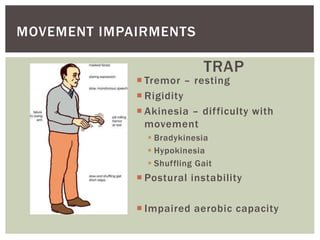
TRAP
 Tremor – resting
 Rigidity
 Akinesia – difficulty with
movement
 Bradykinesia
 Hypokinesia
 Shuffling Gait
 Postural instability
 Impaired aerobic capacity
MOVEMENT IMPAIRMENTS
Decreased:
Quality of Life
Function
Mobility
Safety
Emotional & Cognitive
problems
Sleep disorders
Fatigue
Depression
ADDITIONAL SIGNS AND SYMPTOMS
OVERVIEW: BENEFITS OF EXERCISE
Helps manage your symptoms
Possibility of slowing the disease
progression
Improves mobility, posture, & gait
Increases confidence
EXERCISE CAN SPECIFICALLY HELP PD…
 CONSISTENT – 4-5 hrs/week
 Moderate to VIGOROUS exercise
 SPECIFIC– USE OR LOSE IT!
Evidence shows exercise can result in:
 Optimize brain health & efficiency
 Slows disease protection
 Slow the motor & non-motor deterioration
TYPE OF EXERCISE
Is there
someone to
help me get
started on a
program?
I don’t know
what
exercises are
safe to
perform?
A Physical Therapist
can get you started!!!!
PHYSICAL & OCCUPATIONAL THERAPY
 Introduce you to a program
 Help improve specific impairments
 Teach you specific exercises for home
 Education about lifestyle
 Establish effective motor strategies!
 Help prevent secondary impairments
AVAILABLE PROGRAMS:
 Background:
 Developed by Dr. Becky Farley PT, MS, PhD
 Also developed BIG® program and associated with LSVT LOUD®
 Parkinson’s Wellness Recovery
 Vision:
 Providing research based exercise program for the
Parkinson’s community
 Increase longevity & quality of life
“Exercise from Diagnosis! Stamp out chronic, end-
stage Parkinson’s Disease”2
PWR!MOVES® PROGRAM2
 Patient-Centered Comprehensive Exercise Program
 Not a standardized protocol
 Performed 1:1 or group setting
 Exercises targeted at ALL levels of disease severity
 Integrates:
 HIGH Effort
 LARGE AMPLITUDE Body Movements
 Makes exercise FUNctional
 4 building block movements:
 UP – ROCK– TWIST– STEP
HOW DOES PWR! WORK?2
USE IT!
or
LOSE IT!
SPECIFIC EXERCISES:
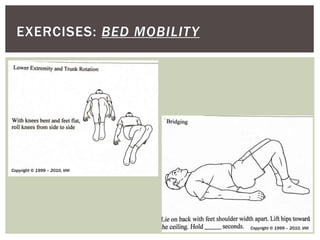
Bed Mobility
Balance
Sit to Stand
Posture
Flexibility
Walking
Aerobic
 Impairments include:
 Reduced head rotation
 Inability to reach to the opposite side
 Decrease trunk rotation
 No visual target
 Evidence shows:3
 An association with spinal flexibility and physical performance
 Exercise demonstrates to improve axial mobility & balance for
individuals who have Parkinson’s disease
HARD TO TURN OVER IN BED…
I want to turn
over for my
belly rubs!
 Visual Cue:
 Look at the alarm clock
 Throw back covers
 Move to the center of
the bed
 Say “GO”
 Break down the
movements
EXERCISES: BED MOBILITY
Copyright © 1999 – 2010, VHI
EXERCISES: BED MOBILITY
Copyright © 1999 – 2010, VHI
PWR! TWIST: TRUNK ROTATION2
 Evidence shows a decrease in near falls or repeated falls with
a personalized 6-week exercise program 4
 ONE-HOUR exercise program performed DAILY
 Exercises included:
 Muscle strengthen – lower extremity muscles
 Range of motion – whole body
 Balance training – static & dynamic
 Walking – inside & outside
 Strategies for fall prevention
I FEEL LIKE I AM GOING TO FALL…
 Find an object to
focus on
Use Upper Extremity
support as needed
Progress to no UE
support
Stand by Kitchen
Counter
EXERCISES: BALANCE
Copyright © 1999 – 2010, VHI
EXERCISES: BALANCE
Copyright © 1999 – 2010, VHI
PWR! ROCK: WEIGHT SHIFTS2
Impairments
include:
Center of gravity is
shifted forward
Rigid/decreased range
of motion
Decreased Spinal
Mobility
Weak back muscles
Hallmark Features:
Rounded shoulders
Forward head
Bent forward
Bending of knees
I CAN’T GET MY BACK STRAIGHT…
Use mirrors to check
posture
Perform stretches &
posture exercises
throughout the day
EXERCISES: POSTURE & FLEXIBILITY
Copyright © 1999 – 2010, VHI
EXERCISES: POSTURE & FLEXIBILITY
Copyright © 1999 – 2010, VHI
EXERCISE: FLEXIBILITY
Copyright © 1999 – 2010, VHI
 Impairments include:
 Inadequate forward lean
 Downward gaze
 Decrease momentum
 Weak lower extremity muscles
 Improve sit to stand by 50%
within 3 months by performing
sit to stand at a minimum 2
times/week5
DIFFICULTY GETTING OUT OF A CHAIR…
Sit to stand technique
 Gently rock back &
forth
 Verbal cue: “GO”
 Mental Rehearsal:
 Think “FORWARD & UP”
 Reach BIG
EXERCISES: SIT TO STAND
Copyright © 1999 – 2010, VHI
PWR! UP: POSTURE & SIT TO STAND2
 Impairments include:
 Reduced speed
 Reduced arm swing
 Short steps
 Feet glued to the ground
 Loss of balance
 Difficult turning
 Intensive training for 4 times/week for 30 minutes sessions
for 6 weeks on a treadmill can:6
 Minimize impairments with walking
 Reduce falls
 Improve quality of life
SLOW, SHUFFLING WALKING…
Consult with a
professional
before using a
treadmill
CORRECT WALKING7
Remove obstacles from
home
 Loose mats or cords, big
furniture in small hallways
Rhythmic
 Metronome
 Music
Adequate Lighting in the
house
EXERCISE: WALKING
Copyright © 1999 – 2010, VHI
EXERCISE: WALKING
Copyright © 1999 – 2010, VHI
 Impairments include:
 Muscle weakness
 Decreased endurance
 Decreased coordination
 Respiratory issues
 Evidence shows the need to
perform REGULAR aerobic
exercise to potentially
maintain normal exercise
capacity. 8
DECREASED FITNESS LEVEL…
Consult with a
professional before
using a machine or
signing up for a class
Bike
Treadmill walking
Nordic walking
Walking outside
Swimming/Water
Aerobics
Classes including:
 Music therapy
 Boxing
 Dancing
 https://www.youtube.com/
watch?v=ZKTufkzpo8E
EXERCISES: AEROBIC
*5 days/week
*30 – 45 min sessions
*Moderate to Vigorous
Intensity
Exercises should be SAFE
Exercise should NOT cause pain
Consult with your physical therapist or
physician before starting an exercise
program
RECOMMENDATION
1. PRACTICE, PRACTICE, PRACTICE!!
2. High intensity
3. 5 days/week for 45 min
4. Large Amplitude body movements
5. THINK BIG!
6. PRACTICE, PRACTICE PRACTICE!!
TAKE HOME MESSAGE
EXERCISE is MEDICATION!
1. http://youtu.be/wElz9jNrqns?t=6s
2. Farley, B. PWR!MovesTM Make FUNctional Exercise!. Tucson, AZ: Wheatmark®;
2014.
3. Schenkman M., Keysor J., Chandler J., Laub K., MacAller H. Axial Mobility Exercise
Program: A home exercise program to Improve Functional Ability: A Therapist
Manual. 2nd Edition. Claude D. Pepper Older American Independence Center at
Duke University; 1994.
4. Ashburn, A. et al. A randomised controlled trial of a home based exercise
programme to reduce the risk of falling among people with Parkinson’s Disease.
J Neural Neurosurg Psychiatry 2007; 78:678-684
5. Yekutiel MP, Pinhasov A, Shahar G, Sroka H. A clinical trial of the re-education of
movement in patients with Parkinson's disease. Clinical Rehabilitation. 1991;
:207-214.
6. Herman T, Giladi, N, Gruendlinger L, Hausdorff J. Six weeks of Intensive
Treadmill Training Improves Gait and Quality of Life in Patients with Parkinson’s
Disease: A Pilot Study. Arch Phys Med Rehab. Sept. 2007; 88: 1154-1158.
7. Hoppenfeld, Stanley. Physical Examination of the Spine Extremities . Apple and
Lange: Norwalk, CT; 1976.
8. Cannin CG, Allison JA, Allen NE, Groeller H. Parkinson’s disease: an investigation
of exercise capacity, respiratory function and gait. Arch Phys Med Rehabil. 1997;
78: 199-207.
9. https://www.youtube.com/watch?v=ZKTufkzpo8E
REFERENCES:
1. http://courtney-bci.blogspot.com/2013/08/5-of-worst-things-you-
could-do.html
2. http://www.neurology24.com/facts/4.jpg
3. http://murtagh.fhost.com.au/html/general_practice/978007013459
1_001_ch33.htm
4. http://www.neurology24.com/facts/4.jpg
5. http://alchemymartialarts.net/brazilian-jiu-jitsu-and-brain-health/
6. http://www.thehappymd.com/blog/bid/284600/Physician-Wellness-
Why-It-s-Such-a-Struggle
7. http://gambarbbm.mytattoo-ideas.com/lsvt-big-&-loud-parkinson's-
therapy-at-touro-neuro-rehab-center.html
8. Farley, B. PWR!MovesTM Make FUNctional Exercise!. Tucson, AZ:
Wheatmark®; 2014
9. http://www.gettyimages.com/detail/photo/skilled-elephant-
balancing-on-a-ball-high-res-stock-photography/456501701
10. http://www.bendomd.com/986-parkinsons-disease-symptoms.html
11. http://www.animationplayhouse.com/new/dogs2.html
12. http://txcowboydancer.com/2014/05/18/the-reboot-continues-part-3-of-3/
13. http://www.walkaboutflintshire.com/nordic-walking.php
14. http://www.military.com/military-fitness/spouse-and-family/attitude-
adjustment
REFERENCES: IMAGES