PANCYTOPENIA
ASWATHY .A
ASSISTANT PROFESSOR
DEPARTMENT OF PATHOLOGY
PANCYTOPENIA
Pancytopenia is a medical condition in which there is reduction in the number of red blood
cell, platelet as well as WBC.
 If only two parameters from the full blood count are low the term BICYTOPENIA.
 It is commonly seen in India
 It is the combination of anemia,leukopenia, and thrombocytopenia :-
Hb < 13.5 in males & 11.5 in females
Leucocyte count < 4x10⁹ /l
Platelet count < 150x109 /l
CAUSES
1) Decreased bone marrow function
2) Increased peripheral destruction
DECREASED BONE MARROW FUNCTION
A) Aplastic anemia -Idiopathic
Secondary
Inherited
B)Myelodysplastic syndrome
C)Bone marrow infiltration- Leukemia, lymphoma , multiple myeloma, tumors , hairy cell leukemia etc..
D)Nutritional deficiency - Vit B12 and folic acid
E)PNH
F)Myelofibrosis
G) Hemophagocytic syndrome
INCREASED PERIPHERAL DESTRUCTION
 Hypersplenism
 Over whelming infection
 Miscellaneous
APPROACH OF PANCYTOPENIA
• History
• Clinical Examination
• CBC
• Peripheral smear examination
• Bone Marrow Aspiration
• Bone Marrow Biopsy
• Other specific investigations
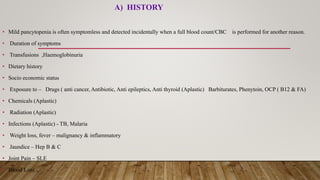
A) HISTORY
• Mild pancytopenia is often symptomless and detected incidentally when a full blood count/CBC is performed for another reason.
• Duration of symptoms
• Transfusions ,Haemoglobinuria
• Dietary history
• Socio economic status
• Exposure to – Drugs ( anti cancer, Antibiotic, Anti epileptics, Anti thyroid (Aplastic) Barbiturates, Phenytoin, OCP ( B12 & FA)
• Chemicals (Aplastic)
• Radiation (Aplastic)
• Infections (Aplastic) - TB, Malaria
• Weight loss, fever – malignancy & inflammatory
• Jaundice – Hep B & C
• Joint Pain – SLE
• Blood Loss
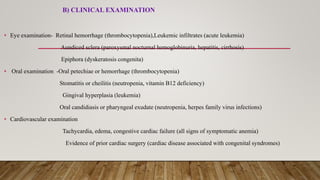
B) CLINICAL EXAMINATION
• Eye examination- Retinal hemorrhage (thrombocytopenia),Leukemic infiltrates (acute leukemia)
Aundiced sclera (paroxysmal nocturnal hemoglobinuria, hepatitis, cirrhosis)
Epiphora (dyskeratosis congenita)
• Oral examination -Oral petechiae or hemorrhage (thrombocytopenia)
Stomatitis or cheilitis (neutropenia, vitamin B12 deficiency)
Gingival hyperplasia (leukemia)
Oral candidiasis or pharyngeal exudate (neutropenia, herpes family virus infections)
• Cardiovascular examination
Tachycardia, edema, congestive cardiac failure (all signs of symptomatic anemia)
Evidence of prior cardiac surgery (cardiac disease associated with congenital syndromes)
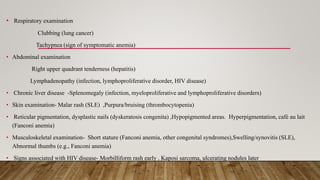
• Respiratory examination
Clubbing (lung cancer)
Tachypnea (sign of symptomatic anemia)
• Abdominal examination
Right upper quadrant tenderness (hepatitis)
Lymphadenopathy (infection, lymphoproliferative disorder, HIV disease)
• Chronic liver disease -Splenomegaly (infection, myeloproliferative and lymphoproliferative disorders)
• Skin examination- Malar rash (SLE) ,Purpura/bruising (thrombocytopenia)
• Reticular pigmentation, dysplastic nails (dyskeratosis congenita) ,Hypopigmented areas. Hyperpigmentation, café au lait
(Fanconi anemia)
• Musculoskeletal examination- Short stature (Fanconi anemia, other congenital syndromes),Swelling/synovitis (SLE),
Abnormal thumbs (e.g., Fanconi anemia)
• Signs associated with HIV disease- Morbilliform rash early . Kaposi sarcoma, ulcerating nodules later
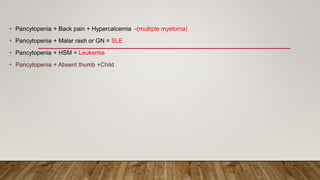
• Pancytopenia + Back pain + Hypercalcemia -(multiple myeloma)
• Pancytopenia + Malar rash or GN = SLE
• Pancytopenia + HSM = Leukemia
• Pancytopenia + Absent thumb +Child
C) CBC
RBC, HB, PLATELET,CT – Decreased
BT,ESR- Increased
D) PERIPHERAL SMEAR EXAMINATION
Red Cell Morphology
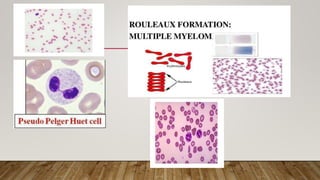
 Normocytic normochromic with no anisopoikilocytosis , few macrocytes, no nRBCs ,
 Reticulocytopenia – Aplastic anemia
 Macro ovalocytes with Howell Jolly Bodies – Megaloblastic anemias
 Tear drop cells, HJ bodies & Basophilic stippling – MDS
 nRBCs, Sickle cells – Aplastic crisis in Hemolytic anemia.
WBCs
 Leucopenia (mostly mature ~80%) – Aplastic anaemia
 Neutrophils present in increased number with toxic granules, shift to left – Infections
 Basophilic stippling, hyper segmented neutrophils – Megaloblastic anaemia
 Blasts – subleukemic leukemia
 Hypo granular neutrophils, pseudo Pelger Heut Anomaly – MDS
Platelets
• Normal count – rules out aplastic anemia
• Giant platelets – MDS/ Hypersplenism
E) BONE MARROW EXAMINATION
• Examination of bone marrow is almost always indicated in cases of
• pancytopenia unless the cause is otherwise apparent (e.g., established liver disease with portal hypertension).
• The bone marrow exam consists of both an aspirate and a trephine biopsy,
• The differential diagnosis of pancytopenia may be broadly classified based on the bone marrow cellularity (reduced
cellularity indicates decreased production of blood cells, whereas normal/increased cellularity indicates ineffective production
or increased destruction or sequestration of blood cells).
• Specifically, bone marrow aspirate permits examination of:
• Cytology (megaloblastic change, dysplastic changes, abnormal cell infiltrates, hemophagocytosis , and infection
[e.g., Leishman-Donovan bodies])
• Immunophenotyping (acute and chronic leukemias, lympho proliferative disorders)
• Cytogenetics (myelodysplasia, acute and chronic leukemias, lymphoproliferative disorders).
Aspiration
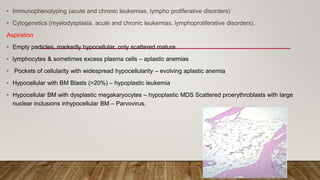
• Empty particles, markedly hypocellular, only scattered mature
• lymphocytes & sometimes excess plasma cells – aplastic anemias
• Pockets of cellularity with widespread hypocellularity – evolving aplastic anemia
• Hypocellular with BM Blasts (>20%) – hypoplastic leukemia
• Hypocellular BM with dysplastic megakaryocytes – hypoplastic MDS Scattered proerythroblasts with large
nuclear inclusions inhypocellular BM – Parvovirus.
Biopsy
• Erythroid hyperplasia with megablastosis – megaloblastic anemia
• Trilineage dysplasis with ringed sideroblasts on pearl’s stain – MDS
• Infiltration by RS Cells – HL
• Infiltration with malignant cells – metastasis In PNH & Fanconi’s anemia – early stage will show hypercellular normal
appearing marrow
F) OTHER TESTS
 Vit B 12 and folic acid assay
 Fibrin and D-Dimer , PT,APTT- Increased
 ALP and ACP - Increased
 Urine BJP
 SLE
 Chest X -ray and Bone X- ray
TREATMENT
Treatment for anaemia , thrombocytopenia and leucopenia
Pancytopenia