Presented by :
Aqsa babar
MPhil(scholar)
TOPIC:
NORM-REFERENCED AND
CRITERION- REFERENCED TESTS
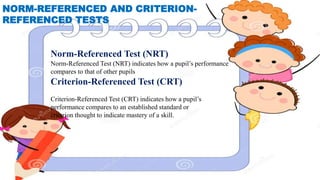
Norm-Referenced Test (NRT)
Norm-Referenced Test (NRT) indicates how a pupil’s performance
compares to that of other pupils
Criterion-Referenced Test (CRT)
Criterion-Referenced Test (CRT) indicates how a pupil’s
performance compares to an established standard or
criterion thought to indicate mastery of a skill.
NORM-REFERENCED AND CRITERION-
REFERENCED TESTS
General
Purpose of
Testing
To gather information to
Help us make better
decisions about.
Special
Information
Desired
Place or rank
Compared to
a norm.
Levelof proficiency
Comparedto astandard
Or criterion ofmastery
Type Of Test
Required Norm-referenced Criterion-referenced
Relationship among the purpose of testing, information desired
And the type of test required
4.1
Comparing
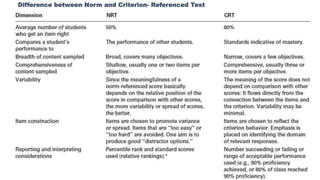
Difference between Norm and Criterion- Referenced Test
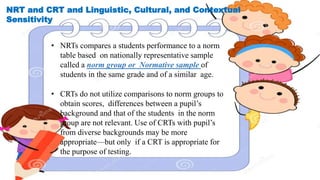
NRT and CRT and Linguistic, Cultural, and Contextual
Sensitivity
• NRTs compares a students performance to a norm
table based on nationally representative sample
called a norm group or Normative sample of
students in the same grade and of a similar age.
• CRTs do not utilize comparisons to norm groups to
obtain scores, differences between a pupil’s
background and that of the students in the norm
group are not relevant. Use of CRTs with pupil’s
from diverse backgrounds may be more
appropriate—but only if a CRT is appropriate for
the purpose of testing.
Norm and Criterion- Referenced Test and Validity
Evidence
>Teachers should have some objectives in mind when they teach.
Short-term and Long-term objectives.
Examples:
Short-term-The learners will count numbers 1-10.
Long-term- The learners will master all phases of
addition.
THREE-STAGE MODEL OF CLASSROOM MEASUREMENT
Stage 2
Instructional
activities
Stage 1
Instructional
objectives
Stage 3
Test
Content
validity
1.Constructing instructional objectives.
2.Implementing instructional activities.
3.Testing to measure the attainment of the instructional activities.
 Instructional activities tend to vary across educational
institutions, and they range from flexible to rigid.
These Instructional activities tend to be determined
by instructional objectives which tend to be derived
from educational goals and state academic standards
which tend to reflect societal attitude and values.
WHY OBJECTIVES? WHY NOT JUST WRITE TEST ITEMS?
FLOW OF GOALS TO OBJECTIVE
THE FUNNELING OF SOCIETAL WANTS INTO OBJECTIVES
Thewants and needs
Of society
Are shared with the
superintendent Through the
school boardand
Translated into educational
goals by program
coordinators
translated into school,
classroom, and student
objectivesby principals and
teachers.
Broad Aimsand
Preferences
Specific Instructional
Procedures Andoutcome
1. Behavioral Objective: (specific)
- it specifies an observable measureable
behavior to be exhibited, the conditions under
which it is to be exhibited, and the criterion for
mastery.
2.Expressive Objective (general)
- it specifies an educational activity but does
not specify the particular outcome of the activity
KINDS OF GOALS AND OBJECTIVES
Goals program objectives and instructional objectives
Category description examples
How can instructional
objectives make a teacher
job easier ?
Comments
Nrt and crt