DATABASE PRESENTATION


NAME: MICHAEL JOSEPH
INTRODUCTION

One of the most important steps in designing a database is
ensuring that the data is properly distributed among its tables.
With proper data structures, illogically or inconsistently stored
data can cause a number of problems. In a relational database, a
logical and efficient design is just as critical. A poorly designed
database may provide erroneous information, may be difficult to
use, or may even fail to work properly. A poorly design database
can cripple an application, producing problems with redundancy,
in accuracy, consistency and concurrency of data. Normalization
is a process that serves to reduce, if not eliminate, these
problems with data.
DESCRIPTION OF NORMALIZATION


 Normalization is the process of organizing data to
 minimize redundancy. The goal of database
 normalization is to decompose relations with
 anomalies in order to produce smaller, well-
 structured relations. Normalization usually
 involves dividing large tables into smaller (and
 less redundant) tables and defining relationships
 between them. The objective is to isolate data so
 that additions, deletions, and modifications of a
 field can be made in just one table and then
 propagated through the rest of the database via
 the defined relationships.
Normalization Levels

There are a few rules for database normalization. Each
 rule is called a "normal form." If the first rule is observed,
 the database is said to be in "first normal form." If the first
 three rules are observed, the database is considered to
 be in "third normal form." Although other levels of
 normalization are possible, third normal form is
 considered the highest level necessary for most
 applications. There is a number of normalization levels
 from 1. normal form through 5. normal form. Each normal
 form describes how to get rid of some specific problem,
 usually related to redundancy. Below are description with
 examples of level one to three normal forms.
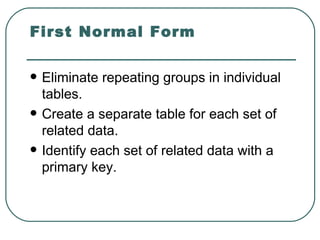
First Normal Form

   Eliminate repeating groups in individual
    tables.
   Create a separate table for each set of
    related data.
   Identify each set of related data with a
    primary key.
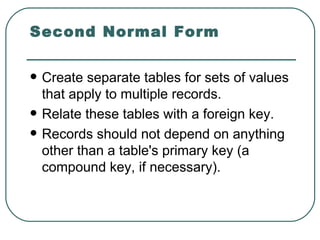
Second Normal Form

   Create separate tables for sets of values
    that apply to multiple records.
   Relate these tables with a foreign key.
   Records should not depend on anything
    other than a table's primary key (a
    compound key, if necessary).
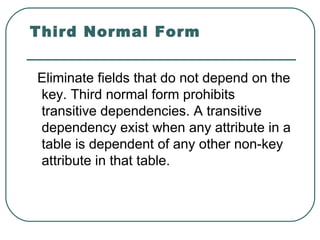
Third Normal Form


Eliminate fields that do not depend on the
key. Third normal form prohibits
transitive dependencies. A transitive
dependency exist when any attribute in a
table is dependent of any other non-key
attribute in that table.
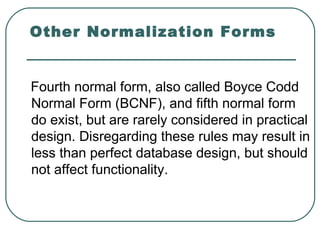
Other Normalization Forms


Fourth normal form, also called Boyce Codd
Normal Form (BCNF), and fifth normal form
do exist, but are rarely considered in practical
design. Disregarding these rules may result in
less than perfect database design, but should
not affect functionality.
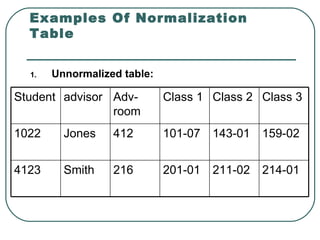
Examples Of Normalization
  Table


  1.   Unnormalized table:

Student advisor Adv-         Class 1 Class 2 Class 3
                room
1022     Jones    412        101-07   143-01   159-02


4123     Smith    216        201-01   211-02   214-01
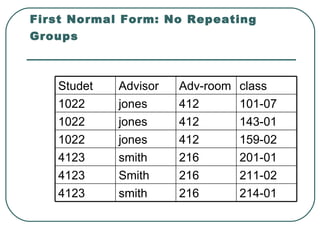
First Normal Form: No Repeating
Groups


   Studet   Advisor   Adv-room   class
   1022     jones     412        101-07
   1022     jones     412        143-01
   1022     jones     412        159-02
   4123     smith     216        201-01
   4123     Smith     216        211-02
   4123     smith     216        214-01
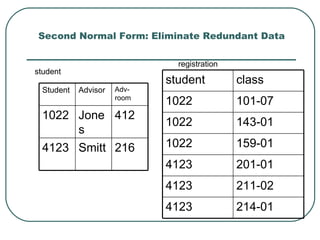
Second Normal Form: Eliminate Redundant Data

                               registration
student
                             student          class
  Student   Advisor   Adv-
                      room
                             1022             101-07
  1022 Jone 412
                             1022             143-01
       s
  4123 Smitt 216             1022             159-01
                             4123             201-01
                             4123             211-02
                             4123             214-01
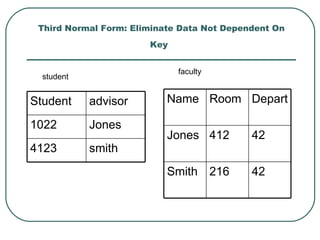
Third Normal Form: Eliminate Data Not Dependent On
                       Key


                             faculty
  student


Student     advisor        Name Room Depart

1022        Jones
                           Jones 412        42
4123        smith
                           Smith 216        42
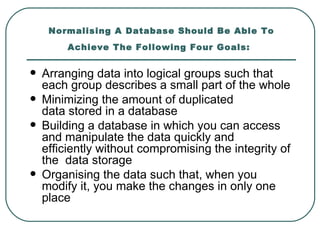
Normalising A Database Should Be Able To
         Achieve The Following Four Goals:


   Arranging data into logical groups such that
    each group describes a small part of the whole
   Minimizing the amount of duplicated
    data stored in a database
   Building a database in which you can access
    and manipulate the data quickly and
    efficiently without compromising the integrity of
    the data storage
   Organising the data such that, when you
    modify it, you make the changes in only one
    place
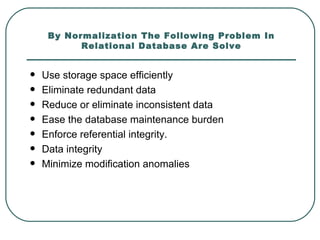
By Normalization The Following Problem In
           Relational Database Are Solve


   Use storage space efficiently
   Eliminate redundant data
   Reduce or eliminate inconsistent data
   Ease the database maintenance burden
   Enforce referential integrity.
   Data integrity
   Minimize modification anomalies
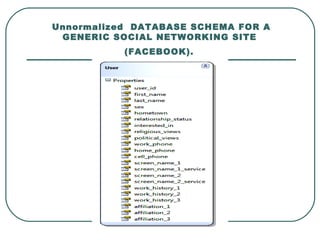
Unnormalized DATABASE SCHEMA FOR A
 GENERIC SOCIAL NETWORKING SITE
           (FACEBOOK).
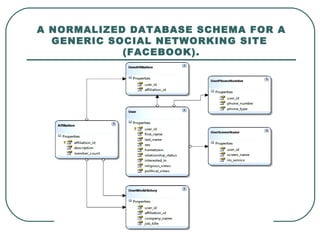
A NORMALIZED DATABASE SCHEMA FOR A
  GENERIC SOCIAL NETWORKING SITE
            (FACEBOOK).
Un Normalized Database
                Problem
   Repetition of information
   Inability to represent certain information
   Loss of information
   Difficulty to maintain information
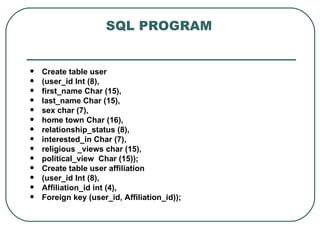
SQL PROGRAM


   Create table user
   (user_id Int (8),
   first_name Char (15),
   last_name Char (15),
   sex char (7),
   home town Char (16),
   relationship_status (8),
   interested_in Char (7),
   religious _views char (15),
   political_view Char (15));
   Create table user affiliation
   (user_id Int (8),
   Affiliation_id int (4),
   Foreign key (user_id, Affiliation_id));
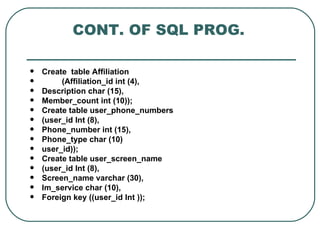
CONT. OF SQL PROG.

   Create table Affiliation
        (Affiliation_id int (4),
   Description char (15),
   Member_count int (10));
   Create table user_phone_numbers
   (user_id Int (8),
   Phone_number int (15),
   Phone_type char (10)
   user_id));
   Create table user_screen_name
   (user_id Int (8),
   Screen_name varchar (30),
   Im_service char (10),
   Foreign key ((user_id Int ));
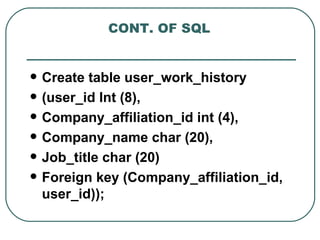
CONT. OF SQL


   Create table user_work_history
   (user_id Int (8),
   Company_affiliation_id int (4),
   Company_name char (20),
   Job_title char (20)
   Foreign key (Company_affiliation_id,
    user_id));
PROBLEM TO FACE IF DATABASE DESIGN IS
          NOT NORMALIZED

 Normalisation is part of successful database design.
 Without normalisation, there will be Problem of high data
 redundancy – if data in the database can be found in two
 different locations (direct redundancy) or if data can be
 calculated from other data items (indirect redundancy)
 then the data is said to contain redundancy. Data should
 only be stored once and avoid storing data that can be
 calculated from other data already held in the database.
 Not normalizing database systems can be inaccurate,
 slow, and inefficient and they might not produce the data
 one may expect. It is adviceable to always use the
 normalization process to design efficient and functional
 databases. By normalizing, data will be store where it
 logically and uniquely belongs.
DISADVANTAGE OF NORMALIZATION

The only real drawback to having a highly normalization database structure is that one may need a
large number of joins to pull back the records the application needs to function.

For example in the social network site schema above one will requires a whopping six joins to
retrieve a single user's information.
select * from Users u
inner join UserPhoneNumbers upn
on u.user_id = upn.user_id                               the fact here is that one
inner join UserScreenNames usn                           need six joins -- or six
on u.user_id = usn.user_id                               individual queries, to
inner join UserAffiliations ua                           retrieve a single user
on u.user_id = ua.user_id                                information. This is time
inner join Affiliations a                                consuming and slow
on a.affiliation_id = ua.affiliation_id                  dawn your system
inner join UserWorkHistory uwh                           performance
on u.user_id = uwh.user_id
inner join Affiliations wa
on uwh.affiliation_id = wa.affiliation_id
CONCLUTION
There are advantages and disadvantages to normalizing database schemas but
the big question now is when is it appropriate to normalize and when not
to. It is true that Database normalization is a formal process of designing one
database to eliminate redundant data, utilize space efficiently and reduce
update errors. Anyone who has ever taken a database class has it drummed
into their heads that a normalized database is the only way to go. This is true for
the most part. However there are certain scenarios where the benefits of
database normalization are outweighed by its costs. So I think people should not
normalize for the sake of normalization or because one school professor told
them to but because the data tells them to for the following reasons.
Normalization makes sense to their team, Normalization provides better
performance. (they’re automatically measuring all the queries that flow through
their software, right?) Normalization prevents an onerous amount of duplication
or avoids risk of synchronization problems that their problem domain or users
are particularly sensitive to and finally that Normalization allows them to write
simpler queries and code.
THANKS YOU ALL FOR LISTENING
REFERENCES
[1] R. Ramakrishnan, J. Gehrke “Database Management System”, McGraw-Hill,
    New York 2003
[2] Dare O. “When Not To Normalize Your SQL Database”
    http://www.25hoursaday.com/weblog/commentview.aspx?
[3] Microsoft Support, “Description Of The Database Normalization Basics”
    http://support.microsoft.com/kb/283878#top