Neuroscience and Brain
Development
by: Kay S. Macanang
What is neuroscience?
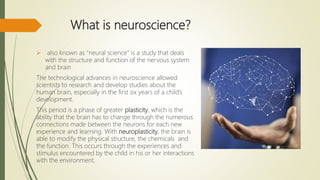
 also known as “neural science” is a study that deals
with the structure and function of the nervous system
and brain
The technological advances in neuroscience allowed
scientists to research and develop studies about the
human brain, especially in the first six years of a child’s
development.
This period is a phase of greater plasticity, which is the
ability that the brain has to change through the numerous
connections made between the neurons for each new
experience and learning. With neuroplasticity, the brain is
able to modify the physical structure, the chemicals and
the function. This occurs through the experiences and
stimulus encountered by the child in his or her interactions
with the environment.
Nervous System
 is our body’s command center
 three basic functions:
 receives sensory input from internal and external environments
 integrate the input
 respond to stimuli
Our nervous system is composed of two major categories:
1. Peripheral Nervous System
2. Central Nervous System (CNS)
Peripheral Nervous System
 It handles central nervous system’s input output. It contains all the portions of
the nervous system outside the brain and spinal cord.
 Contains sensory nerves (to the brain), carry messages from special reporters in
the skin, muscles, and other internal and external sense organs to the spinal cord
and then to the brain, and motor nerves (from the brain), carry orders from CNS
to muscles, glands to contract and produce chemical messengers.
 subdivided into two:
1. Somatic Division
2. Autonomic Division
a. Parasympathetic Nervous System
b. Sympathetic Nervous System
Somatic Nervous System and Autonomic Nervous
System
Somatic Nervous System
 consist of nerves connected to sensory receptors and skeletal muscles
 permits voluntary action
Autonomic Nervous System
 permits involuntary functioning of blood vessels, glands, and internal organs such as the bladder,
stomach and heart
two main divisions:
a. Parasympathetic Nervous System
 slows the body down to keep its rhythm
 enables the body to conserve and store energy
 like the brakes in your car
b. Sympathetic Nervous System
 mobilized the body for action
 increases heart rate
 like the accelerator of your car
Central Nervous System
 made up of brain and spinal cord
Spinal Cord
 protected by a column of bones
 carries nerve signals throughout
the body, these nerve signals help
you feel sensations and move your
body
 example is touching a hot iron
Central Nervous System
Brain
 is a complex organ that controls
thought, memory, emotion, touch,
motor skills, vision, breathing,
temperature, hunger and every process
that regulates our body
 3 main parts:
 Cerebrum
 Cerebellum
 Brainstem
Cerebrum
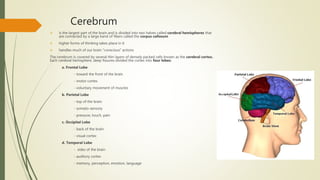
 is the largest part of the brain and is divided into two halves called cerebral hemispheres that
are connected by a large band of fibers called the corpus callosum
 higher forms of thinking takes place in it
 handles much of our brain “conscious” actions
The cerebrum is covered by several thin layers of densely packed cells known as the cerebral cortex.
Each cerebral hemisphere, deep fissures divided the cortex into four lobes:
a. Frontal Lobe
- toward the front of the brain
- motor cortex
- voluntary movement of muscles
b. Parietal Lobe
- top of the brain
- somato-sensory
- pressure, touch, pain
c. Occipital Lobe
- back of the brain
- visual cortex
d. Temporal Lobe
- sides of the brain
- auditory cortex
- memory, perception, emotion, language
Language
 the left hemisphere of the brain is responsible for language and speech and is
called the dominant hemisphere
a. Broca’s area- lies in the left frontal lobe that directs muscle movements involve in
speech
b. Wernicke’s area- lies in the left temporal lobe involved in language
comprehension and expression
Specialization and Integration in Language
1. Visual cortex- receives written words as visual stimulation
2. Angular gyrus- transforms visual representations into an auditory code
3. Wernicke’s area- interprets auditory code
4. Broca’s area- controls speech muscles via the the motor cortex
5. Motor cortex- word is pronounced
Specialty Functions in Brain Lateralization
A. Left Hemisphere
- verbal competence
- speaking, reading, thinking and reasoning
- process information in sequence; one piece of data at a time
- logical
B. Right Hemisphere
- non-verbal areas
- comprehension, spatial relationships, drawing, music, emotion
- process information as a whole
- intuitive
Cerebellum and Brainstem
Cerebellum
 second largest part of the brain
 it functions for muscles coordination and maintains balance and posture
Brainstem
 bottom, stalk-like portion of the brain
 sends messages to the rest of the body to regulate balance, breathing, heart rate and
more
 three parts:
a. Midbrain- top part of the brainstem is crucial for regulating eye movements
b. Pons- middle portion which coordinates facial movements, hearing and balance
c. medulla oblongata- top part which helps regulate your breathing, heart rhythms,
blood pressure and swallowing
Three distinct regions of the brain:
1. Forebrain- largest region of the brain
- hypothalamus regulates homeostasis; involves with drives associated
with survival such as hunger, thirst, emotion, sex and reproduction
- thalamus serve as a central relay point for incoming nervous messages
2. Midbrain- serves important functions in motor movement, particularly
movements of the eye, and in auditory and visual processing
3. Hindbrain- composed of medulla oblongata, pons and cerebellum
The Neurons (neurones or nerve cells)
 fundamental units of the brain and nervous system
 held in place by glial cells that provides neurons with nutrients, insulate neurons,
remove cellular debris when neurons die
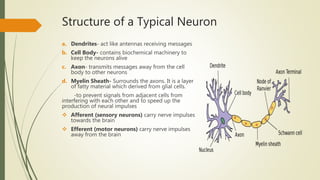
Structure of a Typical Neuron
a. Dendrites- act like antennas receiving messages
b. Cell Body- contains biochemical machinery to
keep the neurons alive
c. Axon- transmits messages away from the cell
body to other neurons
d. Myelin Sheath- Surrounds the axons. It is a layer
of fatty material which derived from glial cells.
-to prevent signals from adjacent cells from
interfering with each other and to speed up the
production of neural impulses
 Afferent (sensory neurons) carry nerve impulses
towards the brain
 Efferent (motor neurons) carry nerve impulses
away from the brain
 Ganglia are clusters of nerve cells.
 Some axons are wrapped in a myelin sheath formed from the plasma membrane of
specialized glial cells known as Schwann cells.
 Schwann cells serves as supportive, nutritive and service facilities for neurons.
 The gap between Schwann cells is known as the node of Ranvier and serves a points
along the neurons for generating a signal.
The brain is the ultimate organ of adaptation. It takes information and orchestrates
behavioral repertoires that allow human beings to act in sometimes marvelous,
terrible ways. Most of what people think of as the “self”—what we think, what we
remember, what we can do, how we feel—is acquired by the brain from the experiences
that occur after birth. Some of this information acquired during critical or sensitive
of development, when the brain appears uniquely ready to take in certain kinds of
information, while other information can be acquired across broad swaths of
that can extend into adulthood.
Thank you!!!