Multimedia
Introduction
 Multimedia is something people can see, hear,
touch and read on websites, radio, television,
video games, phone applications, retail stores,
cinema halls and ATMs. Multimedia can be
defined as a combination of picture, text, sound,
video and animation. In simple terms, multimedia
is the combination of more than one media.
 Multimedia is the medium which provides information to
the users in the form of text, audio,video, animation and
graphics. The information is delivered to the users by
digital or electronic means. When a user is allowed to
control the elements of multimedia then it becomes
interactive multimedia. Interactive multimedia is called
hypermedia when the user is given the structure of linked
elements to control it
Meaning and its Usage
 Multimedia is a mixture of different forms of
media. This includes text, graphics, audio, video,
etc. Today, multimedia is found everywhere in
educational institutes, offices, airports, railway
stations, journalism, creative and entertainment
industries such as TV, films, radio, etc., medicine,
IT industry, research, etc. The kinds of media
components and how they are used in a
multimedia program matter a lot.
A music video and sound should be used together as one
without another
would lose its significance.
 Multimedia provides important information in an
interactive way with the usage of images,
graphics, animation, video and audios. For this
reason, it is gaining popularity as a powerful
educational tool. There are various multimedia
software that are used in the field of education.
CDs and DVDs are used to store information in
different multimedia formats.
Combining Content from Various
Media
There are various components that make up a
multimedia production. In a program, more
than one media element is necessary to call it a
multimedia. Some examples of media are
given below:
 Text and typography
 Coloured, pictorial or graphical backgrounds
 Images and graphics such as photographs,
illustrations, cartoons, diagrams, shapes,
arrows, lines, etc.
 2D and 3D animation.
 Audio files such as a song, sound effects, music, etc
 Video files such as a short movie clip, advertisement,
etc
 Buttons and menu for easy navigation in a program.
Categories of Multimedia
 Based on how multimedia programs are used,
multimedia can be divided into two forms –
linear multimedia and non-linear multimedia. In linear
multimedia, information is read or
viewed in a continuous sequence. Usually, these
presentations begin at a predetermined starting point
and end at a predetermined end point. They can be
automated so that each screen comes after a fixed
time interval.
Example: Powerpoint presentation is one of the most common
examples of linear multimedia.
 On the other hand, non-linear multimedia information
is not presented in sequential or
chronological manner. Non-linear multimedia
programs are usually interactive and require
audience interaction.
 One of the most common examples of this form of
multimedia is the Web.
Features of Multimedia
 Digital and computer based images, text,
graphics, animation, audio and video that can be
turned from one form to another are two
fundamental features of multimedia. Generally,
multimedia presentations are viewed in person in
a boardroom, class, on stage or in an auditorium.
They can be transmitted, projected or played on a
projector using a media player such as a
computer. A live or recorded presentation is called
a broadcast.
 Multimedia games can be used in a physical
environment with multiple users in an online
network, with special effects or with an off-line
computer or game system. Interaction in a
multimedia program can be increased by mixing
multiple forms of media content. However,depending
upon the kinds multimedia content available, it may
differ online.
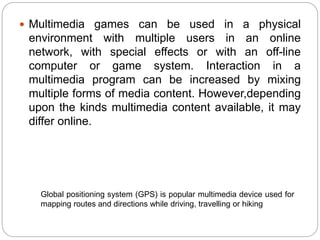
Global positioning system (GPS) is popular multimedia device used for
mapping routes and directions while driving, travelling or hiking
 Multimedia is progressively becoming data-driven
and object-oriented which allows applications
with cooperative end-user innovation and
personalization on many forms of content over a
period. For instance, content available on various
websites such as photo galleries that have
both content and images user-updated, to
simulations whose events, animations, illustrations
or videos are changeable, enabling the multimedia
experience to be changed without reprogramming.
Applications of Multimedia
 Multimedia can be used in a variety of ways in
myriad fields. A multimedia presentation can be
put together in varied formats. Some of the
most common applications are given below:
Business-
Multimedia is used for advertising and selling products on the
Internet. Some businesses use multimedia tools such as CD-
ROMs, DVDs or online tutorials for training or educating staff
members about things the employer want them to learn or
know. Staff members can learn at their own speed and at a
specific time suitable to them as well as the company. It also
saves
money of the employers as now they don’t have to pay extra
expenses on training or education of their human resources.
Multimedia is one of the best ways to provide short-term
training to the workers in a company.
Research and Medicine
 Multimedia is increasingly used in research in the
fields of science, medicine and mathematics.
It is mostly used for modelling and simulation. For
instance, a scientist can look at a molecular
model of a particular substance and work on it to
arrive at a new substance. In Medicine, doctors
acquire training by watching a virtual surgery or they
can simulate how the human body is
affected by diseases spread by germs and then
develop techniques to prevent it.
Public Access
 Public Access is an area of application where
several multimedia applications will be available
very soon. One of the application is the tourist
information system, where a travel enthusiast will
be shown glimpse of the place he would like to
visit. With the help of multimedia various source
providing applications could be created.
Entertainment
 Multimedia is used to create special effects in
films, TV serials, radio shows, games and
animations.Multimedia games are popular
software programs that available online as well as
on DVDs and CD-ROMs. Use of special
technologies such as virtual reality turn these
games into real life experiences. These games
allow uses to fly aeroplanes, drive cars, do
wrestling, etc
Industry
 In the Industrial sector, multimedia is used to present
information to all people related to the industry such
as stakeholders, shareholders, senior level
managers and co-workers. Multimedia
is also helpful in advertising and selling products all
over the world over internet.
Commercial
 Creative presentations are used to grab the attention
of the masses in advertising. Industrial,business to
business and interoffice communications are mostly
developed by firms providing creative services. They
work on advanced multimedia presentations rather
than simple slide shows to sell ideas or make
training programs more interesting.
Education
 Multimedia is used as a source of information in
the field of education. Pupils can research on
various topics such as solar system or information
technology using different multimedia
presentations. To make teaching more interesting
and fun for pupils, teachers can make
multimedia presentations of chapters. Visual
images, animation, diagrams, etc., have more
effect on pupils. Various computer-based training
(CBT) courses are also available online for
study.
Multimedia in Public Places
 In railway stations, hotels, museums, grocery
stores and shopping malls multimedia will
become available at stand-alone terminals to
provide information and help. Such installation
reduce demand on traditional information booths
and personnel, add value, and they can work
around the clock, even in the middle of the night,
when live help is off-duty
Engineering
 Software engineers may use multimedia in
computer simulations for anything from
entertainment to training such as military or
industrial training. Multimedia for software
interfaces are often done as collaboration
between creative professionals and software
engineers.