TIV3033 Multimedia Databases
                                  Group B

Name : Syamsul Bahrin Zaibon
Room : FTM 3124
Phone : 04-928 4679
Email :
URL : http://www.uum.edu.my

Consultation Hour :
Tuesday & Thursday 2.30 – 4.30 pm

                                        1
TIV3033 Multimedia Database
         Topic 1


   INTRODUCTION TO MULTIMEDIA
           DATABASES

   Chapter 1 – MMDB [Lynne Dunckley]
                                       2
OBJECTIVES
  1. Understand why multimedia
     databases are being developed

  2. Appreciate database concepts in
     terms of multimedia

  3. Understand the technological
     background


              http://www.uum.edu.my
                                       3
Background
  • Advances in technology enabled
    more complex and rich-content
    data types to appear
     • Computing power increased dramatically
       (from 64MH to 2.6GH or more)
     • Hardware support (size is no more a problem)
     • High-bandwidth networks
     • Development in digital input and output
       devices for all kinds of non-traditional data
       types
     • User interface paradigms reflecting human
       perception


                http://www.uum.edu.my
                                                       4
Motivation
   • Multimedia is a much more powerful
     communication tool than traditional data in
     our daily life
     • Image showcase, graphic design, TV
       commercial, speech, movie, hand phone
       multimedia message, etc
   • There is a urgent need for more advanced
     systems organizing and managing these
     new multimedia data types
     • Traditional relational database are NO LONGER suitable
       for complex multimedia data
     • Automatic and robust systems which produce, transmit,
       analyze, manage and search multimedia data in a
       reliable way are required


                      http://www.uum.edu.my
                                                                5
INTRODUCTION
  • The importance of Multimedia
    Database (MMDB)
  • The differences from traditional
    databases:
    • data types,
    • manipulation,
    • storage
    • delivery


                http://www.uum.edu.my
                                        6
INTRODUCTION
  • Manage, store and retrieve all these
    different media (multimedia data
    types):
    • Movies, Pictures, Sound Clips, Documents
      etc…
  • Dealing with digital data
    representation


                http://www.uum.edu.my
                                                 7
THE NEED FOR MMDB
  • Multimedia application systems, such
    as electronic publishing,
    teleconferencing and visual simulation
    have already become common in our
    professional practice.
  • Early application of MMDBMSs tended
    to use MM for presentational
    requirement only.
  • For example:

               http://www.uum.edu.my
                                             8
THE NEED FOR MMDBs (cont.)

   • However, this external data could not
     be manipulated by the DBMS.
   • Complex applications are developing
     such as entertainment services (video
     on demand), MM sales, groupware,
     telemedicine etc.
   • An essential requirement for these
     advanced MMDBs is to search and
     manipulate the content of pictures,
     sound & video as easily as text data to
     retrieve the data needed.
                http://www.uum.edu.my
                                               9
WHAT IS ESSENTIAL ABOUT DB SYSTEM?


 Traditional Database

 • Users of a database system expect to
   be able to manipulate the data obtain
   useful output.
 • This requires the ability to:
    - insert new data
    - retrieve and change existing data
    - delete data
               http://www.uum.edu.my
                                           10
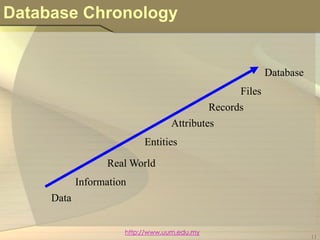
Database Chronology


                                                          Database
                                                  Files
                                            Records
                                   Attributes
                           Entities

                  Real World
            Information
     Data


                      http://www.uum.edu.my
                                                                     11
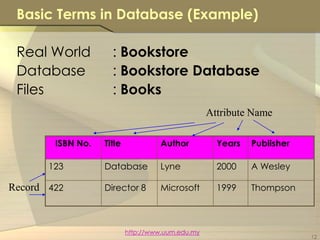
Basic Terms in Database (Example)

 Real World          : Bookstore
 Database            : Bookstore Database
 Files               : Books
                                                   Attribute Name

        ISBN No.   Title             Author          Years   Publisher

       123         Database          Lyne            2000    A Wesley

Record 422         Director 8        Microsoft       1999    Thompson


                           http://www.uum.edu.my
                                                                         12
Database System
  • Consists of 4 major components:
    • Data
    • Hardware
    • Software
    • User
  • For example:
    • database designers do not usually take
      into account the human information
      processing system and it’s requirement


                 http://www.uum.edu.my
                                               13
Database System
  • In the traditional database design,
    logical and physical aspects of the
    system is kept separately
  • The logical design is not concerned for
    examples with the way the data is
    stored because these are considered
    to be unfamiliar to each database
    system


                http://www.uum.edu.my
                                              14
Database Design
  • Database design is a process of
    modeling:
    • Conceptual model (application programs
      hide details of data types. Conceptual
      can also hide information (e.g., salary) for
      security purposes)
    • Logical model (describes data stored in
      database, and the relationships among
      the data)
    • Physical model (how the record is stored)


                 http://www.uum.edu.my
                                                     15
Aims of Data Modeling
   • To identify simple data objects a
     system needs to store the relationships
     between such objects
   • To build a model of the stored data
     requirements of a system that is
     independent of specific processing
     requirements
   • To builds a minimal model of the stored
     data requirements of a system

                http://www.uum.edu.my
                                           16
Data Model: Ideas of data models

 • There are three elements of data
   model:
    Integrity constraints
                            schema
  Database states                    Data
                                     manipulation


  • Data model is extremely important for
    organizing the data within a database
  • Data model is an abstract, logical
    definition of objects and operations
    that allows us to model the structure
    and behavior of the data.
                  http://www.uum.edu.my
                                                    17
Vocabulary of entity modeling

 • entity
 • occurrence of an entity - e.g..
   CUSTOMER = { Customer }
 • attributes of an entity - e.g.. Customer
   = CustomerName + Address +
   CreditRating + ......
 • value of an attribute
 • candidate key to an entity

                 http://www.uum.edu.my
                                              18
The main components of an E-R model &
An example of E-R Modeling
    •     Entities
    •     Attributes
    •     Relationships
  Staff                                           Department
  Employee Number
                              Works in
  Last Name                                       Dept. Number
  First Name                                      Dept. name
  Job Title                                       Dept. Centre

                          http://www.uum.edu.my
                                                                 19