Project
Planning
• Presented by: Professor
• Joves, Marielle M. Josefina B. Bitonio, DPA
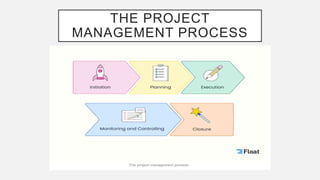
THE PROJECT
MANAGEMENT PROCESS
RELEVANCE OF
PLANNING
• Project plans are important because they provide
a shared vision for what the project aims to
accomplish.
• Project plans give clarity on the responsibilities of
each team member and stakeholder in the
project.
THE BENEFITS OF EFFECTIVE
PROJECT PLANNING
☑️ Map your scope and effort to a realistic timeline
☑️ Provide a roadmap for the project
☑️ Outline roles, responsibilities, and resourcing
requirements
☑️ Help to identify and track project risks
☑️ Keep your project on time and within budget
☑️ Help to identify impacts due to project change
☑️ Keep stakeholders informed of project progress
☑️ Keep teams on task, within scope, and on budget
☑️ Help to keep team members efficient and productive
☑️ Allow for accurate reporting of progress
PLANNING STEPS
1. Determine the project goals and objectives
• Project goals provide a broad idea of what you’re
trying to accomplish and help dictate the direction
of your project.
• Project objectives are similar to your goals, but
they define the project in more specific terms like
cost, time, and quality.
Source: Stella Inabo |
Content writer at Float.com
2. Determine the project scope
• The project scope is based on the project goals
and objectives
• Project scope helps to distinguish what is and is
not involved in the project
Source: Stella Inabo |
Content writer at Float.com
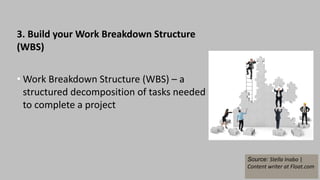
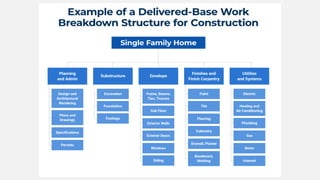
3. Build your Work Breakdown Structure
(WBS)
• Work Breakdown Structure (WBS) – a
structured decomposition of tasks needed
to complete a project
Source: Stella Inabo |
Content writer at Float.com
4. Set timelines
• We can set timelines by comparing
the duration of tasks in similar
projects or asking the team how
long specific tasks take them.
• Project timelines help us estimate
the completion date and keep
things on track.
Source: Stella Inabo |
Content writer at Float.com
5. Determine and plan resources
• For a project to succeed, you need the
right people and resources.
• This step involves a lot of project
assumptions and making estimates.
Source: Stella Inabo |
Content writer at Float.com
6. Estimate Costs
• Ballpark Estimation – A ballpark estimate
is a rough initial estimate based on high
level client objectives, and a large margin
of uncertainty. A ballpark estimate should
be a price range, rather than a fixed fee.
• Parametric Estimation - The use of
historical data or past projects when
calculating estimates
Source: Stella Inabo |
Content writer at Float.com
7. Determine risks and
constraints
• The key to avoiding a
project failure is identifying
the potential pitfalls and
creating an action plan to
handle them.
Source: Stella Inabo |
Content writer at Float.com
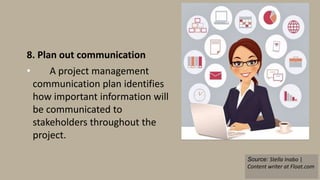
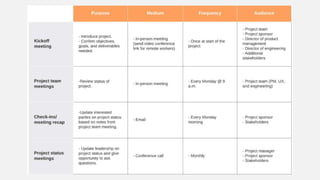
8. Plan out communication
• A project management
communication plan identifies
how important information will
be communicated to
stakeholders throughout the
project.
Source: Stella Inabo |
Content writer at Float.com
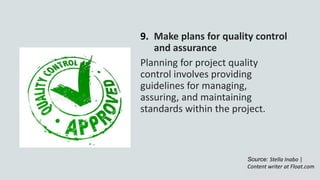
9. Make plans for quality control
and assurance
Planning for project quality
control involves providing
guidelines for managing,
assuring, and maintaining
standards within the project.
Source: Stella Inabo |
Content writer at Float.com
THANK YOU! :)