KK
KK
AEL - N1 TPM - Together Towards World Class Through TPM Slide No. 1 of 23
PROFIT
Profit Can be achieved in TWO WAYS
By increasing
Sales Price
Responsibility:
a. Unit Head
b. Marketing Dept
By reducing
Loss
Responsibility:
All employees in an
organization
KK
KK
AEL - N1 TPM - Together Towards World Class Through TPM Slide No. 2 of 23
TARGET, ACTUAL & LOSS
PLAN - ACTUAL = GAP => CAUSE
=> LOSS
KK
KK
AEL - N1 TPM - Together Towards World Class Through TPM Slide No. 3 of 23
Losses and why they occur
Loss is defined as wastage of material, money, time and
energy. Some of the reasons for the wastage can be
summarized as below:
• Whenever an operation exceeds it’s standard timings
• Whenever an operation is intercepted
• Whenever a non -value adding operation is performed
• When a machine and or man do not give the rated out put.
• Consuming additional time, money, energy than the
specified norms etc.
KK
KK
AEL - N1 TPM - Together Towards World Class Through TPM Slide No. 4 of 23
KK # - 4
COST
Total
Cost
Value
Addition
Non
Value
Addition
Input
Sporadic
&
Chronic
Basic
Function
Every action by Man OR Machine
KK
KK
AEL - N1 TPM - Together Towards World Class Through TPM Slide No. 5 of 23
JIPM 16 Major Losses
16 MAJOR
LOSSES
8
MACHINE
RELATED
5
MAN
RELATED
3
COST
RELATED
LOSS 1 – 8 IS MACHINE RELATED,
9 – 13 IS MAN RELATED AND
14 – 16 IS COST RELATED LOSSES
KK
KK
AEL - N1 TPM - Together Towards World Class Through TPM Slide No. 6 of 23
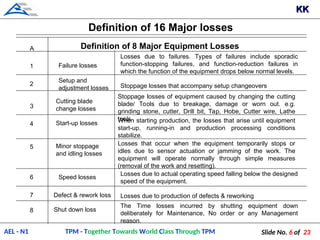
Definition of 16 Major losses
Definition of 8 Major Equipment Losses
Failure losses
Losses due to failures. Types of failures include sporadic
function-stopping failures, and function-reduction failures in
which the function of the equipment drops below normal levels.
1
Cutting blade
change losses
Stoppage losses of equipment caused by changing the cutting
blade/ Tools due to breakage, damage or worn out. e.g.
grinding stone, cutter, Drill bit, Tap, Hobe, Cutter wire, Lathe
tools .
3
Setup and
adjustment losses Stoppage losses that accompany setup changeovers
2
Start-up losses When starting production, the losses that arise until equipment
start-up, running-in and production processing conditions
stabilize.
4
Minor stoppage
and idling losses
Losses that occur when the equipment temporarily stops or
idles due to sensor actuation or jamming of the work. The
equipment will operate normally through simple measures
(removal of the work and resetting).
5
A
Speed losses
Losses due to actual operating speed falling below the designed
speed of the equipment.
6
Losses due to production of defects & reworking
Defect & rework loss
7
Shut down loss
The Time losses incurred by shutting equipment down
deliberately for Maintenance, No order or any Management
reason.
8
KK
KK
AEL - N1 TPM - Together Towards World Class Through TPM Slide No. 7 of 23
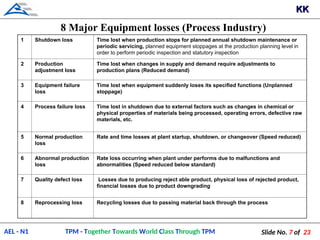
1 Shutdown loss Time lost when production stops for planned annual shutdown maintenance or
periodic servicing, planned equipment stoppages at the production planning level in
order to perform periodic inspection and statutory inspection
2 Production
adjustment loss
Time lost when changes in supply and demand require adjustments to
production plans (Reduced demand)
3 Equipment failure
loss
Time lost when equipment suddenly loses its specified functions (Unplanned
stoppage)
4 Process failure loss Time lost in shutdown due to external factors such as changes in chemical or
physical properties of materials being processed, operating errors, defective raw
materials, etc.
5 Normal production
loss
Rate and time losses at plant startup, shutdown, or changeover (Speed reduced)
6 Abnormal production
loss
Rate loss occurring when plant under performs due to malfunctions and
abnormalities (Speed reduced below standard)
7 Quality defect loss Losses due to producing reject able product, physical loss of rejected product,
financial losses due to product downgrading
8 Reprocessing loss Recycling losses due to passing material back through the process
8 Major Equipment losses (Process Industry)
KK
KK
AEL - N1 TPM - Together Towards World Class Through TPM Slide No. 8 of 23
1 Management
Loss
Loss due to waiting for information or instructions from the management
like material waiting, waiting for tools, waiting for power, postponement of
repair etc.
2 Operating
Motion Loss
Motion losses include losses resulting from running counter to economic
principles of motions, losses arising from skill differences involved in , and
walking losses stemming from a bad layout. etc.
3 Line
Organization
Loss
Line organization losses include waiting losses generating in the multi
process and multi machine processing and also line balance losses in
conveyor work.
4 Logistics Loss Distribution man hour losses due to transport of materials, products
(input/in process/finished) and dollies.
5 Measurement
and adjustment
loss (Set up
Loss)
Man-hour losses resulting from frequent measurement and adjustment
executed to prevent quality defects from occurring and spilling over and
outflow ,
5 Major Losses that impede manpower efficiency
KK
KK
AEL - N1 TPM - Together Towards World Class Through TPM Slide No. 9 of 23
1 Material Yield
Loss
Over consumption of input material as compared to
the specific standards. and Material losses due to
differences in the weight of the input materials and
the weight of the quality products.
2 Energy Loss The loss of energy, such as electrical power, fuel,
steam, air, and water (including treated waste water),
Losses due to ineffective utilization of input energy
(electric, gas, fuel oil, etc) in processing against
standard.
3 Die, jig and tool
losses
Financial losses (expenses incurred in production,
regarding, re-nitriding, etc.) which occur with
production or repairs of dies, jigs and tools due to
aging before services life or breakage, Excess
consumption of Spares and Consumables.
3 Major Losses that impede material and energy utilisation
KK
KK
AEL - N1 TPM - Together Towards World Class Through TPM Slide No. 10 of 23
Loss Structure During Production Activities (16 Major Losses)
[Manpower
Efficiency]
[Equipment Efficiency]
5
Major
Losses
Preventing
Efficiency
of
Manpower
Waiting
instruction loss
Waiting material
loss
Equipment
downtime loss
Equipment
performance
loss
Method/
procedures loss
Skills and
morale loss
Line
organization
loss
Unautomated
system loss
9. Management
loss
12. Logistics loss
13. Measurement and
adjustment loss
Excluding man-
hour (Supported
by other
departments)
Production
Man-hour
loss
Line
organisa
-tion
man-
hour
loss
<Equipment>
Man-hour Elapsed time
<person>
8. Shutdown loss
1. Equipment
failure loss
2. Set-up loss
4. Start - up loss
Other downtime loss
5. Minor stoppage &
idling loss
6. Reduced speed
7. Defects and
rework loss
3. Cutting blade and
jig change loss
Operated man-hour
Duty hour
Loading man-hour Loading time
Net operational
Man-hour Operating time
Effective
man-hour
Net Operating
time
Valued man-hour
(man-hour for
turnout)
Valued
operating time
Scheduled
downtime
Scheduled
downtime
Downti
me loss
Performan
ce loss
Defects
quality
loss
(Adjustment
of measurement)
Cleaning
checking
Waiting
instruction
Quality
confirmation
Waiting
personnel
distribution
Waiting
materials
Start-up loss
Overload loss
Radiation loss
15. Energy loss
Input energy Loading time
Effective energy
No. of qualified
products
Weight of
qualified products
<Energy> <Materials>
Start-up loss
Cutting loss
Losses in weight
Losses in excesses
(increased commission)
14. Yield loss
Defects quality loss
[Efficiency of material and energy] ………
3 Major Losses Preventing Efficiency of Material and Energy.
16. Die and Tool loss
8
Major
Losses
Preventing
Efficiency
of
equipment
10. Operating
motions loss
Defects
in man-
hour
loss
11. Line organisation
loss
KK
KK
AEL - N1 TPM - Together Towards World Class Through TPM Slide No. 11 of 23
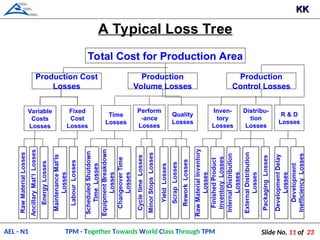
Total Cost for Production Area
Production Cost
Losses
Production
Control Losses
Fixed
Cost
Losses
Variable
Costs
Losses
Production
Volume Losses
Time
Losses
Perform
-ance
Losses
Inven-
tory
Losses
Distribu-
tion
Losses
R & D
Losses
A Typical Loss Tree
Quality
Losses
KK
KK
AEL - N1 TPM - Together Towards World Class Through TPM Slide No. 12 of 23
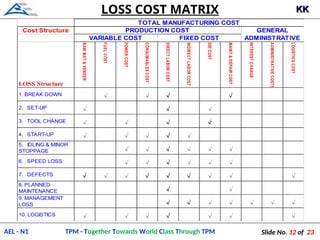
LOSS COST MATRIX
Cost Structure
LOSS Structure RAW
MAT
&
VENDER
FUEL
COST
POWER
COST
CONSUMABLES
COST
DIRECT
LABOR
COST
INDIRECT
LABOR
COST
DIE
COST
MAINT
&
REPAIR
COST
INTEREST
CHARGE
ADMINISTRAT
IVE
COSTS
LOGISTICS
COST
1. BREAK DOWN    
2. SET-UP   
3. TOOL CHANGE    
4. START-UP     
5. IDLING & MINOR
STOPPAGE      
6. SPEED LOSS      
7. DEFECTS         
8. PLANNED
MAINTENANCE  
9. MANAGEMENT
LOSS       
10. LOGISTICS       
TOTAL MANUFACTURING COST
VARIABLE COST FIXED COST
PRODUCTION COST GENERAL
ADMINISTRATIVE
KK
KK
AEL - N1 TPM - Together Towards World Class Through TPM Slide No. 13 of 23
Description
S
hutdown
Los
s
P
rodn
A
djus
t
E
qpt.
F
ailure
P
roc
es
s
F
ailure
Norm
al
P
rodn
A
bnorm
al
P
rodn.
Los
s
Q
uality
Defec
t
Reproc
es
s
ing
Los
s
M
anagem
ent
O
peration
M
otion
Los
s
Line
O
rgn
Dis
tribution
Logis
tic
E
nergy
Repair
&
Repalc
em
ent
M
aterial
Y
ield
Los
s
FIXED COST
B1-Raw material
Raw material X O X X X X O O X X X X O X X O
B2 - Mechanical Maint
a Improvements O O O O O O O O O O O O O O O O
B3 - Electrical Maint
a Improvements O O O O O O O O O O O O O O O O
B4 - Wages & Expences
a Indirect labour O O O X O X O O O O O O O X O X
b Travelling O X O X X X O O X X X X X X O X
c Consultancy O X O X X O O O X X X X X X O X
d Rent & Lease rent O X O O X O X O X X X X X O O X
B5 - General service centre
a Projects O X O X X O X X X X X X X X O X
b Civil Maintenance O X X O X X X X X X X X X O O X
B6-Specific service centre
a Lighting O O O O O O O O O O O O O X O X
LOSS-COST MATRIX 16 LOSSES
TPM O- Applicable X - Not Applicable
KK
KK
AEL - N1 TPM - Together Towards World Class Through TPM Slide No. 14 of 23
Description
S
h
u
t
d
o
w
n
L
o
s
s
P
ro
d
n
A
d
ju
s
t
E
q
p
t
.
F
a
ilu
re
P
ro
c
e
s
s
F
a
ilu
re
N
o
rm
a
l
P
ro
d
n
A
b
n
o
rm
a
l
P
ro
d
n
.
L
o
s
s
Q
u
a
lit
y
D
e
f
e
c
t
R
e
p
ro
c
e
s
s
in
g
L
o
s
s
M
a
n
a
g
e
m
e
n
t
O
p
e
ra
t
io
n
M
o
t
io
n
L
o
s
s
L
in
e
O
rg
n
D
is
t
rib
u
t
io
n
L
o
g
is
t
ic
E
n
e
rg
y
R
e
p
a
ir
&
R
e
p
a
lc
e
m
e
n
t
M
a
t
e
ria
l
Y
i
e
ld
L
o
s
s
VARIABLE COST
A1-Power & Fuel
a. Power X X X O O O O O X O X X X O X X
b. Fuel X X X O O O O O X O X X X O X X
A2 - Stores and Spares
a. Direct consumables X X O X X X O O X X X X O X X O
b Indirect consumables X X O X X X O O X X X X O X X X
A3 - Mechanical Maint
a Lubricants X X O O X O O O X O O X O O X X
b Regular spares O X O X X X X O X X X X X X O X
c Replacement spares O X O X X X X O X X X X X X O X
d Job orders O X O X X X X O X X X X X X O X
A4 - Electrical Maint
a Regular spares O X O X X X X O X X X X X X O X
b Replacement spares O X O X X X X O X X X X X X O X
A5 - Stationaries
a Printing & stationery O X O X X O O O X X X X X X O X
A6 - General service centre
a Technical Development X X X X X X O X X X X X X X X O
b Quality control X X X X X X O O X X X X X X X O
A7- Specific service centre
a Generator X X O O X X O X O X X X X O X X
b Water X O O X O O O O O O O O O X X X
c Steam X O O X O O O O O O O O O X X X
d Air X O O X O O O O O O O O O X X X
LOSS-COST MATRIX 16 LOSSES
TPM O- Applicable X - Not Applicable
KK
KK
AEL - N1 TPM - Together Towards World Class Through TPM Slide No. 15 of 23
COST LOSS TREE
• It helps to find the losses in an organization in terms of money
value
• It brings in all the components of Product cost right from the
beginning of RM procurement to the customer end
• It provides the cost data in structural way, i.e. from the overall
figure broken up to its individual components
• The tree like representation helps to correlate the losses and to
track the reasons easily
• Helps to assess the profitability of the organizations
performance
KK
KK
AEL - N1 TPM - Together Towards World Class Through TPM Slide No. 16 of 23
NET PROFIT
PRODUCTION
AMOUNT
PRODUCTION
COST
PRODUCTIVITY
O.E.E.
AVAILABILITY PERFORMANCE QUALITY
B/D
LOSS
START
UP
MANAGEMENT
LOSS
SET
&
ADJUSTMENT
PROCESS
TROUBLE
TOLL
CHANGE
LOSS
MINOR
STOPPAGE
SPEED
LOSS
DEFECT
&
REWORK
VARIABLE COST FIXED COST
RAW
MATERIAL
COST
JOB
WORK
&
FRIEGHT
COST
SELLING
&
DISTRIBUTION
STORE
&
TOOL
COST
REPAIR
&
MAINT.
COST
POWER
&
FUEL
COST
SALARY
&
WAGES
DEPERICIATION
ADMIN.
&
GENERAL
EXPENSES
CORPORATE
EXPENSES
FINANCIAL
EXPENSES
KK
KK
AEL - N1 TPM - Together Towards World Class Through TPM Slide No. 17 of 23
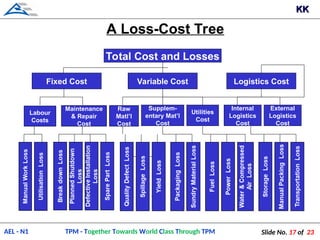
Total Cost and Losses
Fixed Cost Logistics Cost
Maintenance
& Repair
Cost
Labour
Costs
Variable Cost
Raw
Matl’l
Cost
Supplem-
entary Mat’l
Cost
Utilities
Cost
Internal
Logistics
Cost
External
Logistics
Cost
A Loss-Cost Tree
KK
KK
AEL - N1 TPM - Together Towards World Class Through TPM Slide No. 18 of 23
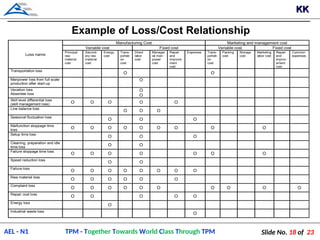
Example of Loss/Cost Relationship
Manufacturing Cost Marketing and management cost
Variable cost Fixed cost Variable cost Fixed cost
Loss name
Principal
raw
material
cost
Second-
ary raw
material
cost
Energy
cost
Trans-
portati
on
cost
Direct
labor
cost
Manager
ial man-
power
cost
Repair
and
improve-
ment
cost
Expenses Trans-
portati-
on
cost
Packing
cost
Storage
cost
Marketing
labor cost
Repair
and
improv-
ement
cost
Common
expenses
Transportation loss
O O
Manpower loss from full scale
production after start-up
O
Vacation loss
Absentee loss
O
O
Skill level differential loss
(skill management loss) O O O O O
Line balance loss
O O O
Seasonal fluctuation loss
O O O
Malfunction stoppage time
loss
O O O O O O O O O
Setup time loss
O O O
Cleaning, preparation and idle
time loss
O O
Failure stoppage time loss
O O O O O O O
Speed reduction loss
O O
Failure loss
O O O O O O O O
Raw material loss
O O O O O O
Complaint loss
O O O O O O O O O O
Repair cost loss
O O O O O
Energy loss
O
Industrial waste loss
O
KK
KK
AEL - N1 TPM - Together Towards World Class Through TPM Slide No. 19 of 23
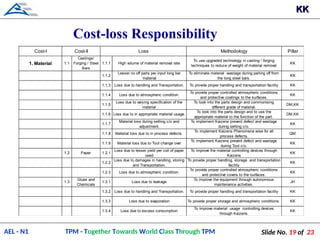
Cost-I Methodology Pillar
1. Material 1.1
Castings/
Forging / Steel
Bars
1.1.1 High volume of material removal rate
To use upgraded technology in casting / forging
techniques to reduce of weight of material removal
KK
1.1.2
Lesser no off parts per input long bar
material
To eliminate material wastage during parting off from
the long steel bars.
KK
1.1.3 Loss due to handling and Transportation. To provide proper handling and transportation facility KK
1.1.4 Loss due to atmospheric condition.
To provide proper controlled atmospheric conditions
and protective coatings to the surfaces.
KK
1.1.5
Loss due to varying specification of the
material
To look into the parts design and commonising
different grade of material.
DM,KK
1.1.6 Loss due to in appropriate material usage.
To look into the parts design and to use the
appropriate material to the function of the part.
DM,KK
1.1.7
Material loss during setting c/o and
adjustment.
To implement Kaizens prevent defect and wastage
during setting c/o.
KK
1.1.8 Material loss due to in process defects.
To implement Kaizens Phenomena wise for all
process defects.
QM
1.1.9 Material loss due to Tool change over
To implement Kaizens prevent defect and wastage
during Tool c/o.
KK
1.2 Paper 1.2.1
Loss due to lesser yield per coil of paper
used
To improve the material controlling devices through
Kaizens
KK
1.2.2
Loss due to damages in handling, storing
and Transportation.
To provide proper handling, storage and transportation
facility
KK
1.2.3 Loss due to atmospheric condition.
To provide proper controlled atmospheric conditions
and protective covers to the surfaces.
KK
1.3
Glues and
Chemicals
1.3.1 Loss due to leakage
To improve the equipment through autonomous
maintenance activities.
JH
1.3.2 Loss due to handling and Transportation. To provide proper handling and transportation facility KK
1.3.3 Loss due to evaporation To provide proper storage and atmospheric conditions. KK
1.3.4 Loss due to excess consumption
To improve material usage controlling devices
through Kaizens.
KK
Cost-II Loss
Cost-loss Responsibility
KK
KK
AEL - N1 TPM - Together Towards World Class Through TPM Slide No. 20 of 23
1. Material 1.3
Glues and
Chemicals
1.3.6
Loss due to lesser no off parts processed
per load.
To improve parts loading fixtures design through
Kaizens, for effective use of processing zone.
KK
1.4
Cutting oil /
Coolants
1.4.1 Loss due to leakage
To improve the equipment through autonomous
maintenance activities.
JH
1.4.2 Loss due to carry over. To provide proper draining and absorption facility. JH,KK
1.4.3 Loss due to handling and Transportation. To provide proper handling and transportation facility KK
1.4.4 Loss due to recycling equipment
To improve the recycling equipment through Kaizens
and JH activities.
JH,KK
1.4.5
Loss due to splashing in larger working
area
To improve the coolant / oil splashing area and
localize the phenomena thorough JH Kaizens
JH
1.4.6 Loss due to many types of coolant oils.
To reduce the no of types of coolant oil used by
analyzing the material machined and cutting oil used
KK
1.4.7
Loss due to higher concentration in
soluble cutting oil
To introduce water / oil mixing devices with
predetermined values.
KK
1.4.8
loss due shorter frequency of change in
water soluble oil.
To improve the coolant storage area by filtering
contaminants, removing / reducing oil from the
surfaces and agitation.
KK
1.4.9
Loss due to evaporation in continuos
coolant flushing.
To eliminate coolant flushing through localized guards. JH
1.4.1
0
Loss due to foaming of the coolant. To introduce chemical additives. KK
1.4.1
1
Loss due to speed loss
To eliminate speed loss thus reduce the no of min.
coolant used per part.
KK
1.5
Calibration oil
used for
product testing
1.5.1 Loss due to leakage
To improve the equipment through autonomous
maintenance activities.
JH
1.5.2 Loss due to carry over.
To provide proper draining and absorption facility, to
eliminate no of parts / fixtures dipped in oil.
JH,KK
1.5.3 Loss due to handling and Transportation. To provide proper handling and transportation facility KK
1.5.4 Loss due to contamination.
To eliminate mixing up of water , chemicals and dirt's
through kaizen activities. Also to recycle the used oil
through kaizen in filtration arrangement.
JH,KK
Cost-loss Responsibility
KK
KK
AEL - N1 TPM - Together Towards World Class Through TPM Slide No. 21 of 23
COST LOSS MATRIX – OFFICE T P M
KK
KK
AEL - N1 TPM - Together Towards World Class Through TPM Slide No. 22 of 23
KK
KK
AEL - N1 TPM - Together Towards World Class Through TPM Slide No. 23 of 23
THANK YOU